Read a page of their writing.
E · Doctors of the Church
Saint Jerome
The scholar of Scripture who translated the Bible into Latin, loved the original languages, and fought for the faith with a sharp pen.
Memorial · 09-30
 book
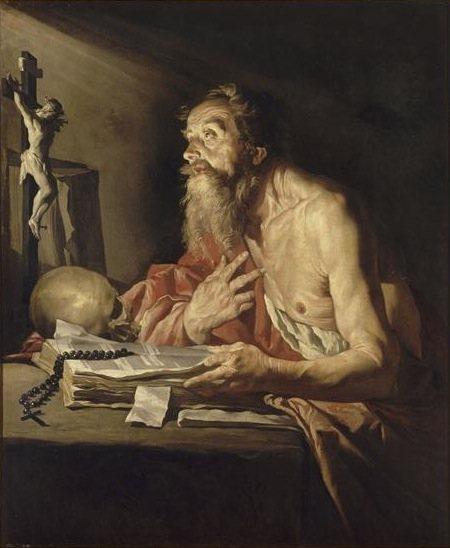
The penitent Saint Jerome in his Study label QS:Lit,"San Girolamo penitente" label QS:Lfr,"Saint Jérôme pénitent" label QS:Len,"Saint Jer... Matthias Stom - Public domain, via Wikimedia Commons
- Feast
- 09-30 · Memorial
- Patronage
- Translators, librarians, scholars, archaeologists
- Era
- 4th-5th century
- Region
- Dalmatia and Bethlehem
The life
The scholar of Scripture who translated the Bible into Latin, loved the original languages, and fought for the faith with a sharp pen.
Jerome of Stridon (; Latin: Eusebius Sophronius Hieronymus; Ancient Greek: Εὐσέβιος Σωφρόνιος Ἱερώνυμος; c. 342–347 – 30 September 420), also known as Hieronymus, was an early Christian priest, confessor, theologian, translator, and historian; he is commonly known as Saint Jerome. He is best known for his translation of the Bible into Latin (the translation that became known as the Vulgate), which was commissioned by Pope Damasus I, and his commentaries on the whole Bible.
Jerome attempted to create a translation of the Old Testament based on a Hebrew version, rather than the Septuagint, as prior Latin Bible translations had done. His list of writings is extensive. In addition to his biblical works, he wrote polemical and historical essays, always from a theologian's perspective.
Jerome was known for his teachings on Christian moral life, especially those in cosmopolitan centers such as Rome. He often focused on women's lives and identified how a woman devoted to Jesus should live her life. This focus stemmed from his close patron relationships with several prominent female ascetics who were members of affluent senatorial families.
Jerome is recognized as a saint and, along with Ambrose, Augustine of Hippo and Pope Gregory the Great, as one of the four Great Latin Church Fathers by the Catholic Church. He is also recognized as a saint in the Eastern Orthodox Church, the Lutheran Church, and the Anglican Communion. His feast day is 30 September (Gregorian calendar).
Why the Church remembers
Holiness is not a personality type. The Doctors are not a rank of importance but a recognition of service: their writing and holiness helped the Church understand and teach the faith. Their books are still worth opening.
Pray with them
Ask for light in your study or work.
Teach one truth gently to someone who needs it.
More in this family
Sources
| Tier | Reference |
|---|---|
| Tier 1 | Catechism of the Catholic Church, 946-962 (the communion of saints) (opens in new tab) |
| Tier 2 | Wikipedia, "Saint Jerome" (biographical outline) (opens in new tab) |
Last reviewed: 2026-11-14