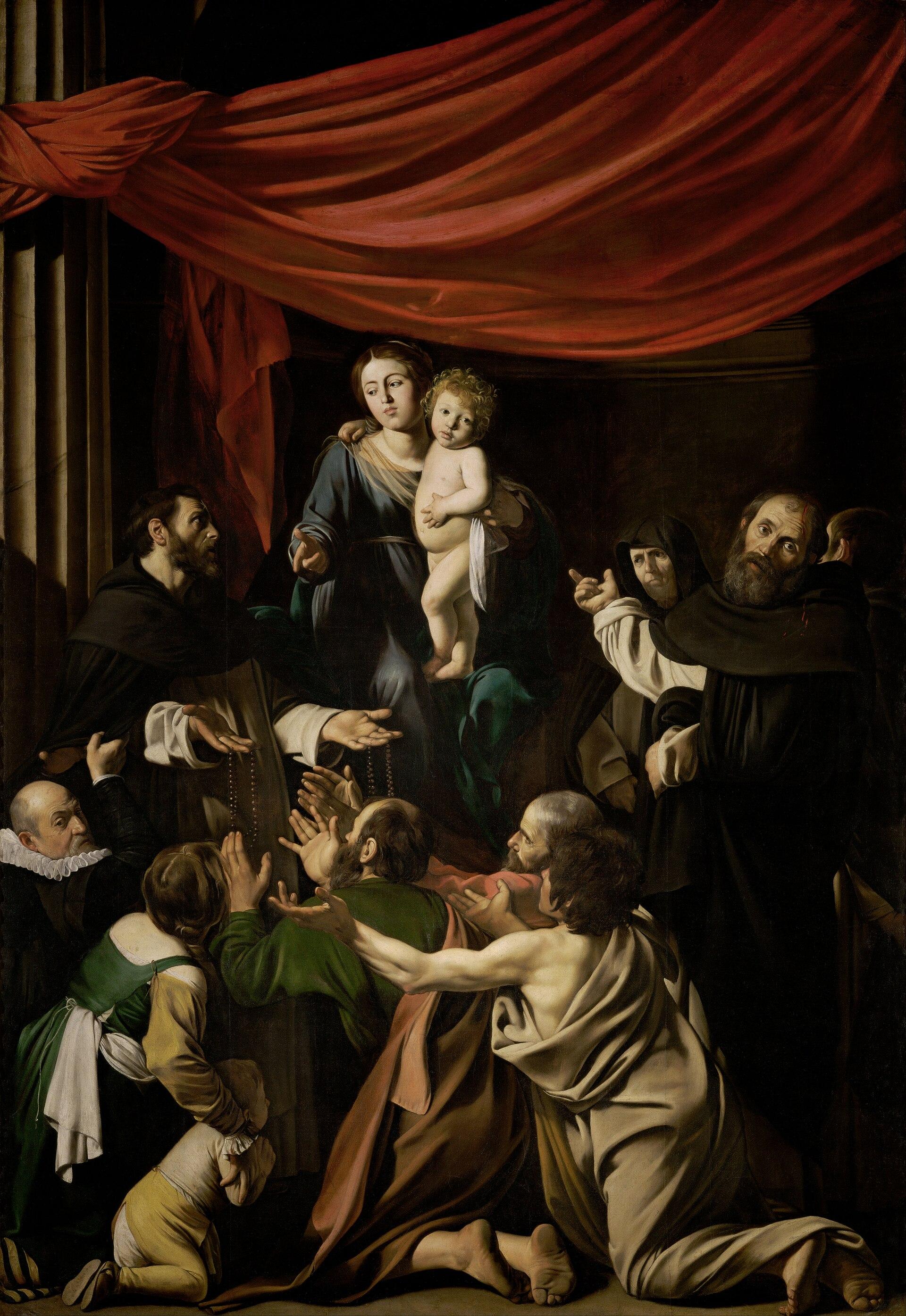
Catholics pray with borrowed words, on a schedule, with the body involved. The prayer is written down before anybody opens his mouth: the psalm, the Our Father, the Hail Mary, the hymn, the collect of the day. That arrangement is not a shortage of imagination. It rests on a claim about where prayer starts, which is that a person does not start it. "If you knew the gift of God!" is how the Catechism puts it, and the sentence that follows is the whole Catholic theory of prayer in six words: "It is he who first seeks us and asks us for a drink" (CCC 2560). Whether a Catholic notices it or not, "prayer is the encounter of God's thirst with ours" (CCC 2560). So the words a Catholic uses are received, repeated, and shared, and the oldest of them are in the Bible twice over.
Humility first, then words
The Catechism opens its long section on prayer with a definition borrowed from St. John of Damascus: "Prayer is the raising of one's mind and heart to God or the requesting of good things from God" (CCC 2590, quoting the eighth-century text). Then it asks the obvious question about who is running the conversation. "But when we pray, do we speak from the height of our pride and will," or out of the depths of a contrite heart (CCC 2559)? The answer is that humility is "the foundation of prayer," and that only a person who admits "we do not know how to pray as we ought" is positioned to receive prayer as a gift (CCC 2559, quoting Romans 8:26). The Catechism's summary line for the whole subject is Augustine's: "Man is a beggar before God" (CCC 2559).
Prayer is therefore a response. The petition a Catholic makes is an answer to a prior request, God's, and the Catechism calls the structure paradoxical: "our prayer of petition is a response to the plea of the living God" (CCC 2561). The covenant language is deliberate. Christian prayer "is a covenant relationship between God and man in Christ," and it is described as a joint action, "springing forth from both the Holy Spirit and ourselves, wholly directed to the Father, in union with the human will of the Son of God made man" (CCC 2564).
Two consequences follow that explain most of what a Catholic does with his mouth. The first is that Catholic prayer goes to the Father through Jesus and not around him: "There is no other way of Christian prayer than Christ," and prayer reaches the Father only when it is prayed "in the name" of Jesus (CCC 2664). The second is that the shortest possible prayer is legitimate, because the name itself can be the whole utterance. "To pray 'Jesus' is to invoke him and to call him within us," and the Catechism says plainly that "the invocation of the holy name of Jesus is the simplest way of praying always" (CCC 2666, 2668). The Eastern habit of repeating the Jesus Prayer, which the Catechism names as one of the traditions it is describing, stands on that sentence (CCC 2667).
Where prayer comes from, and what the body does
The Catechism answers the question of origin with an argument about the human person. "Whether prayer is expressed in words or gestures, it is the whole man who prays," and Scripture, when it names the source of prayer, "most often" names the heart, which it does more than a thousand times (CCC 2562). "If our heart is far from God, the words of prayer are in vain" (CCC 2562). That is the sentence that decides the Catholic quarrel with empty recitation: the words matter, but not by themselves.
The body matters because a person is not only a soul. "The need to involve the senses in interior prayer corresponds to a requirement of our human nature. We are body and spirit, and we experience the need to translate our feelings externally" (CCC 2702). The Catechism adds that this is also "a divine requirement," since God "seeks worshippers in Spirit and in Truth, and consequently living prayer that rises from the depths of the soul" along with the outward form (CCC 2703). So Catholic prayer has posture attached to it, and the postures are not decoration: standing as the sign of resurrection, kneeling and prostrating as the sign of adoration, bowed head and open or folded hands, the Sign of the Cross traced on the forehead, lips and chest, candles, incense, holy water, ashes, the direction of the church building, the bells that call the Angelus.
The gestures have a grammar, and the Church writes down which one belongs where. At Mass the "common posture" of the Roman rite is meant to be the same for everybody, and the General Instruction assigns standing, kneeling and sitting to specific moments of the celebration (General Instruction of the Roman Missal). Outside Mass the same sign is turned toward the reserved Sacrament: the Church expresses her faith in the real presence "by, among other ways, genuflecting or bowing deeply as a sign of adoration of the Lord" (CCC 1378). None of this is a superstition about matter. It is the consequence of a sentence the Catechism states as fact: vocal prayer "is an essential element of the Christian life," and Jesus himself taught one (CCC 2701).
The five kinds of prayer
The Catechism sorts Christian prayer into named forms, and the sorting is worth knowing because it tells a Catholic what he is doing when he cannot find words of one particular kind. Underneath all of them is what the Catechism calls the "basic movement" of prayer, which runs both directions at once: "our prayer ascends in the Holy Spirit through Christ to the Father," and "the grace of the Holy Spirit ... descends through Christ from the Father" (CCC 2626-2627). Blessing is the name for that exchange.
Adoration. "Adoration is the first attitude of man acknowledging that he is a creature before his Creator" (CCC 2628). Its native form in the Church's mouth is the Sanctus, "Holy, Holy, Holy," and the Eucharistic prayer the Catholic sits through every Sunday, which the Catechism calls the "sacrifice of praise" (CCC 1361, 2643). A person who wants to pray adoration without a book can say the Gloria, or sit in front of the exposed Sacrament and say nothing, which is what an adoration hour is for.
Petition. The Catechism notes that the New Testament's vocabulary for asking is unusually rich: "ask, beseech, plead, invoke, entreat, cry out, even 'struggle in prayer'" (CCC 2629). Petition is the most spontaneous form, and it is an act of recognition rather than information: "by prayer of petition we express awareness of our relationship with God. We are creatures who are not our own beginning, not the masters of adversity, not our own last end" (CCC 2629). The first petition is for forgiveness, and the Catechism's model is the tax collector's one-line prayer, "God, be merciful to me a sinner!" (CCC 2631). Then comes the rule about content: "every need can become the object of petition" (CCC 2633).
Intercession. This is petition done for somebody else, and the Catechism defines it as the form that "leads us to pray as Jesus did" (CCC 2634). It has no boundary: the person praying "looks not only to his own interests, but also to the interests of others, even to the point of praying for those who do him harm" (CCC 2635). Asking a saint to pray is intercession extended to the part of the Church that has already died, which is treated on its own page (see the section on Mary and the saints in What do Catholics actually do?).
Thanksgiving. "Thanksgiving characterizes the prayer of the Church which, in celebrating the Eucharist, reveals and becomes more fully what she is" (CCC 2637). Every need can also become a thanks (CCC 2638), which is why grace before meals is not a Catholic formality but the same form at a smaller scale.
Praise. Praise "is the form of prayer which recognizes most immediately that God is God. It lauds God for his own sake and gives him glory, quite beyond what he does" (CCC 2639). It is the one form with no request in it, and the Church's favorite example is Mary's own song, the Magnificat, and the psalms, and the canticles sung at dawn and dusk in the Hours. The Catechism's practical hint for a beginner is that praise is what a Catholic is doing when he sings: "address one another in psalms and hymns and spiritual songs" (CCC 2641, quoting Ephesians 5:19).
The Catechism closes the list by saying that all of these are contained and expressed in the Eucharist, which is "the pure offering" of the whole Church (CCC 2643). The other forms are, in that view, ways of extending what happens at the altar into the rest of the day.
Three ways prayer is made
Below the five kinds there is a simpler division, and it is the one Catholics actually use to describe each other's prayer: vocal prayer, meditation, and contemplative prayer, which "have in common the recollection of the heart" (CCC 2721).
Vocal prayer is prayer with words, said aloud or in the mind, and the Catechism defends it against the charge of emptiness rather than apologizing for it. "Because it is external and so thoroughly human, vocal prayer is the form of prayer most readily accessible to groups," and interior prayer "cannot neglect vocal prayer" anyway (CCC 2704). Its justification is that Jesus taught one: "To his disciples, drawn by their Master's silent prayer, Jesus teaches a vocal prayer, the Our Father" (CCC 2701).
Meditation is prayer with the mind working at a text. "Meditation is above all a quest," and the description of the method is unhurried: the mind "seeks to understand the why and how of the Christian life, in order to adhere and respond to what the Lord is asking" (CCC 2705). The Catechism's image for what happens next is a second book: "To meditate on what we read helps us to make it our own by confronting it with ourselves. Here, another book is opened: the book of life" (CCC 2706). It concedes freely that "there are as many and varied methods of meditation as there are spiritual masters," and that "a method is only a guide; the important thing is to advance, with the Holy Spirit, along the one way of prayer: Christ Jesus" (CCC 2707). What is not optional is the habit. "Christians owe it to themselves to develop the desire to meditate regularly, lest they come to resemble the three first kinds of soil in the parable of the sower" (CCC 2707). The equipment the Catechism lists is ordinary: "the Sacred Scriptures, particularly the Gospels, holy icons, liturgical texts of the day or season, writings of the spiritual fathers, works of spirituality, the great book of creation," and history (CCC 2705). Meditation "engages thought, imagination, emotion, and desire," and the Catechism names the Church's two favorite instruments for it: Christian prayer "tries above all to meditate on the mysteries of Christ, as in lectio divina or the rosary" (CCC 2708). Both have a section below.
Contemplation is the form a person does not produce. The Catechism borrows Teresa of Ãvila's definition almost colloquially: contemplative prayer "is nothing else than a close sharing between friends; it means taking time frequently to be alone with him who we know loves us" (CCC 2709, quoting the Life). It is called "the simplest expression of the mystery of prayer," a gift that "can be accepted only in humility and poverty" (CCC 2713). Its marks are a gaze and an ear and a silence: "I look at him and he looks at me," said a peasant at Ars about his prayer (CCC 2715); contemplative prayer is "hearing the Word of God" (CCC 2716); and it is "silence," which the Catechism calls the "symbol of the world to come" (CCC 2717). The practical instruction attached to it is the least romantic sentence in the section: the time and length of this prayer "arises from a determined will," and a person does not undertake it "only when he has time to spare" (CCC 2710).
The Church's own summary of what she asks of a lay person is short enough to memorize: "The Church invites the faithful to regular prayer: daily prayers, the Liturgy of the Hours, Sunday Eucharist, the feasts of the liturgical year" (CCC 2720). Everything after this point is an expansion of one of those four items.
“The Psalms are the masterwork of prayer in the Old Testament.
”
The Psalms, and how a Catholic day gets prayed
A Catholic who has never opened a book of hours still prays the psalms, because the Church's daily prayer is built out of them and the Church's feasts are built out of the same verses. So the psalms come first, historically and then practically.
The Psalter is the Old Testament's prayer book. "Thus the psalms were gradually collected into the five books of the Psalter (or 'Praises'), the masterwork of prayer in the Old Testament" (CCC 2585). Two qualities of that collection decide how Catholics use it. The first is that a psalm is never a private transaction: "Their prayer is inseparably personal and communal; it concerns both those who are praying and all men" (CCC 2586). The second is the tone. "The prayer of the psalms is always sustained by praise; that is why the title of this collection as handed down to us is so fitting: "The Praises" (CCC 2589). Even the complaints end in praise, which is why a Catholic in a bad week can still pray them.
The strangest claim the Catechism makes about the psalms is that they are the place where the two directions of prayer meet in one book. "The Psalter is the book in which the Word of God becomes man's prayer. In other books of the Old Testament, 'the words proclaim [God's] works and bring to light the mystery they contain.' The words of the Psalmist, sung for God, both express and acclaim the Lord's saving works; the same Spirit inspires both God's work and man's response. Christ will unite the two. In him, the psalms continue to teach us how to pray" (CCC 2587). The Catechism's summary of the whole subject keeps the same judgment: "Prayed and fulfilled in Christ, the Psalms are an essential and permanent element of the prayer of the Church. They are suitable for men of every condition and time" (CCC 2597). The cross-reference the Catechism gives for the cry of the psalms is even Christological: "the Psalter gives us the key to prayer in Christ" (CCC 2606).
The Liturgy of the Hours is the Church praying the psalms on a clock. Vatican II describes the origin of the practice in one sentence: Christ "taking human nature, introduced into this earthly exile that hymn which is sung throughout all ages in the halls of heaven," and he "joins the entire community of mankind to Himself, associating it with His own singing of this canticle of divine praise" (SC 83). The same council states what the office is for: "By tradition going back to early Christian times, the divine office is devised so that the whole course of the day and night is made holy by the praises of God" (SC 84). When it is prayed in the approved form, the council says, "then it is truly the voice of the bride addressed to her bridegroom; It is the very prayer which Christ Himself, together with His body, addresses to the Father" (SC 84). The Catechism repeats the sentence and adds the consequence for lay people: in the Hours "the faithful (clergy, religious, and lay people) exercise the royal priesthood of the baptized" (CCC 1174).
This is not a clerical duty that lay people watch from the pews. "The Liturgy of the Hours is intended to become the prayer of the whole People of God," and the Catechism lists the participants in order: priests in the pastoral ministry, religious by their consecration, and then "all the faithful as much as possible" (CCC 1175). The law says the same thing in its own register. Clerics are bound to it, members of religious institutes by their constitutions, and "other members of the Christian faithful, according to circumstances, are also earnestly invited to participate in the liturgy of the hours as an action of the Church" (canon 1174 §2). The council asked pastors to put the evening hour in front of people: "Pastors of souls should see to it that the chief hours, especially Vespers, are celebrated in common in church on Sundays and the more solemn feasts. And the laity, too, are encouraged to recite the divine office, either with the priests, or among themselves, or even individually" (SC 100). Paul VI's 1970 arrangement of the office says it plainly again: "The Office has therefore been composed so that it is the prayer not only of the clergy but of the whole of the People of God, and religious and lay people can take part in it," and for that reason the Hours are "offered to all the faithful, even to those who are not bound by law to recite it" (Laudis canticum).
The shape is simple once you see it twice. Lauds is morning prayer and Vespers is evening prayer, and the revised rule calls them "the two hinges on which the daily office turns" (SC 89 a). Compline is the hour "drawn up so that it will be a suitable prayer for the end of the day" (SC 89 b). The old night hour, Matins, keeps the character of nocturnal praise in communities but "shall be adapted so that it may be recited at any hour of the day; it shall be made up of fewer psalms and longer readings" (SC 89 c). The hour said at first light, Prime, "is to be suppressed" (SC 89 d; Laudis canticum). Each hour takes a psalm or several, one or two readings, a canticle from the Gospel at Lauds and Vespers, intercessions, and the Our Father. The hours are meant to sit at their real times: "it is best that each of them be prayed at a time which most closely corresponds with its true canonical time" (SC 94), which the Code restates as law (canon 1175). Since Vatican II the psalms are spread over a longer cycle instead of one week, "so that it may really be possible in practice to observe the course of the hours" (SC 91).
The one warning attached to the Hours is about the heart, not the clock. "The divine office, because it is the public prayer of the Church, is a source of piety, and nourishment for personal prayer," the council says, and then it asks for the interior matching the words: those taking part "are earnestly exhorted in the Lord to attune their minds to their voices when praying it" (SC 90). The Catechism restates the demand, including the homework: the celebration of the Hours "demands not only harmonizing the voice with the praying heart, but also a deeper 'understanding of the liturgy and of the Bible, especially of the Psalms'" (CCC 1176). It also explains what the readings do: they "reveal more deeply the meaning of the mystery being celebrated, assist in understanding the psalms, and prepare for silent prayer," and it is here that "lectio divina, where the Word of God is so read and meditated that it becomes prayer, is thus rooted in the liturgical celebration" (CCC 1177). And the Hours are not a competitor to private devotion: the office "is like an extension of the Eucharistic celebration," and "does not exclude but rather in a complementary way calls forth the various devotions of the People of God, especially adoration and worship of the Blessed Sacrament" (CCC 1178).
A lay person starting the Hours does not buy a clerical breviary. He picks one hour. Lauds at the kitchen table in fifteen minutes, or Compline at the end of a day, is the ordinary beginning, and the evening hour in a parish church on a Sunday is what the council actually asked pastors to provide.
The Our Father, petition by petition
The Lord's Prayer is the Catholic's daily prayer and the measure of every other one. It arrives in Scripture because somebody asked for it: "Jesus 'was praying at a certain place, and when he ceased, one of his disciples said to him, "Lord, teach us to pray, as John taught his disciples."'" In answer "the Lord entrusts to his disciples and to his Church the fundamental Christian prayer," and the Catechism notes the two versions: "St. Luke presents a brief text of five petitions, while St. Matthew gives a more developed version of seven petitions. The liturgical tradition of the Church has retained St. Matthew's text" (CCC 2759). That text, in the form the Catechism prints it, is the one a Catholic learns as a child:
Our Father who art in heaven, hallowed be thy name. Thy kingdom come. Thy will be done on earth, as it is in heaven. Give us this day our daily bread, and forgive us our trespasses, as we forgive those who trespass against us, and lead us not into temptation, but deliver us from evil. (CCC 2759)
Its oldest nickname is a summary. Tertullian called it "truly the summary of the whole gospel," and the Catechism quotes his rule for why it comes first: "the regular and appropriate prayer [the Lord's Prayer] is said first, as the foundation of further desires" (CCC 2761, quoting Tertullian). Augustine makes the same claim as a test: "Run through all the words of the holy prayers [in Scripture], and I do not think that you will find anything in them that is not contained and included in the Lord's Prayer" (CCC 2762). Thomas Aquinas supplies, in the Catechism's own footnote, the practical reason this prayer can be said a hundred times a day and never exhausted: it is "the most perfect of prayers" because in it "we ask, not only for all the things we can rightly desire, but also in the sequence that they should be desired," so that it "not only teaches us to ask for things, but also in what order we should desire them" (CCC 2763). The next paragraph states the stakes for a Catholic's week: "Jesus teaches us this new life by his words; he teaches us to ask for it by our prayer. The rightness of our life in him will depend on the rightness of our prayer" (CCC 2764). And the name itself carries the claim: "the prayer that comes to us from Jesus is truly unique: it is 'of the Lord.'" He "is the master of our prayer," and as Word incarnate "he knows in his human heart the needs of his human brothers and sisters and reveals them to us: he is the model of our prayer" (CCC 2765).
Who is being addressed
The Catechism spends more time on the first five words than on most of the petitions, because the address does the work. "Our Father" is possible only because of adoption: "We can adore the Father because he has caused us to be reborn to his life by adopting us as his children in his only Son: by Baptism, he incorporates us into the Body of his Christ" (CCC 2782). The Catechism then quotes Cyprian on the boldness this requires: "Our awareness of our status as slaves would make us sink into the ground and our earthly condition would dissolve into dust, if the authority of our Father himself and the Spirit of his Son had not impelled us to this cry . . . 'Abba, Father!'" (CCC 2777).
That boldness is policed by honesty. "Before we make our own this first exclamation of the Lord's Prayer, we must humbly cleanse our hearts of certain false images drawn 'from this world'" (CCC 2779), and the Catechism names where the false images come from: "paternal or maternal images, stemming from our personal and cultural history, and influencing our relationship with God." The consequence is blunt: "To impose our own ideas in this area 'upon him' would be to fabricate idols to adore or pull down" (CCC 2779).
The "our" is not decoration either. The adjective "does not express possession, but an entirely new relationship with God" (CCC 2786). "Grammatically, 'our' qualifies a reality common to more than one person," and the prayer is said inside a communion, not alone in a room (CCC 2790). "The 'our' at the beginning of the Lord's Prayer, like the 'us' of the last four petitions, excludes no one" (CCC 2792). "In praying 'our' Father, each of the baptized is praying in this communion" (CCC 2790). The Catechism draws the ecumenical consequence: "in spite of the divisions among Christians, this prayer to 'our' Father remains our common patrimony and an urgent summons for all the baptized" (CCC 2791). And "who art in heaven" is not a location: "This biblical expression does not mean a place ('space'), but a way of being; it does not mean that God is distant, but majestic. Our Father is not 'elsewhere'," and the Catechism adds the line about where he is: "'Our Father who art in heaven' is rightly understood to mean that God is in the hearts of the just, as in his holy temple" (CCC 2794).
Two dispositions, then, and the Catechism lists them as the work of the prayer: "the desire to become like him," since "when we call God 'our Father' we ought to behave as sons of God," and "a humble and trusting heart that enables us 'to turn and become like children'" (CCC 2784, 2785). Its summary of the mood is the shortest sentence in the section: "Simple and faithful trust, humble and joyous assurance are the proper dispositions for one who prays the Our Father" (CCC 2797).
The shape of the seven
"After we have placed ourselves in the presence of God our Father to adore and to love and to bless him, the Spirit of adoption stirs up in our hearts seven petitions, seven blessings," the Catechism explains, and the order is the point: "the first three, more theological, draw us toward the glory of the Father; the last four, as ways toward him, commend our wretchedness to his grace. 'Deep calls to deep'" (CCC 2803). By the three first petitions "we are strengthened in faith, filled with hope, and set aflame by charity" (CCC 2806). A Catholic who prays the rosary's first three beads, or the Litany of the Saints, or simply "God, help me," is moving inside that shape whether he names it or not.
Hallowed be thy name. The verb here is about recognition, not manufacture. "The term 'to hallow' is to be understood here not primarily in its causative sense (only God hallows, makes holy), but above all in an evaluative sense: to recognize as holy, to treat in a holy way" (CCC 2807). The petition asks that his name be hallowed "in us and by us": "Our Father calls us to holiness in the whole of our life... both his glory and our life depend on the hallowing of his name in us and by us" (CCC 2813). The Catechism quotes Tertullian's objection and answer: "By whom is God hallowed, since he is the one who hallows?" The asking is about us, "that we who were sanctified in Baptism may persevere in what we have begun to be" (CCC 2813).
Thy kingdom come. The Greek word can be read three ways, "kingship... 'kingdom'... or 'reign'", and the Catechism uses all three to place the Kingdom in history: "The Kingdom of God lies ahead of us. It is brought near in the Word incarnate, it is proclaimed throughout the whole Gospel, and it has come in Christ's death and Resurrection. The Kingdom of God has been coming since the Last Supper and, in the Eucharist, it is in our midst" (CCC 2816). It is also a person: the Catechism quotes the same Father again, "It may even be . . . that the Kingdom of God means Christ himself, whom we daily desire to come" (CCC 2816). And the petition is not an excuse to stop working: the hope of Christ's return "far from distracting the Church from her mission in this present world... commits her to it all the more strongly" (CCC 2818).
Thy will be done. "Our Father 'desires all men to be saved and to come to the knowledge of the truth'... His commandment is 'that you love one another; even as I have loved you,' This commandment summarizes all the others and expresses his entire will" (CCC 2822). The petition therefore has a content a Catholic can state in one sentence: love one another. The Catechism also widens it into intercession: "It would not be inconsistent with the truth to understand the words, 'Thy will be done on earth as it is in heaven,' to mean: 'in the Church as in our Lord Jesus Christ himself'; or 'in the Bride who has been betrothed'," and it notes that the Church prays in communion with Mary and all the saints "who have been pleasing to the Lord because they willed his will alone" (CCC 2827).
Give us this day our daily bread. The Father "cannot not but give us the nourishment life requires - all appropriate goods and blessings, both material and spiritual," and Jesus' insistence on trust "is not inviting us to idleness" (CCC 2830). The Catechism quotes the working rule for the petition: "'Pray and work.' 'Pray as if everything depended on God and work as if everything depended on you.' Even when we have done our work, the food we receive is still a gift from our Father; it is good to ask him for it with thanksgiving, as Christian families do when saying grace at meals" (CCC 2834). Then the second hunger: "Man does not live by bread alone," and "the specifically Christian sense of this fourth petition concerns the Bread of Life: The Word of God accepted in faith, the Body of Christ received in the Eucharist" (CCC 2835). The word "daily" is a curiosity, since it "occurs nowhere else in the New Testament," and the Catechism takes four readings of it: trust for today, what is necessary for life, the super-essential Bread of Christ which is called "the medicine of immortality," and the Day of the Lord anticipated in the Eucharist (CCC 2837). "This day" is the same "today" as the Resurrection: "If you receive the bread each day, each day is today for you. If Christ is yours today, he rises for you every day" (CCC 2836).
Forgive us our trespasses, as we forgive. "This petition is astonishing," the Catechism says, and the astonishment is grammatical: the two halves are joined by one small word, "as," so that "our petition will not be heard unless we have first met a strict requirement. Our petition looks to the future, but our response must come first" (CCC 2838). Christ's parable ends the argument: "So also my heavenly Father will do to every one of you, if you do not forgive your brother from your heart," and the Catechism locates the binding and loosing "in the depths of the heart," where the Holy Spirit "turns injury into compassion and purifies the memory in transforming the hurt into intercession" (CCC 2843). This is why the Catholic's prayer for an enemy is not a sentiment: "Forgiveness is a high-point of Christian prayer; only hearts attuned to God's compassion can receive the gift of prayer" (CCC 2844). And there is no ceiling on it: "There is no limit or measure to this essentially divine forgiveness... We are always debtors," which is also the reason the Church will not let a quarrel sit unfinished at the altar: "God does not accept the sacrifice of a sower of disunion, but commands that he depart from the altar so that he may first be reconciled with his brother" (CCC 2845).
Lead us not into temptation. The petition needs the discernment of two different things, because the same word covers both: "The Holy Spirit makes us discern between trials, which are necessary for the growth of the inner man, and temptation, which leads to sin and death. We must also discern between being tempted and consenting to temptation" (CCC 2847). The Catechism even allows that temptation has a use, quoting the East: "God does not want to impose the good, but wants free beings... But temptation reveals it in order to teach us to know ourselves" (CCC 2847).
Deliver us from evil. The last petition is taken from Jesus' own prayer for his disciples: "I am not asking you to take them out of the world, but I ask you to protect them from the evil one" (CCC 2850, quoting John 17:15). It is said in the first person plural: "it is always 'we' who pray, in communion with the whole Church, for the deliverance of the whole human family" (CCC 2850). The victory, in the Catechism's telling, is already done: "Victory over the 'prince of this world' was won once for all at the Hour when Jesus freely gave himself up to death to give us his life," and the dragon's remaining fury is directed at "the rest of her offspring," which is why "the Spirit and the Church pray: 'Come, Lord Jesus'" (CCC 2853). Praying it also opens the widest window in the prayer: "When we ask to be delivered from the Evil One, we pray as well to be freed from all evils, present, past, and future... the Church brings before the Father all the distress of the world," and asks for "the precious gift of peace" (CCC 2854). The Roman Missal's expanded closing petition, which the assembly sings after the Our Father at Mass, says exactly that: "Deliver us, Lord, we beseech you, from every evil and grant us peace in our day, so that aided by your mercy we might be ever free from sin and protected from all anxiety, as we await the blessed hope and the coming of our Savior, Jesus Christ" (CCC 2854).
The ending the Church added
The prayer as Scripture gives it stops at "deliver us from evil." What a Catholic says next is old, and the Catechism traces it: "Very early on, liturgical usage concluded the Lord's Prayer with a doxology. In the Didache, we find, 'For yours are the power and the glory for ever'" (CCC 2760). The Apostolic Constitutions add "the kingdom," and that is "the formula retained to our day in ecumenical prayer," while "The Byzantine tradition adds after 'the glory' the words 'Father, Son, and Holy Spirit'" (CCC 2760). The English Catholic's ending, "For the kingdom, the power and the glory are yours, now and forever," is that formula, and the Catechism explains its logic rather than treating it as a tag: the doxology "takes up again, by inclusion, the first three petitions to our Father: the glorification of his name, the coming of his reign, and the power of his saving will. But these prayers are now proclaimed as adoration and thanksgiving, as in the liturgy of heaven" (CCC 2855). Then the last word. "Then, after the prayer is over you say 'Amen,' which means 'So be it,' thus ratifying with our 'Amen' what is contained in the prayer that God has taught us" (CCC 2856, quoting Cyril of Jerusalem). The Catechism's own gloss: "By the final 'Amen,' we express our 'fiat' concerning the seven petitions" (CCC 2865).
The Rosary, step by step
The Rosary is the prayer a Catholic is most likely to be asked about and least likely to be taught properly, so this section goes slowly. It is twenty scenes from the life of Christ, prayed in five scenes at a time on a string of beads, with the Our Father, the Hail Mary and the Gloria as the vehicle and a short meditation as the cargo.
Start with what the Church says it is. "The Rosary of the Virgin Mary, which gradually took form in the second millennium under the guidance of the Spirit of God, is a prayer loved by countless Saints and encouraged by the Magisterium. Simple yet profound, it still remains, at the dawn of this third millennium, a prayer of great significance, destined to bring forth a harvest of holiness" (RVM 1). The same document insists on what the beads are carrying: "The Rosary, though clearly Marian in character, is at heart a Christocentric prayer. In the sobriety of its elements, it has all the depth of the Gospel message in its entirety, of which it can be said to be a compendium" (RVM 1). Paul VI's ruling on the same point is the one most often quoted by bishops: "Without contemplation, the Rosary is a body without a soul, and its recitation runs the risk of becoming a mechanical repetition of formulas, in violation of the admonition of Christ: 'And in praying do not heap up empty phrases as the Gentiles do'" (RVM 12, quoting Marialis Cultus 47; Matthew 6:7). The Directory on Popular Piety gives the tempo: "The Rosary is essentially a contemplative prayer, which requires 'tranquillity of rhythm or even a mental lingering which encourages the faithful to meditate on the mysteries of the Lord's life'" (DPP 197). Its oldest Western explanation is almost cheerful: "Medieval piety in the West developed the prayer of the rosary as a popular substitute for the Liturgy of the Hours" (CCC 2678).
The number is the last thing to understand. The Rosary is also called the Psalter of the Blessed Virgin Mary (DPP 197), and Paul VI explains why the count is what it is: the "continued series of Hail Marys is the special characteristic of the Rosary, and their number, in the full and typical number of one hundred and fifty, presents a certain analogy with the Psalter." That 150 was then "divided, according to a well-tried custom, into decades attached to the individual mysteries," which produced "the Rosary of fifty Hail Marys as we know it," and this shorter measure "has entered into use as the normal measure of the pious exercise and as such has been adopted by popular piety and approved by papal authority, which also enriched it with numerous indulgences" (Marialis Cultus 49). John Paul II says the same about the scenes: the traditional selection of mysteries "was determined by the origin of the prayer, which was based on the number 150, the number of the Psalms in the Psalter" (RVM 19). So when a Catholic says "a third of the Rosary" he means one set of five decades: fifty Hail Marys, plus the three on the opening beads, six Our Fathers, and the Glorias.
The sequence, exactly
The Holy See's own page on the Rosary prints the method in eleven lines, and it is worth reproducing because it is the shortest authorized answer to "how is the Rosary prayed":
In the name of the Father and of the Son and of the Holy Spirit. O God come to my aid; O Lord, make haste to help me. Glory be to the Father, and to the Son, and to the Holy Spirit. As it was in the beginning, is now, and ever shall be, world without end. Amen. At the beginning of each decade, announce the "mystery" to be contemplated, for example, the first joyful mystery is "The Annunciation". After a short pause for reflection, recite the "Our Father", ten "Hail Marys" and the "Glory be to the Father". An invocation may be added after each decade. At the end of the Rosary, the Loreto Litany or some other Marian prayer is recited. (How to pray the Rosary, The Holy See)
On the beads themselves, the ordinary Catholic sequence runs like this (Rosary, Wikipedia; How to pray the Rosary, The Holy See). Hold the crucifix and make the Sign of the Cross. Say the Apostles' Creed while the crucifix is in the hand. On the first large bead, one Our Father, offered for the Church and for the intentions of the reigning pope. On the next three small beads, three Hail Marys, traditionally for faith, hope and love. Then the Glory Be in the gap before the next large bead, and an Our Father on that large bead, which opens the first decade. From there the cycle repeats for each mystery: announce the mystery, pause, Our Father on the large bead, ten Hail Marys on the ten small beads, Glory Be in the space, then the concluding prayer of the decade. When the decades are finished, the Hail Holy Queen closes the Rosary, and many people add the Litany of Loreto or a prayer for the pope's intentions, and finish with the Sign of the Cross on the medal or crucifix (Rosary, Wikipedia; RVM 37).
Two things in that list are easy to miss. The first is the pause. "Listening and meditation are nourished by silence. After the announcement of the mystery and the proclamation of the word, it is fitting to pause and focus one's attention for a suitable period of time on the mystery concerned, before moving into vocal prayer. A discovery of the importance of silence is one of the secrets of practicing contemplation and meditation" (RVM 31). The second is the optional Scripture reading, which is what turns a recitation into a meditation: "In order to supply a Biblical foundation and greater depth to our meditation, it is helpful to follow the announcement of the mystery with the proclamation of a related Biblical passage, long or short, depending on the circumstances. No other words can ever match the efficacy of the inspired word" (RVM 30). Announcing the mystery has a purpose too: it "is as it were to open up a scenario on which to focus our attention. The words direct the imagination and the mind towards a particular episode or moment in the life of Christ" (RVM 29).
What a Catholic is saying on each bead
The Hail Mary is the long part, and the Catechism walks through it phrase by phrase. "Hail Mary [or Rejoice, Mary]: the greeting of the angel Gabriel opens this prayer. It is God himself who, through his angel as intermediary, greets Mary" (CCC 2676). "Full of grace, the Lord is with thee: These two phrases of the angel's greeting shed light on one another. Mary is full of grace because the Lord is with her" (CCC 2676). Then the second greeting, "Blessed art thou among women and blessed is the fruit of thy womb, Jesus. After the angel's greeting, we make Elizabeth's greeting our own," and the Catechism calls Mary "blessed among women" because "she believed in the fulfillment of the Lord's word" (CCC 2676, quoting Luke 1:28 and 1:42). The second half is the Church's addition, and the Catechism reads it as an act of self-knowledge: "Because she gives us Jesus, her son, Mary is Mother of God and our mother; we can entrust all our cares and petitions to her," and "By asking Mary to pray for us, we acknowledge ourselves to be poor sinners and we address ourselves to the 'Mother of Mercy'" (CCC 2677). The last clause is the reason a Catholic says the Hail Mary at a deathbed: "We give ourselves over to her now, in the Today of our lives... and our trust broadens further, already at the present moment, to surrender 'the hour of our death' wholly to her care" (CCC 2677). The history of that second half is public record: the petition "Holy Mary, Mother of God, pray for us sinners now and at the hour of our death" first appeared in print in 1495 in Savonarola's commentary on the prayer, was added to a catechism by Peter Canisius in 1555, and entered the Roman Breviary under Pius V in 1568 (Hail Mary, Wikipedia).
The repetition is the part outsiders find hardest, and the Church's answer is not defensive. "It is a method based on repetition. This applies above all to the Hail Mary, repeated ten times in each mystery. If this repetition is considered superficially, there could be a temptation to see the Rosary as a dry and boring exercise. It is quite another thing, however, when the Rosary is thought of as an outpouring of that love which tirelessly returns to the person loved with expressions similar in their content but ever fresh in terms of the feeling pervading them" (RVM 26). The sentence that decides the theology is in the same paragraph: "although the repeated Hail Mary is addressed directly to Mary, it is to Jesus that the act of love is ultimately directed, with her and through her," and the aim is conformity to Christ, "the true programme of the Christian life" (RVM 26). John Paul II points to the hinge inside the prayer: "The centre of gravity in the Hail Mary, the hinge as it were which joins its two parts, is the name of Jesus. Sometimes, in hurried recitation, this centre of gravity can be overlooked, and with it the connection to the mystery of Christ being contemplated. Yet it is precisely the emphasis given to the name of Jesus and to his mystery that is the sign of a meaningful and fruitful recitation of the Rosary" (RVM 33).
The Gloria is not an afterthought. "Trinitarian doxology is the goal of all Christian contemplation. For Christ is the way that leads us to the Father in the Spirit," and Paul VI's successor asks that it be given its weight: "It is important that the Gloria, the high-point of contemplation, be given due prominence in the Rosary. In public recitation it could be sung," so that "far from being a perfunctory conclusion, [it] takes on its proper contemplative tone, raising the mind as it were to the heights of heaven" (RVM 34).
The prayer after each decade is local custom, and the Church's recommendation is more interesting than any single formula. "In current practice, the Trinitarian doxology is followed by a brief concluding prayer which varies according to local custom. Without in any way diminishing the value of such invocations, it is worthwhile to note that the contemplation of the mysteries could better express their full spiritual fruitfulness if an effort were made to conclude each mystery with a prayer for the fruits specific to that particular mystery," and the apostolic letter quotes a collect from the Mass of the Rosary as the model: praying that, by meditation on the mysteries, we may "imitate what they contain and obtain what they promise" (RVM 35). The best-known added invocation in the English-speaking world is the one the Church's Directory calls a "relative clause following the name of Jesus" in the Hail Mary itself: "The custom of making an insertion in the recitation of the Hail Mary, which is an ancient one that has not completely disappeared, has often been recommended by the Pastors of the Church since it encourages meditation and the concurrence of mind and lips," and the suggested form is "a short clause of a Scriptural and Liturgical nature, fixed for every decade" (DPP 201; RVM 33).
The Fatima prayer, said by millions after every decade, comes from the 1917 apparitions at Fátima, where according to the account of the youngest visionary it was taught to the children on 13 June 1917 with an instruction to say it after each decade (Fátima prayers, Wikipedia). Its common English form: "O my Jesus, forgive us, save us from the fire of hell. Lead all souls to Heaven, especially those who are most in need" (Fátima prayers, Wikipedia). It is a private revelation, which the next section explains in more detail.
The closing prayers are also official. The Holy See's own page suggests the Litany of Loreto or another Marian prayer to close, and prints the Hail Holy Queen: "Hail, holy Queen, mother of mercy; hail, our life, our sweetness and our hope... Turn then, most gracious advocate, thine eyes of mercy towards us; and after this our exile, show unto us the blessed fruit of thy womb, Jesus. O clement, O loving, O sweet Virgin Mary" (How to pray the Rosary, The Holy See). The apostolic letter on the Rosary approves the pattern: the Rosary "is then ended with a prayer for the intentions of the Pope, as if to expand the vision of the one praying to embrace all the needs of the Church," and after it "the soul feels the need... to burst forth in praise of the Blessed Virgin, either in that splendid prayer the Salve Regina or in the Litany of Loreto" (RVM 37). The Directory adds the caution against treating the Litany as plumbing: "Following the prescription of Leo XIII that the recitation of the Rosary should be concluded by the Litany of Loreto during the month of October, the false impression has arisen among some of the faithful that the Litany is in some way an appendix to the Rosary. The Litanies are independent acts of worship" (DPP 203).
The beads themselves
"The traditional aid used for the recitation of the Rosary is the set of beads. At the most superficial level, the beads often become a simple counting mechanism to mark the succession of Hail Marys. Yet they can also take on a symbolism which can give added depth to contemplation," starting with the shape of the loop: "the way the beads converge upon the Crucifix, which both opens and closes the unfolding sequence of prayer. The life and prayer of believers is centred upon Christ. Everything begins from him, everything leads towards him" (RVM 36). The physical layout is the one a Catholic buys at a shop near a shrine: a loop of five sets of ten small beads separated by large beads, joined at a center medal, with a short tail strand holding one large bead and three small beads before the crucifix (Rosary, Wikipedia). A single-decade ring exists for saying one mystery in a pocket, and the Dominican five-decade form is the standard (Rosary, Wikipedia). The apostolic letter suggests what to do with a rosary once it is in the hand: use it as a reminder of "the bond of communion and fraternity which unites us all in Christ," and remember Bartolo Longo's image of "a chain, yes, but a sweet chain; for sweet indeed is the bond to God who is also our Father" (RVM 36). The Church's own assessment of the object is a canon-law and indulgence matter: "The Blessing for Rosary Beads indicates the Church's esteem for the Rosary. This rite emphasises the community nature of the Rosary... the blessing of rosary beads is followed by the blessing of those who meditate on the mysteries of the life, death and resurrection of Our Lord so as to 'establish a perfect harmony between prayer and life'" (DPP 198). A rosary blessed by a priest carries a partial indulgence for the person who uses it devoutly (Enchiridion indulgentiarum, conc. 14 §2; Indulgentiarum Doctrina, Norm 17).
The promises attached to the Rosary
A person searching for the Rosary meets a list of fifteen promises before he meets a description of the prayer, and he deserves to know what that list is and what it is worth. There are two kinds of promise here, and telling them apart is most of what a Catholic can say about the subject. One list comes from a private revelation. The other is the Church's own act, and she states her terms.
What the fifteen promises are
"The Fifteen Promises is a tradition held by the Order of Preachers (also known as Dominicans) that the Blessed Virgin Mary made fifteen specific promises through Dominic de Guzmán and Alan de Rupe, to those who faithfully pray the Rosary," and their scope is wide: "The fifteen stated promises range from protection from misfortune to meriting a high degree of glory in heaven" (Fifteen Rosary promises, Wikipedia). They are the words of a tradition, not of a council, and the tradition's own paper trail is late. "The earliest documentation about the Fifteen Promises appears in the 15th century, when they were popularized by Alanus de Rupe," a Dominican priest who spent his priesthood promoting the Rosary and its confraternities (Fifteen Rosary promises, Wikipedia; Alanus de Rupe, Wikipedia).
Here they are in the usual English order, so a Catholic can say what he is talking about (Fifteen Rosary promises, Wikipedia).
- "Those who faithfully serve me by the recitation of the Rosary shall receive signal graces."
- "I promise my special protection and the greatest graces to all those who shall recite the Rosary."
- "The Rosary shall be a powerful armor against hell. It will destroy vice, decrease sin, and defeat heresies."
- "The recitation of the Rosary will cause virtue and good works to flourish. It will obtain for souls the abundant mercy of God. It will withdraw the hearts of men from the love of the world and its vanities, and will lift them to the desire of eternal things. Oh, that souls would sanctify themselves by this means."
- "The soul which recommends itself to me by the recitation of the Rosary shall not perish."
- "Those who recite my Rosary devoutly, applying themselves to the consideration of its sacred mysteries, shall never be conquered by misfortune. In his justice, God will not chastise them; nor shall they perish by an unprovided death, i.e., be unprepared for heaven. Sinners shall convert. The just shall persevere in grace and become worthy of eternal life."
- "Those who have a true devotion to the Rosary shall not die without the sacraments of the Church."
- "Those who faithfully recite the Rosary shall have, during their life and at their death, the light of God and the plenitude of his graces. At the moment of death, they shall participate in the merits of the saints in paradise."
- "I shall deliver from purgatory those who have been devoted to the Rosary."
- "The faithful children of the Rosary shall merit a high degree of glory in heaven."
- "By the recitation of the Rosary you shall obtain all that you ask of me."
- "Those who propagate the holy Rosary shall be aided by me in their necessities."
- "I have obtained from my Divine Son that all the advocates of the Rosary shall have for intercessors the entire celestial court during their life and at the hour of their death."
- "All who recite the Rosary are my beloved children and the brothers and sisters of my only Son, Jesus Christ."
- "Devotion for my Rosary is a great sign of predestination."
The promise about propagation is the reason a Catholic gives somebody else a rosary. The eighth explains the language at a Catholic deathbed. The fifth and the seventh are the two a newcomer will hear quoted most often, and both belong to the same conditional shape as the rest: they are addressed to the person who "faithfully" prays and who "recommends himself" to Mary.
What the Church teaches about private revelation
The fifteen promises arrive through an apparition, so their status is fixed by the Catechism's rules about revelation, not by anybody's enthusiasm. "The Christian economy, therefore, since it is the new and definitive Covenant, will never pass away; and no new public revelation is to be expected before the glorious manifestation of our Lord Jesus Christ" (CCC 66). "Yet even if Revelation is already complete, it has not been made completely explicit; it remains for Christian faith gradually to grasp its full significance over the course of the centuries" (CCC 66). Then the paragraph that decides the case:
Throughout the ages, there have been so-called "private" revelations, some of which have been recognized by the authority of the Church. They do not belong, however, to the deposit of faith. It is not their role to improve or complete Christ's definitive Revelation, but to help live more fully by it in a certain period of history. (CCC 67)
The Catechism also names who sifts them: "Guided by the Magisterium of the Church, the sensus fidelium knows how to discern and welcome in these revelations whatever constitutes an authentic call of Christ or his saints to the Church," and it draws the line a Catholic does not cross: "Christian faith cannot accept 'revelations' that claim to surpass or correct the Revelation of which Christ is the fulfilment" (CCC 67). So a Catholic may hold the fifteen promises and may not, and he stays inside the Church either way: "The Fifteen Promises are considered private revelation, and Catholics are free to accept or reject them" (Fifteen Rosary promises, Wikipedia).
The same caution applies to the most popular origin story attached to the prayer. In the apparition tradition Mary hands the Rosary to Dominic de Guzmán, and the documents do not reach that far back: the story of Dominic's devotion to the Rosary and the "supposed apparition of Our Lady of the Rosary does not appear in any documents of the Catholic Church or the Order of Preachers prior to the writings of the Dominican Alanus de Rupe, some 250 years after Dominic" (Rosary, Wikipedia). Herbert Thurston notes on the other side of the question that "it is certain that in the course of the twelfth century and before the birth of Dominic, the practice of reciting the Ave Maria 50 or 150 times had become generally familiar," and Leonard Foley that "although Mary's giving the Rosary to Dominic is recognized as a legend, the development of this prayer form owes much to the Order of Preachers" (Rosary, Wikipedia). What the Order did for the prayer is documented: meditation with the Hail Marys "is attributed to Dominic of Prussia (1382-1460), a Carthusian monk who termed it 'Life of Jesus Rosary'," who "added a sentence to each of the 50 Hail Marys, using quotes from scripture," and in 1569 "the papal bull Consueverunt Romani Pontifices by the Dominican Pope Pius V officially established the devotion to the Rosary in the Catholic Church" (Rosary, Wikipedia). John Paul II gives the pastoral reason the Rosary spread: "The history of the Rosary shows how this prayer was used in particular by the Dominicans at a difficult time for the Church due to the spread of heresy" (RVM 17).
What the Church attaches to the Rosary
The Church does not promise outcomes the way the fifteen promises do. She makes a different kind of act, and a Catholic should know the term for it: an indulgence. "An indulgence is a remission before God of the temporal punishment due to sins whose guilt has already been forgiven, which the faithful Christian who is duly disposed gains under certain prescribed conditions through the action of the Church which, as the minister of redemption, dispenses and applies with authority the treasury of the satisfactions of Christ and the saints" (CCC 1471, quoting Paul VI's apostolic constitution Indulgentiarum Doctrina). They come in two sizes: "An indulgence is partial or plenary according as it removes either part or all of the temporal punishment due to sin," and they are not limited to the living, since "Indulgences may be applied to the living or the dead" (CCC 1471).
The mechanism behind the term is the reason it is not a get-out-of-purgatory card. Sin has two effects: "Grave sin deprives us of communion with God and therefore makes us incapable of eternal life, the privation of which is called the 'eternal punishment' of sin," and "every sin, even venial, entails an unhealthy attachment to creatures, which must be purified either here on earth, or after death in the state called Purgatory" (CCC 1472). The purification "frees one from what is called the 'temporal punishment' of sin," and the Catechism refuses the wrong picture: "These two punishments must not be conceived of as a kind of vengeance inflicted by God from without, but as following from the very nature of sin" (CCC 1472). The Church's role is petition, not bribery: she "intervenes in favor of individual Christians and opens for them the treasury of the merits of Christ and the saints to obtain from the Father of mercies the remission of the temporal punishments due for their sins," and her aim is formative, since she "does not want simply to come to the aid of these Christians, but also to spur them to works of devotion, penance, and charity" (CCC 1478). The dead are included by the same logic: "Since the faithful departed now being purified are also members of the same communion of saints, one way we can help them is to obtain indulgences for them" (CCC 1479).
For the Rosary the Church's concession is specific about the conditions, and the specifics are the point. Reciting five decades of the Marian Rosary without interruption, with meditation on the mysteries, in a church or oratory, in a family, in a religious community, in a group gathered for a good purpose, or when led by the Pope and followed by radio or television carries a plenary indulgence (Enchiridion indulgentiarum, conc. 17 §1, 1°-2°). Praying the same five decades on your own carries a partial indulgence (Enchiridion indulgentiarum, conc. 17 §1). A plenary needs its dispositions too: sacramental confession, Communion, prayer for the intention of the Pope, and detachment from all sin (Indulgentiarum Doctrina, Norm 7). Read those terms again as a description of the prayer: the Church names the rosary's five decades, its meditation, and its common setting, and she calls that combination worth a plenary. The angelus at the sound of a bell, said morning, midday or evening, carries a partial indulgence, as do the approved litany of Loreto and other approved litanies, and an approved prayer to the Blessed Virgin such as the Salve Regina or the Memorare (Enchiridion indulgentiarum, conc. 17 §2, 2°-3°; conc. 22, 2°). Saying the magnificat, examining your conscience with the resolve to amend, and giving yourself to mental prayer are also indulged acts (Enchiridion indulgentiarum, conc. 17 §2, 1°; conc. 9, 1°; conc. 15).
"The Church has always attributed particular efficacy to this prayer, entrusting to the Rosary, to its choral recitation and to its constant practice, the most difficult problems," and John Paul II names the historical memory behind that confidence: "At times when Christianity itself seemed under threat, its deliverance was attributed to the power of this prayer, and Our Lady of the Rosary was acclaimed as the one whose intercession brought salvation" (RVM 39). He then does what he thinks the prayer is for, in public: "Today I willingly entrust to the power of this prayer... the cause of peace in the world and the cause of family" (RVM 39).
The sentence a Catholic can rely on
If a person wants one line about the Rosary's fruit that is not a private revelation, the Church already prays one. The Mass prayer for the Rosary asks that, by meditation on the mysteries, the faithful may "imitate what they contain and obtain what they promise," and John Paul II holds that up as the model for the prayer that closes each decade (RVM 35). The collect's two verbs are the whole programme: a person imitates the scenes and receives what they hold. Paul VI's successor adds the caution that keeps the indulgences from sounding like a vending machine: the Rosary "is an excellent prayer, but the faithful should feel serenely free in its regard. They should be drawn to its calm recitation by its intrinsic appeal" (Marialis Cultus 55). The Directory repeats the freedom and extends it to guilt: "It is also important to avoid inculcating a sense of guilt in those who do not habitually recite the Rosary: 'The Rosary is an excellent prayer, in regard to which, however, the faithful should feel free to recite it, in virtue of its inherent beauty'" (DPP 202).
Chaplets, and the other prayers said on a string
A chaplet is a smaller or different arrangement of prayers on beads, and the Church keeps several of them in use. She also insists that they stay in use: "In recommending the value and beauty of the Rosary to the faithful, care should be taken to avoid discrediting other forms of prayer, or of overlooking the existence of a diversity of other Marian chaplets which have also been approved by the Church" (DPP 202). The Rosary's own formal name marks the difference. It is formally the "Psalter of Jesus and Mary", also called the Dominican Rosary, "as distinct from other forms of rosary such as the Franciscan Crown, Bridgettine Rosary, Rosary of the Holy Wounds" (Rosary, Wikipedia). A Catholic who buys beads at a shop therefore has a family of prayers to choose from, and the beads usually come with the pattern printed on the back.
The chaplet of the Most Precious Blood takes the reader through the moments the Gospels record of Christ's blood being shed. The Directory's description is the clearest summary available: in it "the seven 'effusions of the Blood of Christ', implicitly or explicitly mentioned in the Gospels, are recalled in a series of biblical meditations and devotional prayers: the Blood of the Circumcision, the Blood of the Garden of Gethsemane, the Blood of the Flagellation, the Blood of the Crowning of Thorns, the Blood of the Ascent to Calvary, the Blood flowing from Christ's side pierced by the lance" (DPP 178). The same devotion produced the Litany of the Blood of Christ, which "clearly traces the line of salvation history through a series of biblical references and passages," and which "in its present form... was approved by the Blessed John XXIII on 24 February 1960" (DPP 178).
The chaplet of St Joseph follows the seven sorrows and seven joys of the foster father of Jesus. It sits inside a longer habit: "the custom of reserving Wednesdays for devotion to St. Joseph, popular at least since the end of the seventeenth century," has generated several pious exercises, among them the Litany of St Joseph, "approved by St. Pope Pius X," and "the recitation of the chaplet of St Joseph, recollecting the Seven agonies and seven joys of St. Joseph" (DPP 222).
The Chaplet of the Divine Mercy is the newest of the common chaplets and the one a Catholic is most likely to hear on a Sunday. It is prayed on ordinary rosary beads. Its text comes from the diary of Faustina Kowalska, written down in Vilnius on 13 and 14 September 1935 (Diary 474-476), where the instruction is given directly:
This prayer will serve to appease My wrath. You will recite it for nine days, on the beads of the rosary, in the following manner: First of all, you will say one OUR FATHER and HAIL MARY and the I BELIEVE IN GOD. Then on the OUR FATHER beads you will say the following words: "Eternal Father, I offer You the Body and Blood, Soul and divinity of Your dearly beloved Son, Our Lord Jesus Christ, in atonement for our sins and those of the whole world." On the HAIL MARY beads you will say the following words: "For the sake of His sorrowful Passion have mercy on us and on the whole world." In conclusion, three times you will recite these words: "Holy God, Holy Mighty One, Holy Immortal One, have mercy on us and on the whole world." (Chaplet of the Divine Mercy, quoting the Diary of Faustina Kowalska)
The pattern is the Rosary's pattern with different words: one prayer on each large bead, ten on the small beads of a decade, and a three-fold conclusion (Chaplet of the Divine Mercy, Wikipedia). The closing invocation is the Trisagion, an ancient Eastern hymn. Kowalska's diary also attaches the chaplet to a specific hour: 3:00 p.m., "the hour Jesus died by crucifixion... is called the Hour of Mercy," and the chaplet is said then in many houses (Chaplet of the Divine Mercy, Wikipedia). Prayed over nine days it becomes the Divine Mercy novena, which "should begin on Good Friday" and run to the Sunday after Easter (Chaplet of the Divine Mercy, Wikipedia). Kowalska was canonized on 30 April 2000, and "In 2000, Pope John Paul II ordained the Sunday after Easter as the Divine Mercy Sunday, where Roman Catholics remember the institution of the Sacrament of Penance" (Chaplet of the Divine Mercy, Wikipedia; DPP 154).
The Directory's ruling on the whole devotion is the sentence a Catholic should know when somebody accuses him of worshipping a vision. The devotion "concentrates on the mercy poured forth in Christ's death and resurrection, fount of the Holy Spirit who forgives sins and restores joy at having been redeemed," and the Church places it inside the liturgy rather than beside it: "Since the liturgy of the Second Sunday of Easter or Divine Mercy Sunday, as it is now called, is the natural locus in which to express man's acceptance of the Redeemer's mercy, the faithful should be taught to understand this devotion in the light of the liturgical celebrations of these Easter days" (DPP 154). The diary lines that promise much at the hour of death, such as those collected under Diary 811 and Diary 1541, are private revelation in the sense the Catechism defines: they "do not belong... to the deposit of faith" and their role is "to help live more fully by it in a certain period of history" (CCC 67).
Praying the Passion, and praying the resurrection
The Way of the Cross walks the Passion in fourteen stops. "Of all the pious exercises connected with the veneration of the Cross, none is more popular among the faithful than the Via Crucis," and the Directory follows the route it retraces: "from the Mount of Olives, where the Lord, 'in a small estate called Gethsemane' (Mk 14, 32), was taken by anguish (cf. Lk 22, 44), to Calvary where he was crucified between two thieves (cf. Lk 23, 33), to the garden where he was placed in freshly hewn tomb" (DPP 131). The fourteen stations are old and not arbitrary: the devotion is "a synthesis of various devotions that have arisen since the high middle ages," including the pilgrimage to the Holy Land and the devotion to "the stations of Christ, those places where Christ stopped on his journey to Calvary," and "in its present form, the Via Crucis, widely promoted by St. Leonardo da Porto Maurizio (+1751), was approved by the Apostolic See and indulgenced, consists of fourteen stations since the middle of seventeenth century" (DPP 132). The Directory keeps the fourteen as the norm: "the traditional form of the Via Crucis, with its fourteen stations, is to be retained as the typical form of this pious exercise" (DPP 134). Its meaning is discipleship: "the idea of life being a journey or pilgrimage... the deep desire to be conformed to the Passion of Christ; the demands of following Christ, which imply that his disciples must follow behind the Master, daily carrying their own crosses," and for that reason it "is a particularly apt pious exercise for Lent" (DPP 133). A plenary indulgence attaches to walking it before lawfully erected stations, moving from station to station with meditation on the Passion, with the usual dispositions (Enchiridion indulgentiarum, conc. 13, 2°; Indulgentiarum Doctrina, Norm 7).
Two relatives of the Way of the Cross are in the same family of prayer. The Via Matris does the same walk with the sorrows of Mary: "Modelled on the Via Crucis, the pious exercise of the Via Matris dolorosae, or simply the Via Matris, developed and was subsequently approved by the Apostolic See," and "this journey is articulated in seven 'stations' corresponding to the 'seven dolours' of the Mother of Our Saviour" (DPP 136). The Via Lucis walks the other half of the Gospel: "Following the model of the Via Crucis, the faithful process while meditating on the various appearances of Jesus - from his Resurrection to his Ascension," and the Directory calls it "potentially an excellent pedagogy of the faith" (DPP 153). The Church is explicit about which end the walk stops at: the Way of the Cross "should conclude, however, in such fashion as to leave the faithful with a sense of expectation of the resurrection in faith and hope; following the example of the Via Crucis in Jerusalem which ends with a station at the Anastasis, the celebration could end with a commemoration of the Lord's resurrection" (DPP 134).
The fixed hours, and the prayers that mark them
The Church sanctifies the day with a few short forms tied to the clock, and a Catholic learns them before he learns much of theology. "The Angelus Domini is the traditional form used by the faithful to commemorate the holy annunciation of the angel Gabriel to Mary. It is used three times daily: at dawn, mid-day and at dusk. It is a recollection of the salvific event in which the Word became flesh in the womb of the Virgin Mary, through the power of the Holy Spirit in accordance with the salvific plan of the Father" (DPP 195). Its structure is three versicles, each answered by one of the words of the Annunciation and followed by a Hail Mary: "Behold the handmaid of the Lord. / Be it done unto me according to thy word"; "And the Word was made flesh. / And dwelt among us," then "Pray for us, O Holy Mother of God. / That we may be made worthy of the promises of Christ" (Angelus, Wikipedia). The collect that closes it ties the whole of the Gospel to one hour of the day:
Pour forth, we beseech Thee, O Lord, Thy grace into our hearts; that, we, to whom the Incarnation of Christ, Thy Son, was made known by the message of an angel, may by His Passion and Cross be brought to the glory of His Resurrection. Through the same Christ our Lord. (Angelus, Wikipedia)
The bells came first. "In 1269, St Bonaventure urged the faithful to adopt the custom of the Franciscans of saying three Hail Marys as the Compline bell was rung," the morning custom "grew from the monastic custom of saying three Hail Marys while a bell rang at Prime," and "the triple recitation is ascribed to Louis XI of France, who in 1472 ordered it to be recited three times daily"; the form of the prayer "was standardised by the 17th century" (Angelus, Wikipedia). The Directory's pastoral instruction for a country that has stopped hearing bells is modest: "In some places changed social conditions hinder its recitation, but in many other parts every effort should be made to maintain and promote this pious custom and at least the recitation of three Aves," because the Angelus "over the centuries has conserved its value and freshness with its simple structure, biblical character... quasi liturgical rhythm by which the various time of the day are sanctified, and by its openness to the Paschal Mystery" (DPP 195). A partial indulgence is attached to saying the Angelus with its versicles and prayer at morning, midday or evening, or the Regina caeli in Eastertide (Enchiridion indulgentiarum, conc. 17 §2, 2°).
Eastertide swaps the Angelus out. "By disposition of Benedict XIV (2 April 1742), the Angelus is replaced with the antiphon Regina Coeli during paschaltide," and the Directory explains the theology of the change: the antiphon "happily conjoins the mystery of the Incarnation of the Word (quem meruisti portare) with the Paschal event (resurrexit sicut dixit)" (DPP 196). Its English form is four lines and an alleluia each: "Rejoice and be glad, O Virgin Mary, alleluia. / For the Lord has truly risen, alleluia," and the prayer that follows is Easter itself: "O God, who have been pleased to gladden the world by the Resurrection of your Son our Lord Jesus Christ, grant, we pray, that through his Mother, the Virgin Mary, we may receive the joys of everlasting life. Through Christ our Lord" (Regina caeli, Wikipedia). The revised Compline "ends with the antiphon alone" (Regina caeli, Wikipedia).
Meals have their own prayer, and it is the Church's answer to the accusation that Catholic prayer is only petition. "The Father cannot not but give us the nourishment life requires - all appropriate goods and blessings, both material and spiritual," and Jesus' insistence on trust "is not inviting us to idleness," so the Catechism quotes the working rule attached to the fourth petition of the Our Father: "'Pray and work.' 'Pray as if everything depended on God and work as if everything depended on you.' Even when we have done our work, the food we receive is still a gift from our Father; it is good to ask him for it with thanksgiving, as Christian families do when saying grace at meals" (CCC 2834). The Church has a name for the habit and a reward attached to it: at the start and close of the day, at the start and completion of work, or before and after meals, saying an approved prayer of petition or thanksgiving such as Benedic Domine or Agimus tibi gratias carries a partial indulgence (Enchiridion indulgentiarum, conc. 26 §2). A Catholic who says grace has already said the shortest form of thanksgiving there is, and the Catechism calls that form the shape of the Church's own life: "Thanksgiving characterizes the prayer of the Church which, in celebrating the Eucharist, reveals and becomes more fully what she is" (CCC 2637).
The prayer to Saint Michael, and the oldest prayer to Mary
Two short prayers have had a turbulent century, and both are back in use. The Prayer to Saint Michael is the one most Catholics over fifty remember from the end of Mass:
Saint Michael the Archangel, defend us in battle; be our protection against the wickedness and snares of the devil. May God rebuke him, we humbly pray: and do thou, O Prince of the heavenly host, by the power of God, thrust into Hell Satan and all of the other evil spirits who prowl about the world seeking the ruin of souls. Amen (Prayer to Saint Michael, Wikipedia)
"From 1886 to 1964, this prayer was recited after Low Mass in the Catholic Church, although not incorporated into the text or the rubrics of the Mass" (Prayer to Saint Michael, Wikipedia). It belongs to the Leonine Prayers, which "originated in 1884, when Pope Leo XIII ordered certain prayers to be said after Low Mass, in defense of the independence of the Holy See," and the Saint Michael prayer "was added to the Leonine Prayers in 1886" (Prayer to Saint Michael, Wikipedia). Its obligation ended by document, not by forgetting: the practice "was officially suppressed by the 26 September 1964 Instruction Inter oecumenici which came into effect on 7 March 1965," and "removing the obligation to recite this prayer... after Low Mass did not mean forbidding its use either privately or publicly in other circumstances" (Prayer to Saint Michael, Wikipedia). John Paul II asked for it back by name: "Although this prayer is no longer recited at the end of Mass, I ask everyone not to forget it and to recite it to obtain help in the battle against the forces of darkness and against the spirit of this world" (John Paul II, Regina Caeli address, 24 April 1994, quoted in Prayer to Saint Michael, Wikipedia). On 29 September 2018 "Pope Francis asked Catholics everywhere to pray the Rosary each day during the following month of October and to conclude it with the ancient prayer 'Sub tuum praesidium' and the Leonine prayer to Saint Michael," asking them "to pray that the Holy Mother of God place the Church beneath her protective mantle" (Prayer to Saint Michael, Wikipedia).
The Sub tuum praesidium is the older text, and its age is documented by a scrap of papyrus. "Beneath thy compassion, we take refuge, O Theotokos [God-bearer]: do not despise our petitions in time of trouble: but rescue us from dangers, only pure one, only blessed one" is the prayer's English form (Sub tuum praesidium, Wikipedia). "Parts of the prayer have been dated to the 3rd or 4th century," and the Greek text on "Rylands Papyrus 470... was dated to the 3rd century by papyrologist Edgar Lobel and by scholar Colin Henderson Roberts to the 4th century" (Sub tuum praesidium, Wikipedia). The Church gives an approved Marian prayer a partial indulgence in general, and this one is among the examples she names: "Devoutly say an approved prayer to the Blessed Virgin Mary, for example Maria Mater gratiae, Memorare, Salve Regina, Sancta Maria succurre miseris or Sub tuum praesidium. The Church attaches a partial indulgence" (Enchiridion indulgentiarum, conc. 17 §2, 3°).
Litanies, and the shortest prayer there is
A litany is a list said out loud, and the Church's own definition is a description of a rhythm. "These consist in a long series of invocations of Our Lady, which follow in a uniform rhythm, thereby creating a stream of prayer characterized by insistent praise and supplication. The invocations, generally very short, have two parts: the first of praise (Virgo clemens), the other of supplication (Ora pro nobis)" (DPP 203). The Litany of Loreto is the Marian one a Catholic is most likely to hear: "The liturgical books contain two Marian litanies: The Litany of Loreto, repeatedly recommended by the Roman Pontiffs; and the Litany for the Coronation of Images of the Blessed Virgin Mary" (DPP 203). Its history is documented: it is "a Marian litany originally approved in 1587 by Pope Sixtus V", and takes its name "after its first-known place of origin, the Shrine of Our Lady of Loreto in Italy, where its usage was recorded as early as 1558" (Litany of Loreto, Wikipedia). It "would often be recited as a call and response chant in a group setting," and "A partial indulgence is granted to those who recite this litany" (Litany of Loreto, Wikipedia). The titles are the part worth reading slowly, since they carry doctrine in the shape of poetry: "Virgin most prudent... Mirror of justice, Seat of wisdom, Cause of our joy... Mystical rose, Tower of David, Tower of ivory, House of gold, Ark of the Covenant, Gate of Heaven, Morning star, Health of the sick, Refuge of sinners... Help of Christians," then the coronation series: "Queen of angels... Queen of martyrs... Queen conceived without Original Sin, Queen assumed into Heaven, Queen of the most holy Rosary, Queen of families, Queen of peace" (Litany of Loreto, Wikipedia). Each one is answered "pray for us."
The Church regulates the genre. "From a pastoral perspective, a proliferation of litanies would not seem desirable, just as an excessive restriction on them would not take sufficient account of the spiritual riches of some local Churches and religious communities," and the Congregation for Divine Worship recommends "taking account of some older and newer formulas used in the local Churches or in religious communities which are notable for their structural rigour and the beauty of their invocations" (DPP 203). The Directory also corrects a common misunderstanding about the Litany said after the Rosary in October: "Following the prescription of Leo XIII that the recitation of the Rosary should be concluded by the Litany of Loreto during the month of October, the false impression has arisen among some of the faithful that the Litany is in some way an appendix to the Rosary. The Litanies are independent acts of worship" (DPP 203). A partial indulgence attaches to devoutly reciting approved litanies, "for example of the Holy Name, the Sacred Heart, the Precious Blood, Our Lady, St. Joseph or the Saints" (Enchiridion indulgentiarum, conc. 22, 2°).
The biggest litany of all is inside the liturgy. "The Litany of the Saints has been used in the Roman Church since the seventh century. Its liturgical structure is subtle, simple and popular," and the Directory lists the moments that call for it: "at the Easter vigil, before blessing the Baptismal fount; in the celebration of the Sacrament of Baptism; in conferring Sacred Orders of the episcopate, priesthood and deaconate; in the rite for the consecration of virgins and of religious profession; in the rite of dedication of a church and consecration of an altar; at rogation; at the station Masses and penitential processions; when casting out the Devil during the rite of exorcism; and in entrusting the dying to the mercy of God" (DPP 235). They are "expressions of the Church's confidence in the intercession of the Saints and an experience of the communion between the Church of the heavenly Jerusalem and the Church on her earthly pilgrim journey" (DPP 235).
The Jesus Prayer is the opposite end of the spectrum: one sentence, no book, no beads required. The Catechism gives the form and its genealogy. "This simple invocation of faith developed in the tradition of prayer under many forms in East and West. the most usual formulation, transmitted by the spiritual writers of the Sinai, Syria, and Mt. Athos, is the invocation, 'Lord Jesus Christ, Son of God, have mercy on us sinners.'" Its construction is Scripture stacked on Scripture: "It combines the Christological hymn of Philippians 2:6-11 with the cry of the publican and the blind men begging for light. By it the heart is opened to human wretchedness and the Savior's mercy" (CCC 2667). The Catechism's argument for saying it repeatedly is an argument about the name: "the one name that contains everything is the one that the Son of God received in his incarnation: JESUS... To pray 'Jesus' is to invoke him and to call him within us. His name is the only one that contains the presence it signifies" (CCC 2666). And the practical instruction: "The invocation of the holy name of Jesus is the simplest way of praying always. When the holy name is repeated often by a humbly attentive heart, the prayer is not lost by heaping up empty phrases, but holds fast to the word and 'brings forth fruit with patience.' This prayer is possible 'at all times' because it is not one occupation among others but the only occupation: that of loving God, which animates and transfigures every action in Christ Jesus" (CCC 2668).
The Akathistos is the East's version of the same devotion to Mary, and the West has borrowed it. "In the Byzantine tradition, one of the oldest and most revered expressions of Marian devotion is the hymn 'Akathistos'
- meaning the hymn sung while standing," and it is "a literary and theological masterpiece, encapsulating in the form of a prayer, the universally held Marian belief of the primitive Church," inspired by Scripture and "the doctrine defined by the Councils of Nicea (325), Ephesus (431), and Chalcedon (451)" (DPP 207). It is "solemnly celebrated in the Eastern Liturgy on the Fifth Saturday of Lent," and "In recent times the Akathistos has been introduced to some communities in the Latin Rite" (DPP 207). The Catechism names it alongside the Western Rosary as one family of prayer: "Medieval piety in the West developed the prayer of the rosary as a popular substitute for the Liturgy of the Hours. In the East, the litany called the Akathistos and the Paraclesis remained closer to the choral office in the Byzantine churches... But in the Ave Maria, the theotokia, the hymns of St. Ephrem or St. Gregory of Narek, the tradition of prayer is basically the same" (CCC 2678). Reciting the Akathistos or the Office of the Paraclesis in a church, a family, or a religious community carries a plenary indulgence, and a partial one otherwise (Enchiridion indulgentiarum, conc. 23 §1).
Novenas, and why nine days
A novena is a prayer repeated for nine days, and the name is the whole method: "A novena (from Latin: novem, 'nine') is an ancient tradition of devotional praying in Christianity, consisting of private or public prayers repeated for nine successive days or weeks" (Novena, Wikipedia). The template is scriptural and sits between two feasts: "The nine days between the Feast of the Ascension and Pentecost, when the disciples gathered in the Upper Room and devoted themselves to prayer, is often considered to be the first novena," a stretch of days the New Testament records in Acts of the Apostles 1:12-2:5 (Novena, Wikipedia). The number also carried a meaning the early Church argued about: "The Church Fathers also assigned special meaning to the number nine, seeing it as symbolic of imperfect man turning to God in prayer, due to its proximity with the number ten, symbolic of perfection and God" (Novena, Wikipedia).
The Church's Directory frames the novena as preparation, which is the difference between a novena and a superstitious count. "Since it is a significant moment, a feast day is frequently preceded by a preparatory triduum, septinaria or novena," and the rule attached to it is about alignment with the liturgy: "'times and modes of popular piety', however, should always correspond to the 'times and modes of the Liturgy'" (DPP 189). The Directory says novenas work as teaching about Mary "especially when they encourage the faithful to approach the Sacraments of Penance and Holy Eucharist, and to renew their Christian commitment following the example of Mary, the first and most perfect disciple of Christ" (DPP 189). The categories are practical: mourning or before a burial, in preparation for a Church feast, and intercessory for a particular request (Novena, Wikipedia). "By standard liturgical norms, novenas may be performed in church, at home, or anywhere where solemn prayers are appropriate, though some indulgenced novenas require church attendance" (Novena, Wikipedia). Of the public ones the Church names, "A partial indulgence is granted to the faithful, who devoutly take part in the pious exercises of a public novena before the feast of Christmas or Pentecost or the Immaculate Conception of the Blessed Virgin Mary" (Enchiridion indulgentiarum, quoted in Novena, Wikipedia). The Directory also notes the monthly form a Catholic will recognize: "In some countries, the faithful gather for prayer on the 13th. of each month, in honour of the apparitions of Our Lady at Fatima" (DPP 189).
If a person wants the dates worked out rather than guessed, the site has a tool that lays a nine-day novena across a calendar and turns it into something a phone can hold: the Novena calculator.
Reading, and reviewing
Lectio divina is prayer done with a passage of Scripture, and the Catechism puts the practice in the same line as the Liturgy of the Hours: "the reading from the Word of God at each Hour (with the subsequent responses or troparia) and readings from the Fathers and spiritual masters at certain Hours, reveal more deeply the meaning of the mystery being celebrated, assist in understanding the psalms, and prepare for silent prayer. the lectio divina, where the Word of God is so read and meditated that it becomes prayer, is thus rooted in the liturgical celebration" (CCC 1177). Its shape is old and named. "The progression from Bible reading, to meditation, to prayer, to loving regard for God, was first formally described by Guigo II, a Carthusian monk and prior of Grande Chartreuse who died late in the 12th century," in a book called The Ladder of Monks, "subtitled 'a letter on the contemplative life'" and "considered the first description of methodical prayer in the western mystical tradition," and "Guigo named the four steps of this 'ladder' of prayer with the Latin terms lectio, meditatio, oratio, and contemplatio" (Lectio divina, Wikipedia). John of the Cross puts the four in one line: "Seek in reading and you will find in meditation; knock in prayer and it will be opened to you in contemplation" (quoted in Lectio divina, Wikipedia). The monastic context explains why the method is slow: with the motto "Ora et labora" ("Pray and work"), "daily life in a Benedictine monastery consisted of three elements: liturgical prayer, manual labor and Lectio Divina, a quiet prayerful reading of the Bible," and Benedict himself wrote "Idleness is the enemy of the soul. Therefore, the brethren should have specified periods of manual labor as well as for prayerful reading [lectio divina]" (Lectio divina, Wikipedia). A lay person's version is four moves with one short passage: read until a phrase stands out, turn the phrase over, answer it out loud, then stop talking. The Catechism's own description of meditation covers the middle two moves: "To meditate on what we read helps us to make it our own by confronting it with ourselves. Here, another book is opened: the book of life" (CCC 2706).
The examen is prayer done with the day's own events as the text. The Church gives it a partial indulgence for the ordinary reason: "Examine your conscience with the resolve to amend, especially in preparation for sacramental confession. The Church attaches a partial indulgence" (Enchiridion indulgentiarum, conc. 9, 1°). Two forms of the practice are worth distinguishing. The moral review before confession is "a review of one's past thoughts, words, actions, and omissions for the purpose of ascertaining their conformity with, or deviation from, the moral law," and "In the Catholic Church, penitents who wish to receive the sacrament of penance are encouraged to examine their conscience using the Ten Commandments as a guide, or the Beatitudes, or the virtues and vices" (Examination of conscience, Wikipedia). The daily examen described by the Ignatian tradition is broader and ends in thanks: in twice-daily examens "one might review the ways God has been present through one to others, and to oneself through others, and how one has responded, and to proceed with one's day with gratitude, more aware of the presence of God in one's life" (Examination of conscience, Wikipedia). There is also a narrower instrument inside the family of practices: "the particular examen, which aims to change one particular feature or defect in one's behavior" (Examination of conscience, Wikipedia). The Catechism's reason for doing either one is the same reason it gives for petition in the first place: the first prayer a creature can make is "God, be merciful to me a sinner!" (CCC 2631).
Praying for other people, and for the dead
Intercession is the form that a beginner most often gets wrong, because it looks like telling God what to do. The Catechism defines it by its effect on the person praying: it "leads us to pray as Jesus did" (CCC 2634), and its scope has no edge. The one who intercedes "looks not only to his own interests, but also to the interests of others, even to the point of praying for those who do him harm" (CCC 2635). Asking a saint is the same form extended across death, which is treated on its own page (see the section on Mary and the saints in What do Catholics actually do?).
The Church's prayer for the dead is the part outsiders find strangest, and she grounds it in communion rather than in a ledger. "In full consciousness of this communion of the whole Mystical Body of Jesus Christ, the Church in its pilgrim members, from the very earliest days of the Christian religion, has honored with great respect the memory of the dead; and 'because it is a holy and a wholesome thought to pray for the dead that they may be loosed from their sins' she offers her suffrages for them," and the Catechism adds the two-way street: "Our prayer for them is capable not only of helping them, but also of making their intercession for us effective" (CCC 958). The theological machinery is the purification described under indulgences above: "The Church gives the name Purgatory to this final purification of the elect, which is entirely different from the punishment of the damned. The Church formulated her doctrine of faith on Purgatory especially at the Councils of Florence and Trent" (DPP 251, quoting the Catechism). From that comes "the pious custom of suffrage for the souls of the faithful departed, which is an urgent supplication of God to have mercy on the souls of the dead, to purify them by the fire of His charity, and to bring them to His kingdom of light and life," and the Directory names what kind of act it is: "This suffrage is a cultic expression of faith in the communion of saints" (DPP 251). The Church's reach is wider than the visible Church, since her prayer of suffrage "implies eternal life not only for the disciples of Christ who have died in his peace, but for the dead whose faith is known to God" (DPP 250).
In practice a Catholic's prayer for a dead person is short and specific. The versicle said at the end of the Rosary and at a grave is the standard form: "Eternal rest, grant unto him/her, O Lord. / And let perpetual light shine upon him/her. / May he/she rest in peace. / Amen" (Eternal Rest, Wikipedia). The Mass of the funeral rites, the vigil at the home of the deceased, and the anniversary are the occasions the Church provides, and the Directory describes the vigil's three aims: "family, friends and members of the Christian community gather to pray to God in suffrage, to hear the 'the words of life eternal', and in their light, to see beyond this world by contemplating the risen Christ in faith; to comfort those who mourn the deceased; and to express Christian solidarity in accordance with the words of the Apostle 'be sad with those in sorrow'" (DPP 252). The Hail Mary has a deathbed built into its second half, and the litany has one too: the Church has the faithful pray "From a sudden and unforeseen death, deliver us, O Lord," asks Mary to intercede "at the hour of our death," and "to entrust ourselves to St. Joseph, the patron of a happy death" (CCC 1014). The Catechism then quotes a real author on the practical use of remembering death: "Every action of yours, every thought, should be those of one who expects to die before the day is out. Death would have no great terrors for you if you had a quiet conscience.... Then why not keep clear of sin instead of running away from death?" (CCC 1014).
When prayer goes dry
Almost everybody who starts praying regularly hits the same three walls, and the Church wrote them down before anyone did research on them. Her first sentence is the one a beginner needs: "Prayer is both a gift of grace and a determined response on our part. It always presupposes effort... prayer is a battle. Against whom? Against ourselves and against the wiles of the tempter who does all he can to turn man away from prayer, away from union with God. We pray as we live, because we live as we pray" (CCC 2725).
Distraction is the first and most common. The Catechism's advice is to stop fighting the distractions themselves: "To set about hunting down distractions would be to fall into their trap, when all that is necessary is to turn back to our heart: for a distraction reveals to us what we are attached to, and this humble awareness before the Lord should awaken our preferential love for him and lead us resolutely to offer him our heart to be purified. Therein lies the battle, the choice of which master to serve" (CCC 2729). Note that the diagnosis covers all three ways of praying: distraction "can affect words and their meaning in vocal prayer; it can concern, more profoundly, him to whom we are praying, in vocal prayer (liturgical or personal), meditation, and contemplative prayer" (CCC 2729).
Dryness is the second, and the Catechism is precise about which kind of prayer it belongs to: "Dryness belongs to contemplative prayer when the heart is separated from God, with no taste for thoughts, memories, and feelings, even spiritual ones. This is the moment of sheer faith clinging faithfully to Jesus in his agony and in his tomb" (CCC 2731). The remedy changes with the cause: "If dryness is due to the lack of roots, because the word has fallen on rocky soil, the battle requires conversion" (CCC 2731). A Catholic who has never been told this reads a dry week as evidence that he is a bad person or that the prayer was nonsense.
Acedia is the third, and the spiritual writers gave it a name for a reason: "Another temptation, to which presumption opens the gate, is acedia. the spiritual writers understand by this a form of depression due to lax ascetical practice, decreasing vigilance, carelessness of heart. 'The spirit indeed is willing, but the flesh is weak.' The greater the height, the harder the fall. Painful as discouragement is, it is the reverse of presumption. the humble are not surprised by their distress; it leads them to trust more, to hold fast in constancy" (CCC 2733).
The Catechism lists the whole set of failure-feelings so a person can recognize his own: "discouragement during periods of dryness; sadness that, because we have 'great possessions,' we have not given all to the Lord; disappointment over not being heard according to our own will; wounded pride, stiffened by the indignity that is ours as sinners; our resistance to the idea that prayer is a free and unmerited gift; and so forth," and it quotes the objection a Catholic will actually hear in his own head: "the conclusion is always the same: what good does it do to pray?" The answer is three virtues rather than an argument: "To overcome these obstacles, we must battle to gain humility, trust, and perseverance" (CCC 2728). Unanswered prayer gets its own paragraph, since it is the reason people stop: "Filial trust is put to the test when we feel that our prayer is not always heard. the Gospel invites us to ask ourselves about the conformity of our prayer to the desire of the Spirit" (CCC 2756). The summary the Catechism gives of the whole subject is the line to remember on a bad day: "The principal difficulties in the practice of prayer are distraction and dryness. the remedy lies in faith, conversion, and vigilance of heart" (CCC 2754).
Then the schedule, because the Church treats persistence as the actual technique. Jesus' parables are read as instruction on it: the importunate friend teaches "urgent prayer," and the importunate widow "is centered on one of the qualities of prayer: it is necessary to pray always without ceasing and with the patience of faith" (CCC 2613). Paul's command is the one the Catechism quotes as the rule: "Pray constantly... always and for everything giving thanks in the name of our Lord Jesus Christ to God the Father," and, "For 'we have not been commanded to work, to keep watch and to fast constantly, but it has been laid down that we are to pray without ceasing.' This tireless fervor can come only from love" (CCC 2742). The definition of what that means in practice is not mystical: "He 'prays without ceasing' who unites prayer to works and good works to prayer. Only in this way can we consider as realizable the principle of praying without ceasing" (CCC 2745).
What Catholic prayer is not
A person who has been told that Catholic prayer is magic beads can be answered with the Church's own list of errors, which she puts in the section on the battle of prayer. "In the battle of prayer, we must face in ourselves and around us erroneous notions of prayer. Some people view prayer as a simple psychological activity, others as an effort of concentration to reach a mental void. Still others reduce prayer to ritual words and postures. Many Christians unconsciously regard prayer as an occupation that is incompatible with all the other things they have to do: they 'don't have the time.' Those who seek God by prayer are quickly discouraged because they do not know that prayer comes also from the Holy Spirit and not from themselves alone" (CCC 2726).
The Catechism also names the modern temperamental errors that get inside a practising person: "some would have it that only that is true which can be verified by reason and science; yet prayer is a mystery that overflows both our conscious and unconscious lives. Others overly prize production and profit; thus prayer, being unproductive, is useless. Still others exalt sensuality and comfort as the criteria of the true, the good, and the beautiful; whereas prayer, the 'love of beauty' (philokalia), is caught up in the glory of the living and true God. Finally, some see prayer as a flight from the world in reaction against activism; but in fact, Christian prayer is neither an escape from reality nor a divorce from life" (CCC 2727).
The error on the side of the beads and the medals has a name, and the Church applies it to her own worship: "Superstition is the deviation of religious feeling and of the practices this feeling imposes. It can even affect the worship we offer the true God, e.g., when one attributes an importance in some way magical to certain practices otherwise lawful or necessary. To attribute the efficacy of prayers or of sacramental signs to their mere external performance, apart from the interior dispositions that they demand, is to fall into superstition" (CCC 2111). This is why the instructions above keep returning to the interior part: the rosary without contemplation "is a body without a soul" and "runs the risk of becoming a mechanical repetition of formulas" (Marialis Cultus 47, quoted in RVM 12), and the faithful are told to feel "serenely free" about the prayer rather than bound to it by a count (Marialis Cultus 55). The same paragraph of the Catechism rules out the neighbouring practice a Catholic is often accused of: "All practices of magic or sorcery, by which one attempts to tame occult powers, so as to place them at one's service and have a supernatural power over others
- even if this were for the sake of restoring their health - are gravely contrary to the virtue of religion," and the sentence that covers the good-luck object: "Wearing charms is also reprehensible" (CCC 2117). The difference between a blessed rosary and a charm is the difference the Church herself draws: the first is prayed with dispositions, the second is worn for efficacy "to their mere external performance" (CCC 2111).
The last negative is the one about technique, and the Catechism removes it so a beginner will not invent one: there is no single Catholic method. "There are as many and varied methods of meditation as there are spiritual masters," and a person who tries one and finds it does not suit him has not failed at prayer. The Catechism's insistence on regularity is a warning about soil rather than a rule: "Christians owe it to themselves to develop the desire to meditate regularly, lest they come to resemble the three first kinds of soil in the parable of the sower," and the next clause keeps the method in its place: "But a method is only a guide; the important thing is to advance, with the Holy Spirit, along the one way of prayer: Christ Jesus" (CCC 2707). What the Church guarantees is not a technique but a company: she "invites the faithful to regular prayer: daily prayers, the Liturgy of the Hours, Sunday Eucharist, the feasts of the liturgical year" (CCC 2720).
A first week, in the order a Catholic would actually do it
Everything above is a map. Here is the smallest walk across it, and it uses only the prayers the Church expects a lay person to know (CCC 2720).
- Every morning, on getting up: the Sign of the Cross, then one Our Father, one Hail Mary and a Glory Be offered for the day and for the Pope's intentions. Saying an approved prayer at the start of the day is an indulged act (Enchiridion indulgentiarum, conc. 26 §2).
- At the bell or the alarm, midday: three Hail Marys with the Angelus versicles, or, between Easter and Pentecost, the Regina caeli (DPP 195, DPP 196).
- Before eating: grace. The fourth petition of the Our Father is where the Catechism puts it, and it names the family table as the place (CCC 2834).
- One fixed quarter-hour: five decades of the Rosary on the day's mysteries (Monday or Saturday joyful, Thursday light, Tuesday or Friday sorrowful, Wednesday and Sunday glorious), with the pause and the Scripture reading that make it meditation rather than recitation (DPP 200; RVM 29-31).
- One Sunday: Mass, and the attempt to follow it rather than endure it (see What Catholics Do).
- At night: an examen of five minutes, ending in thanks rather than in the ledger (Enchiridion indulgentiarum, conc. 9, 1°), and one Hail Mary for somebody who has died.
Two Hail Marys and a Glory Be at the end, said "for the souls in purgatory," is the habit most Catholic children inherit, and it is a complete theology of the subject in eleven English words (CCC 958; CCC 1479). A person who does the above for a week has done what the Church asks of a layperson, and everything else on this page is an expansion of one of those six items.
The twenty mysteries
The fastest way to learn what a Catholic actually thinks about for twenty minutes is to read the list, which the Holy See publishes with a Scripture passage under every title. "The Rosary is made up of twenty 'mysteries' (significant events or moments in the life of Jesus and Mary), which, following the Apostolic Letter Rosarium Virginis Mariae, are grouped into four series" (The Mysteries of the Rosary, The Holy See). The word "mystery" does not mean a puzzle with an answer. It names an event that a person never finishes taking in, and John Paul II quotes the Catechism on exactly that point: "everything in the life of Jesus is a sign of his Mystery" (RVM 24). Each mystery gets one Our Father, ten Hail Marys and a Glory Be, and the scene sits behind the words the whole time (The Mysteries of the Rosary, The Holy See).
The joyful mysteries cover the infancy of Christ.
- The Annunciation (Luke 1:26-27)
- The Visitation (Luke 1:39-42)
- The Birth of Our Lord (Luke 2:1-7)
- The Presentation in the Temple (Luke 2:21-24)
- The finding of Jesus in the temple (Luke 2:41-47)
"The first five decades, the 'joyful mysteries', are marked by the joy radiating from the event of the Incarnation," and John Paul II traces that joy through the set: Gabriel's "Rejoice, Mary", John leaping "for joy" in Elizabeth's womb, the angels' announcement to the shepherds as "news of great joy" (RVM 20). The last two of the five change register: the Presentation "records the prophecy that Christ will be a 'sign of contradiction' for Israel and that a sword will pierce his mother's heart," so that this set is "joy mixed with drama" (RVM 20).
The mysteries of light cover the public ministry, and they are the reason a Catholic says twenty mysteries instead of fifteen.
- The Baptism in the Jordan (Matthew 3:16-17)
- The wedding feast of Cana (John 2:1-5)
- The proclamation of the kingdom of God (Mark 1:15)
- The Transfiguration (Matthew 17:1-2)
- The institution of the Eucharist (Matthew 26:26)
John Paul II added them on 16 October 2002, and he explained the gap he was closing: the Rosary skipped thirty years of Christ's life, "it would be suitable to make an addition to the traditional pattern which, while left to the freedom of individuals and communities, could broaden it to include the mysteries of Christ's public ministry between his Baptism and his Passion" (RVM 19). He names the five himself: "(1) his Baptism in the Jordan, (2) his self-manifestation at the wedding of Cana, (3) his proclamation of the Kingdom of God, with his call to conversion, (4) his Transfiguration, and finally, (5) his institution of the Eucharist, as the sacramental expression of the Paschal Mystery" (RVM 21). At the Baptism "the heavens open wide and the voice of the Father declares him the beloved Son... while the Spirit descends on him to invest him with the mission which he is to carry out" (RVM 21).
The sorrowful mysteries cover the passion.
- The agony in the Garden (Matthew 26:36-39)
- The scourging at the pillar (Matthew 27:26)
- The crowning with thorns (Matthew 27:27-29)
- The carrying of the cross (Mark 15:21-22)
- The crucifixion (Luke 23:33-46)
"The sequence of meditations begins with Gethsemane, where Christ experiences a moment of great anguish before the will of the Father," and his prayer there reverses Eden: "This 'Yes' of Christ reverses the 'No' of our first parents in the Garden of Eden" (RVM 22). Then the body of the set: "by his scourging, his crowning with thorns, his carrying the Cross and his death on the Cross, the Lord is cast into the most abject suffering: Ecce homo!" (RVM 22). The apostolic letter draws a whole anthropology out of those four words: "Ecce homo: the meaning, origin and fulfilment of man is to be found in Christ, the God who humbles himself out of love 'even unto death, death on a cross'" (RVM 22).
The glorious mysteries cover the resurrection and its effects.
- The Resurrection (Luke 24:1-5)
- The Ascension (Mark 16:19)
- The descent of the Holy Spirit (Acts 2:1-4)
- The Assumption (Luke 1:48-49)
- The crowning of Our Lady Queen of Heaven (Revelation 12:1)
"The contemplation of Christ's face cannot stop at the image of the Crucified One. He is the Risen One!" (RVM 23). Two of the five are about Mary, and the Church's reasoning is stated with the resurrection of the dead in view: in the Ascension "Christ was raised in glory to the right hand of the Father, while Mary herself would be raised to that same glory in the Assumption, enjoying beforehand, by a unique privilege, the destiny reserved for all the just at the resurrection of the dead" (RVM 23). The third glorious mystery is Pentecost, and John Paul II reads it as an image of the Church: it "reveals the face of the Church as a family gathered together with Mary, enlivened by the powerful outpouring of the Spirit and ready for the mission of evangelization" (RVM 23).
The set is not meant to be exhaustive. "The cycles of meditation proposed by the Holy Rosary are by no means exhaustive, but they do bring to mind what is essential and they awaken in the soul a thirst for a knowledge of Christ continually nourished by the pure source of the Gospel" (RVM 24).
Which mysteries, and on which day
"The Rosary can be recited in full every day, and there are those who most laudably do so," and the Vatican lists who they are: "it fills with prayer the days of many a contemplative, or keeps company with the sick and the elderly who have abundant time at their disposal" (RVM 38). Everybody else prays a third of it, so the weeks get colored one mystery-set at a time. "According to current practice, Monday and Thursday are dedicated to the 'joyful mysteries', Tuesday and Friday to the 'sorrowful mysteries', and Wednesday, Saturday and Sunday to the 'glorious mysteries'. Where might the 'mysteries of light' be inserted? If we consider that the 'glorious mysteries' are said on both Saturday and Sunday, and that Saturday has always had a special Marian flavour, the second weekly meditation on the 'joyful mysteries', mysteries in which Mary's presence is especially pronounced, could be moved to Saturday. Thursday would then be free for meditating on the 'mysteries of light'" (RVM 38). The Holy See's page records the result: joyful on Monday and Saturday, light on Thursday, sorrowful on Tuesday and Friday, glorious on Wednesday and Sunday (The Mysteries of the Rosary, The Holy See).
The schedule loses to the liturgy. John Paul II flags the reason in the same breath as the suggestion: "This indication is not intended to limit a rightful freedom in personal and community prayer, where account needs to be taken of spiritual and pastoral needs and of the occurrence of particular liturgical celebrations which might call for suitable adaptations" (RVM 38, quoted on The Mysteries of the Rosary, The Holy See). The Directory gives the concrete collision and the rule for it: "Where this system is rigidly adhere to, conflict can arise between the content of the mysteries and that of the Liturgy of the day: the recitation of the sorrowful mysteries on Christmas day, should it fall on a Friday" (DPP 200). The ruling is that "the liturgical character of a given day takes precedence over the usual assignment of a mystery of the Rosary to a given day," and the Directory's example is a Catholic on Epiphany swapping his planned fifth joyful mystery for the Magi: "the faithful act correctly when, for example, they contemplate the arrival of the three Kings on the Solemnity of the Epiphany, rather than the finding of Jesus in the Temple" (DPP 200). Even then the change is not casual: "such substitutions can only take place after much careful thought, adherence to Sacred Scripture and liturgical propriety" (DPP 200).