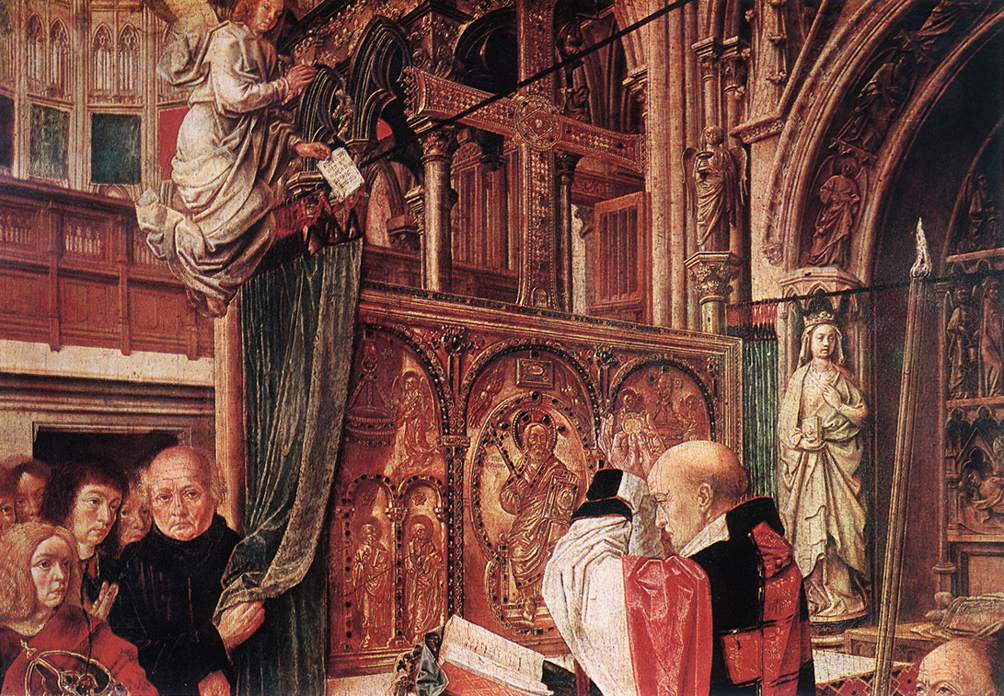
Catholics gather every Sunday for a shared meal they believe is the body and blood of Jesus Christ, and between those meals they mark the hours with fixed prayers: the Sign of the Cross to open the day, the Angelus at noon, the Rosary in the evening, and the Church's public prayer of praise at dawn and dusk. They bless food, homes, cars, candles, medals, and people. They ask friends who have died to pray for them. They keep a calendar in which every week and most days have a name, a color, and a reading set. All of it runs on one conviction: no hour, no object, and no ordinary day sits outside the reach of God.
What you can see from the back pew
Walk into a Catholic church at any hour of any day and you will find the same furniture and the same signals. A door with a stoup or font of water beside it, so people touch themselves on the forehead with it as they enter. Candles in metal stands, some still guttering, lit for somebody. A lamp burning red or white near a small locked box at the front, which Catholics believe holds consecrated bread. A raised table, usually stone or wood, that the priest kisses when he arrives at it. Crucifixes on the walls, and fourteen small framed pictures running around the sides, numbered one to fourteen. Statues, some with flowers at the feet. A book stand holding a lectionary with a cover the color of the week. A tall candle near the front, lit only between Easter and Pentecost. Bread and wine on the table, and at one point in the service, bells.
Everything on that list has a rule behind it, and the rules trace to one of three authorities: the sacraments, the Church's own liturgical books, or customs the Church has blessed and left in place. The Catechism calls the third category sacramentals, "sacred signs which bear a resemblance to the sacraments," instituted by the Church to sanctify the occasions of ordinary life (CCC 1667). That is the sentence that explains most of what a visitor sees.
“The Eucharist is the source and summit of the Christian life.
”
A Catholic day
The day begins with the Sign of the Cross. "The Christian begins his day, his prayers, and his activities with the Sign of the Cross: in the name of the Father and of the Son and of the Holy Spirit. Amen" (CCC 2157). The words come from Matthew 28:19, and the gesture is the child's first learned prayer. A Catholic crosses himself before a meal, before a journey, before an exam, and when the Gospel is read at Mass, with a thumb on the forehead, lips, and chest first.
Then the rhythms. The Catechism lists them plainly: "morning and evening prayer, grace before and after meals, the Liturgy of the Hours" (CCC 2698). In practice a Catholic household does some of these and not all of them, and the honest picture of Catholic life is a spectrum from the woman who sings Terce daily to the man who remembers a Hail Mary when his car turns over.
Three moments of the day get named again and again in Church documents because they used to be rung in on a bell. The Angelus is said at dawn, at noon, and at dusk, and the Church's Directory on Popular Piety and the Liturgy calls it "the traditional form used by the faithful to commemorate the holy annunciation of the angel Gabriel to Mary," prayed three times daily (DPP 195). Paul VI defended it in 1974 by listing exactly what it has going for it: simplicity, a biblical base, an origin in the medieval prayer for peace, and a rhythm that marks the day at its working hours (Marialis Cultus 41, MC). In many parishes the noon bell still rings, and people who have forgotten ten thousand other things remember to stop and say three Hail Marys when they hear it. During the fifty days of Easter the Angelus is swapped for the Regina Caeli, "by disposition of Benedict XIV" in 1742 (DPP 196).
Evening brings the Rosary for a great many families, then the examination of conscience and Compline for the ones who keep them (the night prayer's short form runs "Into thy hands, Father, I commend my spirit"). The Ignatian examen, a ten-minute review of the day for where God showed up and where you didn't, is the version taught to most Catholic schoolchildren.
A Catholic week
Sunday first, and by law. "Sunday, on which by apostolic tradition the paschal mystery is celebrated, must be observed in the universal Church as the primordial holy day of obligation" (canon 1246 §1). The obligation is attendance: the faithful "are obliged to participate in the Mass" and to "abstain from those works and affairs which hinder the worship to be rendered to God" (canon 1247). Missing it gravely and deliberately is the sin Catholics are taught to confess. Attending a Saturday evening Mass satisfies the Sunday obligation, and the law says so explicitly (canon 1248 §1), which is how Saturday vigil Masses came to exist in every city.
The reason given is not legal. It is that Sunday "is the pre-eminent day for the liturgical assembly," where the faithful gather to hear the Word and to take part in the Eucharist and so "call to mind the Passion, Resurrection, and glory of the Lord Jesus" (CCC 1167, quoting Sacrosanctum Concilium 106, SC). The day is counted as the first day and the eighth day at once, the day creation began and the day it ends (CCC 1166).
Friday is the other day with a shape. It is a penitential day all year, and the law makes the whole Church keep it that way: "The penitential days and times in the universal Church are every Friday of the whole year and the season of Lent" (canon 1250). The default observance is abstinence from meat unless a conference of bishops substitutes something else (canon 1251, 1253). Saturday carries a "special Marian flavour" in the old pattern of the Rosary and is a day of the memorial of Mary in the Roman calendar (Rosarium Virginis Mariae 38, RVM; DPP 188). Wednesday, in a great many Catholic homes, belongs to Joseph, husband of Mary, a custom at least three centuries old (DPP 222).
And on Saturday mornings, in most parishes, the confessional is occupied.
The eleven holy days, and the bishops' veto
The law lists the days besides Sunday that a Catholic is expected to keep: the Nativity (Christmas Day), the Epiphany, the Ascension, the Body and Blood of Christ, Holy Mary the Mother of God (1 January), her Immaculate Conception (8 December), her Assumption (15 August), Saint Joseph (19 March), Saints Peter and Paul (29 June), and All Saints (1 November). That is the list in canon 1246 §1.
Two things happen to that list in real life. The conference of bishops in a country can suppress some of these days or move them to a Sunday, but only with Rome's prior approval (canon 1246 §2). So the Ascension is a Sunday in the United States, and the Assumption is an ordinary workday in much of Europe. And a great many Catholics keep the days anyway, because the food, the flowers, and the processions attached to them travel faster than the law. In the Philippines, 8 December and 15 August empty offices and fill plazas; in Ireland, a patron's day is a public holiday.
The Church's directory explains the mechanic: a feast day "is frequently preceded by a preparatory triduum, septinaria or novena," and the pious calendar imitates the liturgical one (DPP 189). Nine days of prayer before a feast is not decoration. It is the Church's own way of teaching the feast.
The year, season by season
The liturgical year begins four Sundays before Christmas and runs in a loop with one center. "By celebrating this annual cycle of the mysteries of Christ, Holy Church honors the Blessed Mary" and proposes the saints "as examples who draw all men to the Father" (SC 103-104, quoted at CCC 1172-1173). Easter sits at the middle of it and everything else radiates outward. The Catechism quotes Athanasius: Easter is "the Great Sunday," the "Feast of feasts" (CCC 1169).
Advent
Four weeks of waiting, and the year's starting block. The directory describes Advent as "a time of waiting, conversion and of hope" (DPP 96), and the Church's liturgical color for it is violet. Two Sundays carry exceptions: the third, Gaudete Sunday, and the fourth Sunday of Lent, Laetare Sunday, where rose vestments are allowed, the two days the year permits a lighter color as a signal to continue (General Instruction of the Roman Missal 346; Liturgical colours). The four candles on a green wreath are the season's best-known domestic object, and the directory names it and its Germanic and North American home origin without embarrassment (DPP 98). Some countries hold public processions in Advent to announce the coming birth (DPP 99), and the Philippines begins its nine dawn Masses on 16 December, a practice that came out of farmers needing to reach church before sunrise (Simbang Gabi).
Christmas and Epiphany
The Church wants the night before Christmas prayerfully, and the directory suggests families say the Office of Readings in the afternoon or evening of 24 December (DPP 110). At midnight the Nativity Mass is sung, and its Gospel is Luke's shepherds. The octave holds the Holy Family, celebrated on the Sunday between Christmas and New Year (DPP 112), and 1 January holds Mary as Mother of God, which is also the World Day of Peace in the Church's calendar. Epiphany on 6 January, or transferred to a Sunday, is the Magi, the baptism, and the wedding at Cana in one day, and it is the day Catholics bless their houses in many countries, chalk above the door and a written year and the names Caspar, Melchior, Balthazar. On 2 February the Church marks the presentation of Jesus in the Temple, "the feast of Light" as the directory calls it in its modern form, with candles blessed and carried (DPP 120).
Ordinary Time, first half
Between the Baptism of the Lord and Ash Wednesday, green vestments, unnumbered Sundays, and the longer readings from one Gospel in sequence. This stretch, and its longer twin after Pentecost, is where most of the year's Christian living happens.
Lent
Forty-six days, counted as six weeks plus the Triduum, opening on Ash Wednesday. "The use of ashes is a survival from an ancient rite according to which converted sinners submitted themselves to canonical penance," the directory says, and the act "symbolizes fragility and mortality, and the need to be redeemed by the mercy of God" (DPP 125). The season has two faces, baptism and penance, and the Council asked that both be brought out more clearly in the liturgy and in teaching (SC 109).
The Friday practice of Lent is the Stations of the Cross, walked through fourteen numbered moments of the Passion, which the directory calls the most popular of all the devotions attached to the Cross (DPP 131). The faithful also fast, and the law of fasting binds those between eighteen and the beginning of their sixtieth year on Ash Wednesday and Good Friday (canon 1252), while conferences of bishops may substitute "other forms of penance, especially works of charity" (canon 1253). The directory names the three remedies "the arms of Christian penance: prayer, fasting and good works" (DPP 124), and the Catechism counts the same three, fasting, prayer and almsgiving, as the forms of interior penance that Scripture and the Fathers insist on (CCC 1434).
Lent is also when the Rosary's sorrowful mysteries fit the day, and when Catholics who have drifted make their first confession in years.
Holy Week and the three days
Palm Sunday opens it with a procession and a branch, "uniting the royal splendour of Christ with the proclamation of his Passion" (DPP 139). Then the Triduum, "the most sacred triduum of the crucifixion, burial and resurrection" (DPP 140), which is one liturgy in three parts rather than three separate services.
On Holy Thursday the Mass of the Lord's Supper is celebrated in the evening, the foot-washing is done, the bread is processed to a side altar called the altar of repose, and the faithful spend time there that night. The directory praises that adoration, records that the place of repose has traditionally been referred to as a holy sepulchre, and asks that the term be dropped, since the reposition is "an austere solemn conservation of the Body of Christ for the community of the faithful which takes part in the liturgy of Good Friday and for the viaticum of the infirmed" (DPP 141). Good Friday is the one day of the year with no Mass anywhere in the world. The liturgy is in the afternoon: the Word read, the Passion proclaimed, prayers out loud for the Jews, for rulers, "and for those who do not believe in Christ," the cross unveiled and approached, and Communion from hosts consecrated the night before (DPP 142). Holy Saturday the Church "pauses at the Lord's tomb" with prayer and fasting and no liturgy of her own beyond the Hours (DPP 146).
The Great Vigil, and fifty days
The Easter Vigil after sundown is the longest service of the year and the best-loved. Fire is lit in the courtyard, the new passover is read out in seven or nine passages from Genesis to the Gospels, the gloria and the bells come back after being silent since Maundy Thursday, water is blessed, the catechumens are baptized, the whole congregation renews its baptismal promises, and the Eucharist is celebrated. The Easter candle stays lit through the fifty days, and the color is white or gold. The directory notes a small custom that survives in many parishes: at the end of the vigil, or at second Vespers, flowers are blessed and brought to the image of the Risen Lord (DPP 151).
The fifty days close with Pentecost, and the Church asks that the days before it be spent in the "Pentecost novena," which the directory says is "already present in the Missal and in the Liturgy of the Hours," ideally prayed as solemn Vespers (DPP 155). Trinity Sunday follows. Then the Thursday or, in many countries, the following Sunday holds the Body and Blood of Christ, the day of the outdoor procession. "The Corpus Christi procession represents the typical form of an Eucharistic procession," the directory says, "a prolongation of the celebration of the Eucharist" in which the Host is carried out of the church so the faithful can "make public profession of faith" (DPP 160-162).
The Friday after the second Sunday after Pentecost is the Solemnity of the Sacred Heart, and the Saturday after it the memorial of the Immaculate Heart (DPP 166, 174).
Ordinary Time, second half, and the last weeks
Green again, and a long stretch, and then four Sundays at the end of the year that face outward toward judgment, the dead, and the second coming. All Saints on 1 November is a holy day in the law and a costume party in the culture. 2 November is the commemoration of all the faithful departed, and it is the day the Church, in the directory's phrase, "incessantly offers the holy sacrifice of the Mass for the souls of all the faithful departed and prays the Liturgy of the Hours for them" (DPP 255). Cemetery visits, flowers on graves, and lamps are proper to these days and are encouraged with the instruction that they be Christian in tone (DPP 260).
The colors on the priest, and what they mean
Vestments are not fashion and the Church says why: "The purpose of a variety of colour of the sacred vestments is to give effective expression even outwardly to the specific character of the mysteries of faith being celebrated and to a sense of Christian life's passage through the course of the liturgical year" (Redemptionis Sacramentum 121, RS, quoting the Roman Missal's general instruction). The set is small: white or gold for Christmas, Easter, the feasts of Our Lord that are not of his Passion, Marian feasts, and the feasts of angels and non-martyr saints; red for Palm Sunday, Good Friday, Pentecost, and the feasts of apostles and martyrs; green for the weeks in Ordinary Time; violet for Advent and Lent, and for Penance and funerals; rose on Gaudete and Laetare Sundays; and black permitted at funerals (General Instruction of the Roman Missal, the norms collected in the current Missal).
A visitor who learns the colors reads the year off the man at the front of the room.
The readings, and the cycle they run on
The lectionary of the Roman Rite is the Ordo Lectionum Missae, and it hands out Scripture on a clock. Sunday Masses take four readings, an Old Testament passage, a psalm sung in response, a New Testament epistle, and a Gospel, and the Gospels rotate through Matthew, Mark, and Luke over three years labeled A, B, and C, with John distributed across all three. The weekday readings run on a two-year cycle, so a Catholic who goes to Mass every day for three years hears nearly the whole New Testament and a large part of the Old.
The Council ordered this expansion so that "the table of the Word of God is prepared more abundantly for the faithful" (SC 51), and the Catechism records what the Church thinks is on that table: "the writings of the prophets," meaning the Old Testament, and "the memoirs of the apostles," meaning the letters and the Gospels (CCC 1349). Readings are not illustration. They are the first of the Mass's two halves.
The Mass, step by step
The Catechism lays out the order in two named parts: the liturgy of the Word, with its readings, homily and general intercessions, and the liturgy of the Eucharist, with the presentation of the bread and wine, the consecratory thanksgiving and communion. Together, it says, they form "one single act of worship" (CCC 1346, quoting Sacrosanctum Concilium 56). Here is what happens, in sequence, at an ordinary Sunday Mass in the Roman Rite.
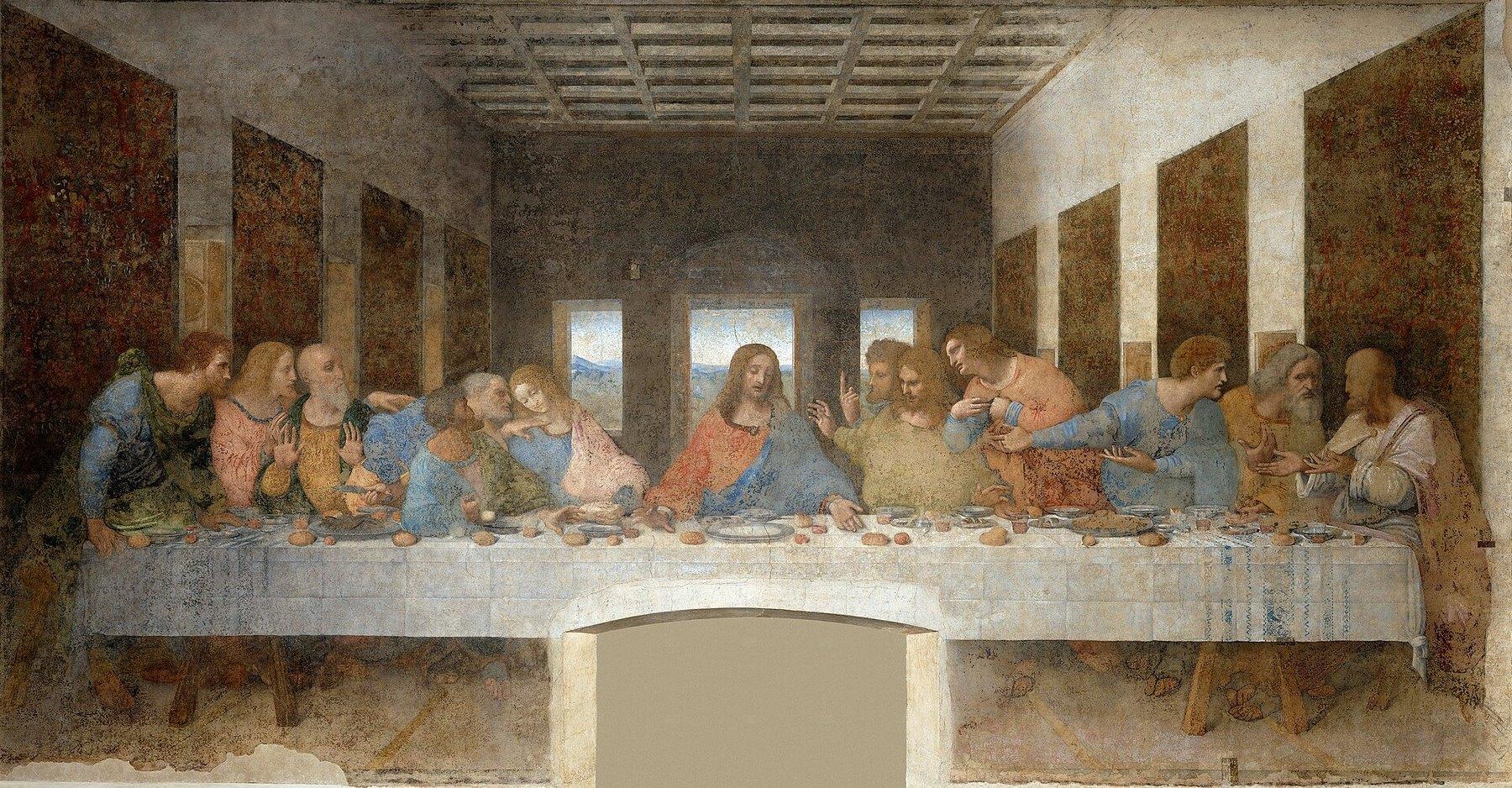
The first half, the readings
- The priest and the ministers come in, and the priest venerates the altar with a kiss. The altar is a consecrated stone or table holding relics in many churches, a practice the Church still permits and explains: relics of saints may be placed under an altar being dedicated (DPP 237; canons 1237 in the section on altars).
- The Sign of the Cross over the people, and the greeting: "The Lord be with you," answered "And with your spirit."
- The act of penance. Either the Confiteor, the "I confess to almighty God and to you, my brothers and sisters," struck on the chest at "my fault, my fault, my most grievous fault," or the Kyrie, "Lord, have mercy; Christ, have mercy; Lord, have mercy." On Sundays, especially in Easter time, the priest may sprinkle the congregation with holy water instead, an ancient renewal of baptism (Roman Missal, the Asperges rite).
- The Gloria, the angels' hymn from Luke 2:14, sung on Sundays outside Advent and Lent and on solemnities and feasts (Gloria in excelsis Deo, the norm in the Roman Missal). It is not said in Advent or Lent, and people notice.
- The collect, one short prayer the priest says in the person of Christ, and the people answer "Amen."
- The readings. Sitting. The Old Testament, the sung psalm, the epistle. Then everybody stands for the Gospel, and the priest crosses his forehead, lips, and heart before reading it, and the people do the same. The Alleluia is sung before the Gospel except in Lent, when a Lenten acclamation replaces it.
- The homily, preached standing, and the Church requires it at Sunday and holyday Masses "except for a serious reason" (SC 52). It is supposed to explain the readings just heard, and when it drifts into announcements or politics, bishops complain about it in the same documents year after year.
- The Creed, said standing by the whole room: the Nicene-Constantinopolitan text on Sundays and solemnities, the shorter Apostles' Creed sometimes, especially with children. This is the moment when a visitor can hear what the community claims about reality in ninety seconds.
- The universal prayer, also called the prayer of the faithful: intercessions for the Church, the world, the sick, the dead, and the congregation, each answered "Lord, hear our prayer" (CCC 1349, citing 1 Timothy 2:1-2).
The second half, the offering
- The gifts are brought up, bread and wine, sometimes in procession, sometimes brought by the families whose children are being baptized or married that day. The priest places them on the altar and says the prayers over the bread and the cup. This is "the presentation of the offerings," and the Catechism notes it "takes up the gesture of Melchizedek" (CCC 1350).
- The collection goes up at the same time or right after. "From the very beginning Christians have brought, along with the bread and wine for the Eucharist, gifts to share with those in need," and the Catechism quotes the second-century account of what the money was for: "orphans and widows, those whom illness or any other cause has deprived of resources, prisoners, immigrants and, in a word, all who are in need" (CCC 1351).
- The preface and the Sanctus. "Lift up your hearts," and the people answer, and then the whole room sings the angels' line from Isaiah 6: "Holy, Holy, Holy, Lord God of heaven and earth." The Catechism says the reason plainly: "the whole community thus joins in the unending praise that the Church in heaven, the angels and all the saints, sing to the thrice-holy God" (CCC 1352).
- The Eucharistic Prayer, which is one long prayer with parts. The epiclesis, asking the Father to send the Spirit on the bread and wine. The institution narrative, the words of Jesus at the supper spoken by the priest in the first person: "This is my Body," and "This is the chalice of my Blood." The anamnesis, the memorial, in which "the Church calls to mind the Passion, resurrection, and glorious return of Christ Jesus." And the intercessions, in which the prayer names the pope, the local bishop, the priests and deacons, "the whole Church in heaven and on earth, the living and the dead," and, in the Roman Canon, the Virgin Mary and a list of saints by name (CCC 1353-1354).
- The doxology and the Great Amen. The priest lifts the paten and the cup and says "Through him, with him, in him, in the unity of the Holy Spirit, all glory and honor is yours, almighty Father, God, for ever and ever," and the people shout the Amen. The Catechism spends four paragraphs on that word, which means "so be it" and is the same root as the Hebrew word for believe (CCC 1061-1065, 2856).
- The Our Father, said or sung by everybody, hands often raised the way an early Christian prayed.
- The embolism and the sign of peace: "Deliver us, Lord, we pray, from every evil," and then the deacon says "Let us offer each other a sign of peace," and people in the pew shake hands with the person beside them. This is the moment the ushers dread, and the moment a first-timer finds unnervingly friendly.
- The fraction and the Agnus Dei: "Lamb of God, you take away the sins of the world," sung while the priest breaks the large host. A piece of the consecrated host is dropped into the chalice.
- The priest's own communion, and then the display: "Behold the Lamb of God, behold him who takes away the sins of the world. Blessed are those called to the supper of the Lamb." The people answer with the centurion's line from Matthew 8:8, "Lord, I am not worthy that you should enter under my roof, but only say the word and my soul shall be healed" (CCC 1386).
- Communion is distributed. Catholics come up in procession, one by one. The minister says "The Body of Christ," the communicant answers "Amen," and eats the host. Where the conference allows it, the wine may also be offered. The posture is set locally: "The faithful should receive Communion kneeling or standing, as the Conference of Bishops will have determined" (RS 90).
- A silence. People sit down and stay there, sometimes for ten minutes, sometimes with the choir singing quietly. The Church asks for it by name (SC 30).
- The prayer after Communion, said by the priest standing with arms out.
- The announcements, which the Church tolerates in the rubrics and mocks in sacristies.
- The final blessing, "in the name of the Father, and of the Son, and of the Holy Spirit," and then the dismissal, given by the deacon or the priest: "Go forth, the Mass is ended," answered "Thanks be to God." The Latin line behind that exchange, Ite, missa est, is where the word Mass comes from, and Benedict XVI drew out what the oldest meaning implies: "In antiquity, missa simply meant 'dismissal.' However in Christian usage it gradually took on a deeper meaning. The word 'dismissal' has come to imply a 'mission.' These few words succinctly express the missionary nature of the Church" (Sacramentum Caritatis 51).
- The recessional, and the priest kisses the altar again on his way out.
What Catholics believe is happening
Two things, and the Church states both as facts about God rather than about feelings.
That this is a sacrifice. Not a repeat, since the Catechism is explicit that Christ "offered himself once for all" and the Mass is that one offering made present; the memorial of the Passover eaten by Jews and the memorial Christ commanded at the supper are the models (CCC 1362-1367, SC 47). The Council's sentence is short: at the Last Supper Christ "instituted the Eucharistic sacrifice of his Body and Blood, and... handed it to his Bride to perpetuate it through the centuries" (SC 47).
That the bread and wine are his body and blood. The Catechism admits how this is known: "That in this sacrament are the true Body of Christ and his true Blood is something that cannot be apprehended by the senses, but only by faith, which relies on divine authority" (CCC 1381). The Church then behaves as if it is physically true. She genuflects. She keeps a lamp burning in front of the reserved Sacrament (canons 938 and 940). She carries it in procession (canon 944, and RS 90-92 on posture and distribution). She sets aside hours every day in which the church stays open so people can sit in front of it (canon 937). And the Church's directory describes adoration of the Sacrament as "a form of Eucharistic cult which is particularly widespread in the Church and earnestly recommended" (DPP 164). The hymn the Catechism itself quotes at that moment, "Godhead here in hiding, whom I do adore," is what Catholics are saying on their knees.
Who may receive Communion, and what a visitor should do
The gate is Baptism. "Any baptized person not prohibited by law can and must be admitted to holy communion" (canon 912). That is the whole rule in one sentence, and it explains why a Catholic child who has not yet made her First Communion watches from the pew while her brother goes up.
The second condition is a state of conscience, and the Church states it as seriously as anything on this page. St. Paul's warning is read aloud in the Catechism: "Whoever, therefore, eats the bread or drinks the cup of the Lord in an unworthy manner will be guilty of profaning the body and blood of the Lord" (CCC 1385, quoting 1 Cor 11:27-29). The rule that comes out of it is canon 916: "A person who is conscious of grave sin is not to celebrate Mass or receive the body of the Lord without previous sacramental confession," unless there is a grave reason and no chance to confess, in which case the person owes an act of perfect contrition with the intention of confessing as soon as possible.
There is a third case, and it is public rather than private. Canon 915 says that those who have been excommunicated or interdicted, and "others obstinately persevering in manifest grave sin," are not to be admitted to Communion. This canon is the reason a Catholic politician, a divorced and remarried Catholic living as husband and wife, or someone who has publicly abandoned the faith gets quietly turned away in some dioceses and not in others. The judgment is made by the minister, and the law tells him to make it.
For the one receiving, there is also a fast. "A person who is to receive the Most Holy Eucharist is to abstain for at least one hour before holy communion from any food and drink, except for only water and medicine" (canon 919 §1). The elderly, the sick, and the people who feed them are exempt (canon 919 §3). The Catechism gives the reason for the bodily discipline: it is fitting that "bodily demeanor (gestures, clothing) ought to convey the respect, solemnity, and joy of this moment when Christ becomes our guest" (CCC 1387).
How often: the minimum is one Communion a year, in the Easter season (canon 920), and the Church "strongly encourages the faithful to receive the holy Eucharist on Sundays and feast days, or more often still, even daily" (CCC 1389). The practice in healthy parishes sits between those two sentences.
Now the visitor. A non-Catholic who walks in and stays for the whole Mass is doing nothing wrong, and the Church's law on what happens next is precise. Catholic ministers administer the sacraments to Catholics, and Catholics receive them from Catholic ministers (canon 844 §1). If a member of an Eastern church that is not in communion with Rome asks for it on their own, and has the right dispositions, Communion may be given (canon 844 §3). For other Christians the bar is higher and narrower: individual necessity, danger of death or another urgent case, the Catholic teaching about the sacrament accepted, and the right dispositions (canon 844 §4). The Catechism names the sadness behind the law rather than pretending it is not there, quoting Augustine on the Eucharist as "O sacrament of devotion! O sign of unity! O bond of charity!" and adding that the more painful the divisions, the more urgent the prayer for unity (CCC 1398).
So a Protestant visitor does not receive, and nobody is offended when she doesn't. Two customs cover it. The common one in English-speaking countries is to stay in the pew, seated or kneeling, while Communion is distributed. The other is to come forward in the line with your arms crossed flat over your chest, which signals the priest, and gets a prayer or a short blessing instead. The crossed arms are not in the law. The law says only that blessings "can also be given to catechumens and even to non-Catholics unless there is a prohibition of the Church to the contrary" (canon 1170).
What the communicant does at the rail is regulated, and the regulation is worth reading, because it explains why two Catholic churches in two countries behave differently at the same moment. The norm says the faithful receive "kneeling or standing, as the Conference of Bishops will have determined," with the conference's choice needing Rome's approval (RS 90). Each person always retains the right to receive on the tongue, and where Communion in the hand is authorized, the host is placed in the hand and the communicant steps aside to consume it (RS 92). The minister says "The Body of Christ" and the communicant answers "Amen," the word the Catechism spends a paragraph on as the human yes to God's promise (CCC 1061-1065).
Confession, and what happens in the box
Catholics confess to an actual human being, out loud, in words, and the Church calls this a sacrament rather than advice. The structure has two halves, and the Catechism names both: "on the one hand, the acts of the man who undergoes conversion through the action of the Holy Spirit: namely, contrition, confession, and satisfaction; on the other, God's action through the intervention of the Church," which "forgives sins in the name of Jesus Christ and determines the manner of satisfaction, also prays for the sinner and does penance with him" (CCC 1448). The reason the second half is necessary at all is the Church's own image for it: the Fathers present this sacrament as "the second plank [of salvation] after the shipwreck which is the loss of grace" (CCC 1446). The minister has to be an ordained man: "A priest alone is the minister of the sacrament of penance" (canon 965).
The obligation is a floor, not a ceiling. After the age of reason, each Catholic is bound "to confess faithfully his or her grave sins at least once a year" (canon 989), and this is the second of the five precepts the Catechism lists (CCC 2042). When it is required, the confession has to be specific: grave sins committed after Baptism and not yet absolved must be confessed "in kind and number" after a diligent examination of conscience (canon 988 §1). Venial sins need not be confessed and are nonetheless "strongly recommended" (canon 988 §2). Individual confession, with no general absolution for a crowd, is "the only ordinary means" for grave sin (canon 960); the exception is danger of death or a shortage of priests so severe that people would go a long time without the sacrament through no fault of their own (canon 961 §1).
Inside, three acts belong to the penitent. The first is contrition, defined as "sorrow of the soul and detestation for the sin committed, together with the resolution not to sin again" (CCC 1451). The second is the telling, and the Catechism argues for it on plain human grounds as well as supernatural ones: confession "frees us and facilitates our reconciliation with others," because in saying it the person "looks squarely at the sins he is guilty of, takes responsibility for them, and thereby opens himself again to God and to the communion of the Church" (CCC 1455). The third is satisfaction, the penance: prayer, an offering, works of mercy, service of neighbor, voluntary self-denial, or "patient acceptance of the cross we must bear" (CCC 1460).
Then the priest does the thing Catholics believe actually happens. The form is short and the Catechism prints it: "God, the Father of mercies, through the death and the resurrection of his Son has reconciled the world to himself and sent the Holy Spirit among us for the forgiveness of sins; through the ministry of the Church may God give you pardon and peace, and I absolve you from your sins in the name of the Father, and of the Son, and of the Holy Spirit" (CCC 1449).
Two physical arrangements exist and both are legal: a screen with the priest on one side and the penitent on the other, or face to face in a room designed for it. What never changes is the seal. "The sacramental seal is inviolable; therefore it is absolutely forbidden for a confessor to betray in any way a penitent in words or in any manner and for any reason" (canon 983 §1), and anyone who overhears or interprets is bound by the same secrecy (canon 983 §2). A priest goes to prison before he repeats what he heard, and the Church has always understood that literally.
The practical shape of Catholic life: the confessional is open before weekend Masses and on Saturday mornings, Lent and Advent bring lines, children go before First Communion, and the great majority of practising Catholics go monthly or every couple of months rather than yearly. Going to confession is also the ordinary way a Catholic gets the Mass ready for Communion in the state canon 916 demands.
Fasting, abstinence, and the five precepts
Beyond Sunday, the Church prescribes a minimum of self-denial, and the current law is deliberately modest. All Catholics are bound by divine law "to do penance each in his or her own way"; the common minimum exists so that they do it together (canon 1249). The penitential days are "every Friday of the whole year and the season of Lent" (canon 1250). Abstinence from meat, or from whatever food the conference of bishops names instead, binds every Friday unless a solemnity falls on it; both abstinence and fasting bind Ash Wednesday and Good Friday (canon 1251). The ages are narrow: abstinence from fourteen years old, fasting from the age of majority to the beginning of the sixtieth year (canon 1252). Bishops' conferences may define the observance more precisely and may substitute other exercises, "especially works of charity and exercises of piety," for fast and abstinence wholesale (canon 1253), which is why the English bishops commuted Friday abstinence and many American Catholics ended up with a charity offering instead of fish.
The stated purpose is not punishment. Fasting and abstinence "ensure the times of ascesis and penance which prepare us for the liturgical feasts; they help us acquire mastery over our instincts and freedom of heart" (CCC 2043, on the fifth precept). Fasting is the middle one of the three arms of Christian penance the directory names in its Lenten paragraph (DPP 124), and the third, good works, has its own list in the Catechism: the seven corporal works of mercy, feeding the hungry, sheltering the homeless, clothing the naked, visiting the sick and imprisoned, and burying the dead, with giving alms singled out as "one of the chief witnesses to fraternal charity" (CCC 2447).
The five precepts, in the Catechism's own summary, are: attend Mass on Sundays and holy days of obligation; confess sins at least once a year; receive the Eucharist at least during the Easter season; keep the holy days; observe the prescribed days of fasting and abstinence (CCC 2042-2043). The Catechism appends one more duty that is not always counted in the five: "the faithful also have the duty of providing for the material needs of the Church" (CCC 2043). The reason given for the whole set is honest about human nature: the precepts "guarantee to the faithful the indispensable minimum in the spirit of prayer and moral effort" (CCC 2041). A Catholic who keeps all five has met the minimum and nothing more.
The prayers, by name
Everything above is what the Church does. What follows is what Catholics say: the fixed texts, where each came from, and what it is for. There are two categories here and the distinction matters the moment a Catholic tries to explain himself to a Protestant. One category is liturgy, meaning the Mass and the Liturgy of the Hours, the Church's official public worship, which "is the summit toward which the activity of the Church is directed" and "the font from which all her power flows" (SC 10). The other category is devotion: the Rosary, the Angelus, the Stations, the litanies, the novenas, the hymns. The Church regulates these and does not require them. Her directory says so in one sentence: "The Liturgy and popular piety, while not conterminous, remain two legitimate expressions of Christian worship" (DPP 58). A Catholic who never prays a Rosary has not sinned. A Catholic who skips Mass on Sunday, deliberately and gravely, has.
The Sign of the Cross
In the name of the Father, and of the Son, and of the Holy Spirit. Amen.
The words are Matthew 28:19, and the gesture is older than most of the prayers on this list. The Catechism puts it at the very start of the Christian day: "The Christian begins his day, his prayers, and his activities with the Sign of the Cross... the baptized person dedicates the day to the glory of God and calls on the Savior's grace which lets him act in the Spirit as a child of the Father. The sign of the cross strengthens us in temptations and difficulties" (CCC 2157). A lay person signs himself; a priest or bishop blesses with the same three names and the hands stay open. Catholics do it at the church door with the water from the stoup, at the start of every prayer, before the Gospel is read (thumb on forehead, lips, and chest, because the Word is to be known, spoken, and kept in the heart), at the Absolution, and in moments of fear. The Latin form uses the whole hand from forehead to breast to shoulder; the Eastern form uses three fingers joined, and signs forehead, belly, right shoulder, left shoulder, in that order.
The Our Father
Our Father, who art in heaven, hallowed be thy name; thy kingdom come, thy will be done on earth as it is in heaven. Give us this day our daily bread, and forgive us our trespasses, as we forgive those who trespass against us; and lead us not into temptation, but deliver us from evil.
This is the only prayer Catholics share with almost every other Christian, and the Catechism's account of its origin is plain: a disciple asked, "Lord, teach us to pray," and "in response to this request the Lord entrusts to his disciples and to his Church the fundamental Christian prayer." Luke preserves five petitions, Matthew seven, and "the liturgical tradition of the Church has retained St. Matthew's text" (CCC 2759). The Church quotes Tertullian calling it "truly the summary of the whole gospel" (CCC 2761), and Augustine's line follows: "Run through all the words of the holy prayers in Scripture, and I do not think that you will find anything in them that is not contained and included in the Lord's Prayer" (CCC 2762). Thomas Aquinas, quoted in the same section, calls it "the most perfect of prayers" because in it "we ask, not only for all the things we can rightly desire, but also in the sequence that they should be desired" (CCC 2763).
Its place in Catholic practice is everywhere: said aloud by the whole room at Mass immediately after the Eucharistic Prayer, said at the start of every Rosary decade, said in the Angelus, said in the chaplets, said as the penance a confessor gives, said at a deathbed, and said by a Catholic who has nothing else. The doxology that ends it in most parishes, "For yours is the kingdom and the power and the glory for ever," is old: the Catechism records it in the Didache, the earliest Christian prayer book outside the New Testament, and notes that the Roman Missal now expands the last petition toward the Second Coming (CCC 2760).
The Hail Mary
Hail Mary, full of grace, the Lord is with thee. Blessed art thou amongst women, and blessed is the fruit of thy womb, Jesus. Holy Mary, Mother of God, pray for us sinners, now and at the hour of our death. Amen.
Two thirds of it is Scripture, and the Catechism says who is speaking. "It is God himself who, through his angel as intermediary, greets Mary," and the prayer "dares to take up this greeting to Mary with the regard God had for the lowliness of his humble servant" (CCC 2676). Elizabeth's cry from Luke 1:42 makes the rest of the first movement. Then the Church adds her own two petitions, and the Catechism explains the second one as an admission rather than an honor: "By asking Mary to pray for us, we acknowledge ourselves to be poor sinners and we address ourselves to the Mother of Mercy" (CCC 2677). The same paragraph gives the reason for asking at all: "Because she gives us Jesus, her son, Mary is Mother of God and our mother; we can entrust all our cares and petitions to her: she prays for us as she prayed for herself." The Catechism also names the shape of all Marian prayer: two alternating movements, one that "magnifies" the Lord for the great things he did for her, one that "entrusts the supplications and praises of the children of God to the Mother of Jesus" (CCC 2675).
This is the prayer that outsiders misread most often. It is not addressed to Mary as a god, and the title inside it, "Mother of God," is the Church's shorthand for the claim that the child she carried was not someone private but the eternal Son. Paul VI put the point bluntly about the repetition: the sequence of Hail Marys "becomes in itself an unceasing praise of Christ, who is the ultimate object" of the prayer (MC 46).
The Glory Be
Glory be to the Father, and to the Son, and to the Holy Spirit. As it was in the beginning, is now, and ever shall be, world without end. Amen.
The Church's directory calls this "the little doxology," and pairs it with the great doxology, the Gloria sung at Mass, as the standard way a Christian prayer closes: by naming three Persons instead of asking for something (DPP 159). It ends every psalm in the Liturgy of the Hours, every decade of the Rosary, and most Catholic prayers of petition. It is short enough that children have it before they know what it says.
The two creeds
Catholics say two long statements of belief out loud, and both came out of Baptism. The shorter one, the Apostles' Creed, is the old Roman baptismal symbol, three articles shaped around the Father, the Son, and the Holy Spirit. It opens the Rosary and closes Compline. The longer one, the Nicene Creed, is said at Sunday Mass and at the Easter Vigil, and it exists because someone denied that the Son was God, which is why it bothers to say "begotten, not made, consubstantial with the Father."
I believe in God, the Father almighty, creator of heaven and earth. I believe in Jesus Christ, his only Son, our Lord... I believe in the Holy Spirit, the holy Catholic Church, the communion of saints, the forgiveness of sins, the resurrection of the body, and life everlasting. Amen.
The detail a visitor notices: the Creed is said standing, by everyone, together, out loud. It is the ninety seconds in the week when a Catholic announces what he thinks is true about reality instead of asking for something. A person who does not believe it should not say it, and nobody will make him.
The Angelus, and the Regina Caeli
The Angel of the Lord declared unto Mary, and she conceived of the Holy Spirit. Hail Mary... Behold the handmaid of the Lord. Be it done unto me according to thy word. Hail Mary... And the Word was made flesh, and dwelt among us. Hail Mary... Pray for us, O holy Mother of God, that we may be made worthy of the promises of Christ.
Then the collect: "Pour forth, we beseech thee, O Lord, thy grace into our hearts, that we, to whom the Incarnation of Christ thy Son was made known by the message of an angel, may by his Passion and Cross be brought to the glory of his Resurrection."
Three Bible verses, three Hail Marys, one prayer, roughly forty seconds, said at dawn, at noon, and at dusk. The directory calls it "the traditional form used by the faithful to commemorate the holy annunciation of the angel Gabriel to Mary," in use "three times daily" (DPP 195). Paul VI refused to modernize it and gave the reasons: "its simple structure, its biblical character, its historical origin which links it to the prayer for peace and safety, and its quasi-liturgical rhythm which sanctifies different moments during the day" (MC 41). The bell that carries it is the reason the old Catholic towns of Europe still sound at noon.
For the fifty days of Easter the Church swaps it out, "by disposition of Benedict XIV" on 2 April 1742, for the Regina Caeli, an antiphon the directory dates to the tenth or eleventh century and praises for joining the Incarnation ("whom thou didst merit to bear") to the Resurrection ("has risen as he said") in one breath (DPP 196).
Queen of heaven, rejoice, alleluia. For him whom thou didst merit to bear, alleluia. Has risen as he said, alleluia. Pray for us to God, alleluia. Rejoice and be glad, O Virgin Mary, alleluia. For the Lord has truly risen, alleluia.
The Rosary
This is the prayer the outsider hears named most and understands least, so it gets the space here.
What it is: twenty meditations on the life of Christ, each one prayed slowly while a set of beads is counted. Each meditation is a decade of ten Hail Marys, framed by an Our Father before and a Glory Be after, and each decade announces an event from the Gospels first. The beads are only an abacus; the prayer is the meditation, and the Church says so in the plainest possible way. Paul VI: without contemplation "the Rosary is a body without a soul, and its recitation is in danger of becoming a mechanical repetition of formulas and of going counter to the warning of Christ: And in praying do not heap up empty phrases as the Gentiles do" (MC 47). The directory: the Rosary "is essentially a contemplative prayer, which requires tranquillity of rhythm or even a mental lingering which encourages the faithful to meditate on the mysteries of the Lord's life" (DPP 197).
Where it came from: not from an apparition and not from a pope. It grew in the Middle Ages out of the practice of saying the fifteen psalms of the Psalter, and the Catechism states the origin in one line: "Medieval piety in the West developed the prayer of the rosary as a popular substitute for the Liturgy of the Hours" (CCC 2678). That is why it still has a psalter's shape: John Paul II notes that the older selection of mysteries "was determined by the origin of the prayer, which was based on the number 150, the number of the Psalms in the Psalter" (RVM 19). Ordinary people who could not sing the Divine Office in Latin in a choir stall could walk the same day's worth of praise with fifteen decades of a prayer they could memorize.
The four sets of mysteries, as the Church lists them (RVM 20-23):
Joyful, drawn from the infancy narratives:
- The Annunciation, Gabriel's greeting and Mary's answer
- The Visitation, Mary's visit to Elizabeth, and the child leaping in the womb
- The Nativity, the birth in Bethlehem and the shepherds
- The Presentation in the Temple, and Simeon's prophecy that a sword would pierce her heart
- The Finding of the twelve-year-old Jesus in the Temple
Luminous, added in 2002 for the public ministry, which the older Rosary had left out (RVM 19, 21):
- The Baptism in the Jordan, where the Father's voice is heard
- The self-manifestation at the wedding at Cana
- The proclamation of the Kingdom of God, with the call to conversion
- The Transfiguration
- The institution of the Eucharist
Sorrowful, from the Passion narratives (RVM 22):
- The Agony in the Garden of Gethsemane
- The Scourging at the Pillar
- The Crowning with Thorns
- The Carrying of the Cross to Calvary
- The Crucifixion and death
Glorious, from the Resurrection accounts and the beginning of the Church (RVM 23):
- The Resurrection
- The Ascension
- The Descent of the Holy Spirit at Pentecost
- The Assumption of Mary
- The Coronation of Mary
How it is actually said, on the beads: the Creed on the crucifix, one Our Father on the first large bead, three Hail Marys on the three small beads for faith, hope, and charity, a Glory Be, then each decade: the mystery announced, an Our Father, ten Hail Marys, a Glory Be. At the end, the Litany of Loreto or a final prayer, and the Hail Holy Queen. A full Rosary is all four sets, which is ninety minutes or more. Almost nobody does that outside a convent.
Which set, on which day: the pattern in wide use assigns joyful to Monday and Thursday, sorrowful to Tuesday and Friday, glorious to Wednesday, Saturday, and Sunday, with the luminous on the remaining day, and the directory notices that the custom has no authority behind it and can collide with the liturgy. Its example is the worst case: "the recitation of the sorrowful mysteries on Christmas day, should it fall on a Friday." The rule it gives is that "the liturgical character of a given day takes precedence over the usual assignment of a mystery of the Rosary to a given day," and Catholics who switch the set to match the day are "acting correctly" (DPP 200). John Paul II, adding the luminous mysteries, made the same point: the full Rosary daily is laudable and some do it, but the weekly distribution lets one say a third a day without weariness (RVM 38).
The objections, answered as the Church answers them. Is it in the Bible? Both greetings are (Luke 1:28 and 1:42), the Our Father is Matthew 6, and the meditations are Gospel scenes, which is why the Church calls it a "biblically inspired prayer" (DPP 197) and Paul VI traces its formulas to the Gospel (MC 44-45). The pattern of repetition is not in the Bible as a command, and the Church's own answer to that is that the prayer's tissue is Scripture and its method is meditation. Does praying it mean worshiping Mary? The directory's description of what the prayer is about is Christ's "salvific events" (DPP 197), and Marialis Cultus calls the Hail Marys "an unceasing praise of Christ" (MC 46); the exhortation's whole argument is that Marian devotion has to be measured against the liturgy, where Mary appears because God did something through her (MC 25, 28). Is it a magic formula? The Church warns against exactly that reading: "To attribute the efficacy of prayers or of sacramental signs to their mere external performance, apart from the interior dispositions that they demand, is to fall into superstition" (CCC 2111).
Two practical notes the Church makes for people who want to pray it well. She recommends announcing the mystery and then reading a related passage of Scripture before the decade, because "no other words can ever match the efficacy of the inspired word" (RVM 30). And she asks for silence after the reading, "to pause and focus one's attention for a suitable period of time on the mystery concerned, before moving into vocal prayer," calling the discovery of silence "one of the secrets" of the Rosary (RVM 31). Some communities make the prayer more solemn by distributing the parts among several voices and singing some of it (DPP 199). Priests and religious are expressly told to use it in their own formation (DPP 197), and families are told to keep it: Paul VI "desire[s]... to recommend strongly the recitation of the family Rosary," quoting the Council that the family "shows itself to be the domestic sanctuary of the Church through the mutual affection of its members and the family's common practice of praying together" (MC 52). The beads themselves can be blessed, and the rite for doing so "emphasises the community nature of the Rosary" and asks that prayer and life be brought into "a perfect harmony" (DPP 198).
The insertion many Catholics add after the Glory Be at the end of each decade, "O my Jesus, forgive us our sins, save us from the fires of hell; lead all souls to Heaven, especially those in most need of thy mercy," comes from the Fátima apparitions claimed by three children in Portugal in 1917. That is private revelation, and it sits in a different category from anything else on this page: no Catholic is required to believe it, and the Church's directory warns that forms of piety need to be measured against Scripture and doctrine rather than handed on uncritically (DPP 65). Say it or skip it; nobody will notice.
And the warning against guilt, which the Church puts in writing because people needed it: care should be taken "to avoid discrediting other forms of prayer," and "to avoid inculcating a sense of guilt in those who do not habitually recite the Rosary" (DPP 202).
The Chaplet of the Divine Mercy
Eternal Father, I offer you the Body and Blood, Soul and Divinity of Your dearly beloved Son, Our Lord Jesus Christ, in atonement for our sins and those of the whole world.
For the sake of His sorrowful Passion, have mercy on us and on the whole world.
Holy God, Holy Mighty One, Holy Immortal One, have mercy on us and on the whole world.
The chaplet uses the same beads as the Rosary: five decades, with the "Eternal Father" on each large bead and ten "For the sake of His sorrowful Passion" on the small ones, and the "Holy God" said three times at the end, opened by the Sign of the Cross, the Apostles' Creed, an Our Father, and a Hail Mary. Its text comes from a notebook kept by Faustina Kowalska, a Polish nun who died in 1938, who wrote that Christ dictated it to her (Chaplet of the Divine Mercy, the Diary text).
Because the origin is a claimed private revelation, the honest history has a chapter most people who pray it have never heard. For decades the Roman authorities withheld approval of the devotion, and it was restricted in Poland; the ban was lifted on 15 April 1978, after pressure from the Polish cardinal Karol Wojtyła (Chaplet of the Divine Mercy, the history of the devotion). He became John Paul II, canonized Faustina on 30 April 2000, and in that homily described her as "an apostle of the Divine Mercy" who "belongs today to the group of the most popular and well-known saints of the Church," and said that through her the Lord "reveals the pattern of Christian perfection based on trust in God and on the attitude of mercy toward one's neighbors." A few days later the second Sunday of Easter was given the title Divine Mercy for the whole Church, so the chaplet now has a day as well as a form (Divine Mercy Sunday).
What a Catholic is doing when he prays it: asking for mercy for the whole world, naming the Passion as the reason, and repeating a short invocation from the same notebook, "Jesus, I trust in you." It is said most often at three in the afternoon, the hour at which the Gospels place the death of Jesus (Mark 15:34-37), and it is said on the beads by a great many people who would never attempt the twenty decades of the Rosary.
The litanies
A litany is a list of names answered with one refrain. Two kinds matter. The Litany of the Saints is the older one and belongs to the liturgy itself: "used in the Roman Church since the seventh century," the directory says, and sung "at the Easter vigil, before blessing the Baptismal fount; in the celebration of the Sacrament of Baptism; in conferring Sacred Orders of the episcopate, priesthood and deaconate; in the rite for the consecration of virgins and of religious profession; in the rite of dedication of a church and consecration of an altar; at rogation; at the station Masses and penitential processions; when casting out the Devil during the rite of exorcism; and in entrusting the dying to the mercy of God" (DPP 235). If you hear "Saint Michael, pray for us" shouted at someone being ordained, that is this litany. Its structure is praise of God, then petition to the saints, then a set of short deliver-us petitions, then the Christ Kyrie.
The Marian litany is the one people meet in pews. The directory explains its mechanics: "a long series of invocations of Our Lady, which follow in a uniform rhythm, thereby creating a stream of prayer characterized by insistent praise and supplication," with each invocation in two parts, "the first of praise (Virgo clemens), the other of supplication (Ora pro nobis)." The liturgical books contain two Marian litanies, "the Litany of Loreto, repeatedly recommended by the Roman Pontiffs," and one for the coronation of Marian images, and the directory adds that "a proliferation of litanies would not seem desirable" (DPP 203). The Loreto litany is the source of the strange names a visitor sees painted on church walls: Mirror of Justice, Tower of David, House of Gold, Mystical Rose, Ark of the Covenant. They are biblical images applied to Mary, and the list is poetry rather than doctrine. The Litany of St. Joseph is also approved, "by St. Pope Pius X," and belongs to the Wednesday devotion to him (DPP 222). A third kind is Christ-centered rather than Marian: the Litany of the Holy Name of Jesus, credited to Bernardino of Siena and John Capistrano in the fifteenth century, one of the litanies approved for public and private use and one that carries a partial indulgence (Litany of the Holy Name of Jesus). And the directory counts the Litany of the Saints among the rites used "in entrusting the dying to the mercy of God" (DPP 235).
The Salve Regina, and the great hymns
Hail, holy Queen, Mother of Mercy, our life, our sweetness, and our hope. To thee do we cry, poor banished children of Eve. To thee do we send up our sighs, mourning and weeping in this valley of tears. Turn then, most gracious advocate, thine eyes of mercy toward us, and after this our exile, show unto us the blessed fruit of thy womb, Jesus. O clement, O loving, O sweet Virgin Mary.
The Salve Regina closes Compline, the Church's night prayer, and closes a public Rosary, and its four "O clement, O loving" lines are the reason it is the most-sung Marian hymn in Latin. Three other texts a visitor will hear named:
The Nunc Dimittis, Simeon's words on holding the child Jesus in the Temple, "now lettest thou thy servant depart in peace" (Luke 2:29-32), prayed at Compline every night of the year.
The Te Deum, the great canticle of praise sung at the Office of Readings on Sundays outside Lent and on solemnities, and attributed since the seventh century to Ambrose and Augustine.
The Tantum Ergo, two stanzas of Thomas Aquinas's Eucharist hymn for Corpus Christi, sung before the priest lifts the monstrance in Benediction, when the bell rings and everyone kneels.
The Council took an interest in all of this twice. On the hymns of the Hours: they "are to be restored to their original form," anything that "smacks of mythology" removed, and new ones composed as needed (SC 93). Which is why a hymn written in the ninth century, the Veni Creator Spiritus, is still the song the Church sings at Pentecost, at ordinations, and at the opening of a council or synod (Veni Creator Spiritus). On music in general: "the musical tradition of the universal Church is a treasure of inestimable value, greater even than that of any other art," because "as sacred song united to the words, it forms a necessary or integral part of the solemn liturgy" (SC 112), and the people's own singing "is to be intelligently fostered" (SC 118), with the pipe organ "held in high esteem" (SC 120) and local musical traditions respected in mission lands (SC 119).
The Jesus Prayer
Lord Jesus Christ, Son of God, have mercy on us sinners.
Western Catholics meet this one late, but the Catechism treats it as the clearest form of what praying always could mean. It starts with the name: "the divine name may not be spoken by human lips, but by assuming our humanity the Word of God hands it over to us and we can invoke it: Jesus... To pray Jesus is to invoke him and to call him within us. His name is the only one that contains the presence it signifies" (CCC 2666). Then the form, and its geography: "the most usual formulation, transmitted by the spiritual writers of the Sinai, Syria, and Mt. Athos, is the invocation, Lord Jesus Christ, Son of God, have mercy on us sinners," which joins the Christ hymn of Philippians 2 to the tax collector's cry and the blind men begging for light (CCC 2667). And then the argument for repetition, which is the answer to the Protestant objection to the Rosary as well: "The invocation of the holy name of Jesus is the simplest way of praying always. When the holy name is repeated often by a humbly attentive heart, the prayer is not lost by heaping up empty phrases, but holds fast to the word and brings forth fruit with patience" (CCC 2668).
The East has its own great Marian chant, the Akathistos, "one of the oldest and most revered expressions of Marian devotion" in the Byzantine tradition, and the directory calls it "a literary and theological masterpiece" and notes the title means "the hymn sung while standing," which is how you can tell an Akathist service when you walk into one (DPP 207).
The Anima Christi
Soul of Christ, sanctify me. Body of Christ, save me. Blood of Christ, inebriate me. Water from the side of Christ, wash me. Passion of Christ, strengthen me. O good Jesus, hear me. Within thy wounds hide me. Suffer me not to be separated from thee. From the malicious enemy defend me. In the hour of my death call me and bid me come to thee, that with thy saints I may praise thee, forever and ever. Amen.
A communion prayer, and the Church's own liturgy is full of the same instinct. It is traditionally attached to Ignatius of Loyola, whose soldiers and students said it after receiving Communion, and it is the text Catholics fall back on when they want a thanksgiving and cannot think of one. The liturgy itself supplies the shortest version, the centurion's line before Communion and the "Lord, I am not worthy" that the whole congregation answers with (CCC 1386), and the Church asks for silence afterward rather than more words: "at the proper times all should observe a reverent silence" (SC 30).
The Liturgy of the Hours
This is the prayer most Catholics have never done and most non-Catholics have never heard of, so it is worth describing properly, because it is the one thing on this page that is neither the Mass nor a devotion.
Christ "introduced into this earthly exile that hymn which is sung throughout all ages in the halls of heaven," and "joins the entire community of mankind to himself" in this priestly work of praise (SC 83). The result is the Divine Office, and its purpose is stated as an engineering fact: it "is devised so that the whole course of the day and night is made holy by the praises of God" (SC 84). When it is prayed properly, the Catechism says what happens: "the faithful (clergy, religious, and lay people) exercise the royal priesthood of the baptized," and it is "the public prayer of the Church" (CCC 1174). It "continues his priestly work through his Church," and participation is graded by state of life: priests, religious, and "all the faithful as much as possible" (CCC 1175).
Seven hours, in the current book: the Office of Readings, Lauds, three small daytime hours, Vespers, and Compline. Lauds at morning and Vespers at evening are "the two hinges on which the daily office turns" (SC 89). Between them sit the daytime hours, Terce at nine, Sext at noon, None at three, now mostly kept by religious and by laypeople who want a five-minute prayer at a fixed clock time; the reform suppressed the old hour of Prime (Liturgy of the Hours). After them comes Compline before sleep. The Office of Readings, formerly Matins, can be said at any hour and is the one with the long psalms and the reading from the Fathers. The reform deliberately re-attached the hours to the clock: "the traditional sequence of the hours is to be restored so that once again they may be genuinely related to the time of the day when they are prayed" (SC 88), and "the true time for each hour is to be observed insofar as possible" (canon 1175). The psalms were moved off the single week onto a longer cycle so a person could actually get through them (SC 91; the four-week cycle of the current book), and the readings were widened so "the riches of God's word may be easily accessible in more abundant measure" (SC 92).
Who is bound: clerics, by law, in virtue of their ordination (canon 1174 §1, referring to canon 276 §2 3°), and religious by their constitutions. Everyone else is "earnestly invited to participate in the liturgy of the hours as an action of the Church" (canon 1174 §2). The practical minimum the Church asks of parishes is one hour in common: "Pastors of souls should see to it that the chief hours, especially Vespers, are celebrated in common in church on Sundays and the more solemn feasts," with the laity encouraged to pray it with priests or among themselves (SC 100). Those who do say it are "sharing in the greatest honor of Christ's spouse, for by offering these praises to God they are standing before God's throne in the name of the Church, her Bride" (SC 85).
What it sounds like: mostly psalms. A Catholic praying Lauds on an ordinary Thursday is saying a psalm, a canticle, and a Gospel canticle with an antiphon each, and the hymn and the reading and the intercession and the Our Father around them. The Catechism notes that the hymns and litanies "integrate the prayer of the psalms into the age of the Church, expressing the symbolism of the time of day, the liturgical season, or the feast being celebrated" (CCC 1177). And it is the office that the Rosary historically replaced for people who could not read (CCC 2678), which is why the two prayers are always compared. The Hours "do not exclude but rather in a complementary way call forth the various devotions of the People of God, especially adoration and worship of the Blessed Sacrament" (CCC 1178).
Lectio divina, and how Catholics read the Bible
Four steps, in the old order: read a passage, meditate on it, pray what it stirred in you, and rest in it. The Church's own anchor for the practice is liturgical: "the lectio divina, where the Word of God is so read and meditated that it becomes prayer, is thus rooted in the liturgical celebration" (CCC 1177), since each Hour has a reading from Scripture followed by a response. Meditation "is above all a quest," the Catechism says, in which "the mind seeks to understand the why and how of the Christian life," and "we are usually helped by books... the Sacred Scriptures, particularly the Gospels, holy icons, liturgical texts of the day or season, writings of the spiritual fathers" (CCC 2705). Its goal is not information: meditation "engages thought, imagination, emotion, and desire" in order to deepen convictions of faith and "prompt the conversion of the heart," and the Catechism names both lectio divina and the Rosary as the two standard ways Christians "meditate on the mysteries of Christ" (CCC 2708).
The practical consequence for a Catholic: he reads the Bible inside a schedule that the Church set for him, either the three-year Sunday cycle at Mass, or a daily lectionary, or a book of the Hours. A Catholic who says he reads his Bible usually means one of those three things.
The Stations of the Cross, and the Via Lucis
Fourteen numbered pictures around the walls, a cross at each, and a walk. The directory calls it the most popular of all the devotions attached to the Cross: "Of all the pious exercises connected with the veneration of the Cross, none is more popular among the faithful than the Via Crucis," in which the faithful "follow the final earthly journey of Christ: from the Mount of Olives... to Calvary where he was crucified between two thieves... to the garden where he was placed in freshly hewn tomb," and the proof of its popularity is "the numerous Via Crucis erected in so many churches, shrines, cloisters, in the countryside, and on mountain pathways" (DPP 131). It is a synthesis of several older devotions: the pilgrimage to the Holy Land, the devotion to Christ's three falls under the cross, and the devotion to the stations or "stops" along the road (DPP 132). The Church's own excuse for it is that it "has retained a living memory of the words and gestures of the final earthly days of her Spouse" (DPP 133). The fourteen traditional titles, read off the walls in order (Stations of the Cross):
- Jesus is condemned to death
- Jesus takes up his Cross
- Jesus falls the first time
- Jesus meets his Mother
- Simon of Cyrene helps Jesus carry the Cross
- Veronica wipes the face of Jesus
- Jesus falls for the second time
- Jesus meets the women of Jerusalem
- Jesus falls for the third time
- Jesus is stripped of his garments
- Jesus is nailed to the Cross
- Jesus dies on the Cross
- Jesus is taken down from the Cross
- Jesus is laid in the tomb
The walk goes from one to the next in a line, with a short prayer at each, and it is the ordinary Friday exercise of Lent in a great many parishes: a quarter of an hour after Mass, and the children are brought.
Be straight with a visitor about the source list. "Out of the fourteen traditional Stations of the Cross, only eight have a clear scriptural foundation": no Gospel says anyone wiped Jesus's face, which is station six; the three falls under the cross, stations three, seven, and nine, are not in the Gospels at all; and the thirteenth station, in which his body is laid in his mother's arms, is a piety the Gospels do not record, since they say Joseph of Arimathea took him down and buried him (Stations of the Cross). The number itself settled late: the European sets built in the fifteenth and sixteenth centuries ran anywhere from seven stations to thirty, and fourteen became the standard afterward. The devotion exists because most Catholics could never travel to Jerusalem. The Franciscans held the custody of the holy places, the papal proclamation of 1342 made them custodians, and they began erecting outdoor shrine-sets in Europe to duplicate the road, along approaches to churches and on hillsides, so that the walk around a parish church could stand in for the walk through Jerusalem (Stations of the Cross). An indulgence is attached to the walk, which is the historical reason the Church promoted the European copies so hard: the fruit of the pilgrimage was moved to the parish (Stations of the Cross; on indulgences, CCC 1471-1479). The usual rhythm is once a week in Lent, five or ten minutes after Mass, with the priest leading and the people following the stations around the walls.
The Easter version exists and is far less common: the Via Lucis, "a pious exercise" following the model of the Via Crucis, in which "the faithful process while meditating on the various appearances of Jesus, from his Resurrection to his Ascension" (DPP 153).
Novenas, and what they are for
Nine days of prayer before a feast, or nine days of prayer for a dying person's soul, or nine Fridays, or seven Wednesdays. The directory names the shape and then sets a limit: "a feast day is frequently preceded by a preparatory triduum, septinaria or novena," but "the times and modes of popular piety should always correspond to the times and modes of the Liturgy" (DPP 189). The Church's own example is the best one, because it is scriptural rather than invented: the days between the Ascension and Pentecost, when the apostles "joined in continuous prayer, together with several women, including Mary the mother of Jesus" (Acts 1:14), and from that the "Pentecost novena" emerged, which "is already present in the Missal and in the Liturgy of the Hours," and "where possible, the Pentecost novena should consist of the solemn celebration of vespers" (DPP 155).
The Filipino Christmas novena, the devotion attached to the nine dawn Masses before Christmas, is the same form with a local surface. So is the novena said for the dead, which the directory mentions as "the novena for the dead in preparation for the 2 November, and the octave prolonging it," with the instruction that it "should be celebrated in accordance with liturgical norms" (DPP 260). And there is a chaplet "recollecting the Seven agonies and seven joys of St. Joseph," with the Wednesday custom that goes with it (DPP 222).
The thing a Catholic is not supposed to do with a novena is treat nine repetitions as a mechanism. The Catechism's sentence on that is the standard: "To attribute the efficacy of prayers or of sacramental signs to their mere external performance, apart from the interior dispositions that they demand, is to fall into superstition" (CCC 2111).
The examen, or what Catholics do before bed
Before Compline, or before going to confession, or before sleep in a Catholic school dormitory, a person runs the day back. Five movements in the standard form: thank, ask light, review the day hour by hour, ask forgiveness for where you failed, and resolve what to do differently tomorrow. The Church requires the review before confession: grave sins must be confessed "of which the person has knowledge after diligent examination of conscience" (canon 988 §1), and the Catechism explains why the looking works: in confession the person "looks squarely at the sins he is guilty of, takes responsibility for them, and thereby opens himself again to God and to the communion of the Church" (CCC 1455). The Ignatian examen is the best-known version of that review as a daily practice rather than a once-a-year duty, and it was designed for people with jobs: a few minutes, five questions, no book (Examen).
Grace at meals, and the family's own church
The smallest Catholic liturgy is at a table. Hands, a blessing over the food, and the Sign of the Cross to close it. The Catechism lists it among the rhythms the Church proposes "to nourish continual prayer," together with morning and evening prayer and the Hours (CCC 2698). The family that does this is doing something the Church has a name for: "The Christian family constitutes a specific revelation and realization of ecclesial communion, and for this reason it can and should be called a domestic church" (CCC 2204). It "is called to partake of the prayer and sacrifice of Christ. Daily prayer and the reading of the Word of God strengthen it in charity" (CCC 2205). And the law gives parents a share in the sanctifying function of the Church, by marriage itself rather than by delegation: "Parents share in a particular way in this function by leading a conjugal life in a Christian spirit and by seeing to the Christian education of their children" (canon 835 §4), while Christian parents have "a most grave obligation and possess the right to educate" their children, and "it is for Christian parents particularly to take care of the Christian education of their children according to the doctrine handed on by the Church" (canon 226 §2).
The directory hands on the practical list, and it is worth quoting because it answers the question "what do Catholic families actually do at home": "as preparation for worship celebrated in church, and as its prolongation in the home, the Christian family makes use of prayer," and "apart from morning and evening prayers, certain prayers are to be expressly encouraged... such as reading and meditating on the word of God, preparation for the reception of the sacraments, devotion and consecration to the Sacred Heart of Jesus, the various forms of the veneration of the Blessed Virgin Mary, grace before and after meals, and observance of popular devotions" (DPP 68).
Two blessings belong here because they are the home's own rather than the parish's. There is an annual blessing of the family in the house, "during Eastertide or at other times of the year," which the directory says is "highly recommended to parish priests" because it "affords a precious occasion to recollect God's blessing on the family" (DPP 152). And the Epiphany blessing of the house, chalk above the door and the year written with the names of the Magi, is the same instinct on a fixed day.
Blessings, and the objects that carry them
Catholics bless a great deal: meals, homes, cars, rosaries, medals, candles, a new baby, a new school, animals, a field. From outside, that looks like a religion of lucky objects. The Church's own definition is much smaller and much stranger than the practice appears: "Sacramentals are sacred signs by which effects, especially spiritual effects, are signified in some imitation of the sacraments and are obtained through the intercession of the Church" (canon 1166).
Two words in that sentence do the work. "Imitation" means a sacramental is a relative of the sacraments and never one of them. "Intercession" means the prayer doing the work is the Church's, and the effect is "obtained" rather than produced.
Here is the boundary the Church draws herself, in one sentence that answers most of the accusation: "Sacramentals do not confer the grace of the Holy Spirit in the way that the sacraments do, but by the Church's prayer, they prepare us to receive grace and dispose us to cooperate with it" (CCC 1670). A sacrament, in Catholic belief, is something Christ instituted that acts on the person who receives it. A sacramental is a prayer the Church says over a person, a place, a meal, or a thing, so that the person walks away more open to what God wants to give.
The authority for this runs downward from Baptism, which is why a parent can bless a child and why the parish secretary cannot bless a church: "Sacramentals derive from the baptismal priesthood: every baptized person is called to be a 'blessing,' and to bless. Hence lay people may preside at certain blessings; the more a blessing concerns ecclesial and sacramental life, the more is its administration reserved to the ordained ministry" (CCC 1669).
Every blessing has the same furniture. "They always include a prayer, often accompanied by a specific sign, such as the laying on of hands, the sign of the cross, or the sprinkling of holy water (which recalls Baptism)" (CCC 1668). And the reason Catholics bless in the name of Jesus with a cross on the forehead is stated with the logic: "Every blessing praises God and prays for his gifts. In Christ, Christians are blessed by God the Father 'with every spiritual blessing.' This is why the Church imparts blessings by invoking the name of Jesus, usually while making the holy sign of the cross of Christ" (CCC 1671).
The law then says who may do what. The minister of a sacramental is a cleric who has been given the required power, yet "lay persons who possess the appropriate qualities can also administer some sacramentals," according to the liturgical books and the judgment of the local bishop (canon 1168). Any priest can impart blessings except those reserved to the pope or to bishops, and a deacon "can impart only those blessings expressly permitted by law" (canon 1169 §2-§3). Blessings "are to be imparted first of all to Catholics" and "can also be given to catechumens and even to non-Catholics unless there is a prohibition of the Church to the contrary" (canon 1170). That last line is why a priest will bless a car in a parking lot for a neighbor who is not in the Church at all.
Most blessings are for one occasion. Some leave a permanent mark, and the Catechism lists them: the blessing of an abbot or abbess, the consecration of virgins, religious profession, and the blessing of certain ministries such as readers, acolytes, and catechists, plus "the dedication or blessing of a church or an altar, the blessing of holy oils, vessels, and vestments, bells" (CCC 1672). These are not confused with ordination, and the Catechism says so in the same paragraph.
One sacramental is heavier than the rest, and it has rules of its own. "When the Church asks publicly and authoritatively in the name of Jesus Christ that a person or object be protected against the power of the Evil One and withdrawn from his dominion, it is called exorcism" (CCC 1673). The simple form happens inside the Baptism rite. The solemn form, called a major exorcism, "can be performed only by a priest and with the permission of the bishop," and the bishop gives that permission only to a priest "who has piety, knowledge, prudence, and integrity of life" (canon 1172 §2).
So the whole apparatus is fenced. Only the Holy See can create a new sacramental, interpret the existing ones, or abolish them (canon 1167 §1). Priests and laypeople must observe "the rites and formulas approved by the authority of the Church" carefully (canon 1167 §2). Objects that have been dedicated or blessed "are to be treated reverently and are not to be employed for profane or inappropriate use even if they are owned by private persons" (canon 1171), and relics cannot be bought at all: "It is absolutely forbidden to sell sacred relics" (canon 1190 §1).
The reason for the fences is the same reason the Church gives for the whole practice. The Catechism names the failure mode: "To attribute the efficacy of prayers or of sacramental signs to their mere external performance, apart from the interior dispositions that they demand, is to fall into superstition" (CCC 2111). A medal worn as a charm is the exact object Catholics are warned against.
The object-by-object detail lives on its own page. What holy water is for, what a scapular asks of the person who wears it, why candles are carried on February 2, what gets blessed on Palm Sunday, and which blessings a layperson may give at home are all set out in The Sacramentals.
Indulgences, and the treasury the Church draws on
An indulgence is the practice most visitors cannot get inside their heads, because they have heard it described as a ticket out of punishment bought with money. Start with the question the doctrine is answering, which is about what happens to a person after sins are forgiven.
"Sin has a double consequence," the Catechism says. Grave sin breaks communion with God and so costs eternal life, which is called the eternal punishment of sin. But "every sin, even venial, entails an unhealthy attachment to creatures, which must be purified either here on earth, or after death in the state called Purgatory," and that purification is the temporal punishment of sin (CCC 1472). The next sentence keeps the picture from turning into a courtroom: "These two punishments must not be conceived of as a kind of vengeance inflicted by God from without, but as following from the very nature of sin" (CCC 1472). Absolution removes the eternal punishment. The attachment is what is left, and it is dealt with either by a life of charity and penance now (CCC 1473) or after death.
An indulgence is the Church acting on that residue. The definition is legal and precise: "An indulgence is the remission before God of temporal punishment for sins whose guilt is already forgiven, which a properly disposed member of the Christian faithful gains under certain and defined conditions by the assistance of the Church which as minister of redemption dispenses and applies authoritatively the treasury of the satisfactions of Christ and the saints" (canon 992). It is partial or plenary "insofar as it partially or totally frees from the temporal punishment due to sins" (canon 993).
The treasury is where the suspicion lands, so read what the Church says it is made of: "not the sum total of the material goods which have accumulated during the course of the centuries. On the contrary the 'treasury of the Church' is the infinite value, which can never be exhausted, which Christ's merits have before God" (CCC 1476). It includes "as well the prayers and good works of the Blessed Virgin Mary" and "the prayers and good works of all the saints" (CCC 1477). The Church's stated purpose in drawing on it is pastoral: she "does not want simply to come to the aid of these Christians, but also to spur them to works of devotion, penance, and charity" (CCC 1478).
Two facts about scope settle most arguments. Any believer can gain one for herself or send one to a dead person: "Any member of the faithful can gain partial or plenary indulgences for oneself or apply them to the dead by way of suffrage" (canon 994), because "the faithful departed now being purified are also members of the same communion of saints" (CCC 1479). And no one below the pope hands them out at discretion: besides the supreme authority of the Church, only those whose power "is acknowledged in the law or granted by the Roman Pontiff" can bestow them, and no lower authority may delegate that power unless the Holy See has expressly given it (canon 995).
The conditions are ordinary rather than exotic. The person must be baptized, not excommunicated, and "in the state of grace at least at the end of the prescribed works," must have at least the general intention of gaining the indulgence, and must do the enjoined work "in the established time and the proper method, according to the tenor of the grant" (canon 996). For the fuller indulgences the standard set is sacramental confession, Eucharistic communion, and a prayer for the pope's intentions (Indulgence).
The current list is the Enchiridion Indulgentiarum, which replaced the older Raccolta and attached indulgences to the most important works of piety, charity, and penance rather than to an enormous inventory of prayers (Indulgence). Its four general grants are worth reading out loud, because they are about an ordinary Tuesday. The first grants a partial indulgence to someone "Raising the mind to God with humble trust while performing one's duties and bearing life's difficulties, and adding, at least mentally, some pious invocation." The other three cover giving oneself or one's goods to people in need, giving up something lawful and pleasant in a spirit of penance, and witnessing to the faith openly in everyday circumstances (Indulgence). These are partial, and their "worth therefore depends on the fervour with which the person performs the recommended actions" (Indulgence), which is the opposite of a mechanism.
Four works carry a plenary indulgence on any day, once a day: reading or listening to Scripture piously for at least half an hour, adoring Jesus in the Eucharist for at least half an hour, the pious exercise of the Stations of the Cross, and reciting the Rosary or the Akathist in a church, an oratory, a family, a religious community, or any assembly of people gathered for an honorable purpose (Indulgence). Three of the four are practices a Catholic household would recognize: the Rosary, the Stations, and time sitting before the exposed Sacrament.
The money question has a history, and the honest version is short. Indulgences came to be attached to giving money, sometimes to add lustre to a pilgrimage site, more often to fund churches, hospitals, schools, roads and bridges (Indulgence). Professional collectors, called pardoners, were sent to gather the alms, and many of them exceeded official Church doctrine and "promised rewards such as salvation from eternal damnation in return for money" (Indulgence). The abuse became a serious problem the Church recognized but could not restrain effectively; the Counter-Reformation curbed it, and the Council of Trent confirmed the doctrine itself as part of the Catholic faith (Indulgence). In 1567 Pius V canceled every grant of indulgences involving fees or other financial transactions, and indulgences stopped being attached to almsgiving because the potential for abuse was judged too great (Indulgence). Twentieth-century reformers then abolished the quantification in days or years, which had meant an equivalent length of penance and was widely mistaken for time spent in Purgatory, and greatly reduced the number of indulgences granted for visiting particular churches and other locations (Indulgence). What is left is a list of recommended works rather than a price. The doctrine behind it is that the Church's own prayer can cover what an individual's penance does not, and that the coverage costs nothing.
Why Catholics ask Mary and the saints for prayers
A visitor who has sat through a Mass here will have heard the practice twice without noticing. The Hail Mary ends "pray for us sinners, now and at the hour of our death." The litany of the saints answers every petition with "pray for us." Both are requests for prayer addressed to people who are not in the room, and one of them is addressed to a woman the Church confesses as "taken up to heaven" (CCC 969).
The Church's law puts the two cases separately, and put that way it is easier to see what she is claiming about each. She "commends to the special and filial reverence of the Christian faithful the Blessed Mary ever Virgin, Mother of God, whom Christ established as the mother of all people," and she "promotes the true and authentic veneration of the other saints whose example instructs the Christian faithful and whose intercession sustains them" (canon 1186). Reverence for a mother, instruction and sustained prayer from the rest.
The doctrinal claim underneath is that the dead who are in Christ are still in the family and still praying. "Being more closely united to Christ, those who dwell in heaven fix the whole Church more firmly in holiness.... They do not cease to intercede with the Father for us, as they proffer the merits which they acquired on earth through the one mediator between God and men, Christ Jesus.... So by their fraternal concern is our weakness greatly helped" (CCC 956, quoting Lumen Gentium). The Catechism adds that the Church's memory of the saints is not a museum: "It is not merely by the title of example that we cherish the memory of those in heaven; we seek, rather, that by this devotion to the exercise of fraternal charity the union of the whole Church in the Spirit may be strengthened" (CCC 957). And in the chapter on prayer: "Their intercession is their most exalted service to God's plan. We can and should ask them to intercede for us and for the whole world" (CCC 2683).
The standard objection is 1 Timothy 2:5, one mediator. The Catechism answers it with the verse rather than around it. "Mary's function as mother of men in no way obscures or diminishes this unique mediation of Christ, but rather shows its power," and her influence "flows forth from the superabundance of the merits of Christ, rests on his mediation, depends entirely on it, and draws all its power from it." Then the parallel that makes the logic concrete: "just as the priesthood of Christ is shared in various ways both by his ministers and the faithful, and as the one goodness of God is radiated in different ways among his creatures, so also the unique mediation of the Redeemer does not exclude but rather gives rise to a manifold cooperation which is but a sharing in this one source" (CCC 970, quoting Lumen Gentium 62). Catholics ask the saints for prayer on the same footing they ask their spouse. "No creature could ever be counted along with the Incarnate Word and Redeemer" is in the same paragraph (CCC 970).
Mary gets a longer treatment because of one claim about her, that she is the mother of believers in "a wholly singular way" who "cooperated by her obedience, faith, hope, and burning charity in the Savior's work of restoring supernatural life to souls" (CCC 968). The Church's sentence on her continuing work is the one Catholics repeat at the end of the Hail Mary: "Taken up to heaven she did not lay aside this saving office but by her manifold intercession continues to bring us the gifts of eternal salvation.... Therefore the Blessed Virgin is invoked in the Church under the titles of Advocate, Helper, Benefactress, and Mediatrix" (CCC 969).
Now the part that draws the hardest looks: statues, pictures, kissing a ring, lighting a candle in front of an image. The Church's guardrail is a sentence about direction. "The image is not venerated in itself. Rather, that which it represents is venerated," and sacred images "are given due honour and veneration, not because there are believed to contain some divinity or power justifying such cult, nor because something has to be requested of an image, nor because trust is reposed in them, as the pagans used to do with idols, but because the honour given to sacred images is given to the prototypes whom they represent" (DPP 241). The directory repeats the warning in pastoral terms: the faithful "should be careful not to fall into the error of raising sacred images to the level of paragons," even images so loved that they have become "embodiments of the religious culture of nations or cities" (DPP 242).
The law limits public veneration to people the Church has actually named: only those "whom the authority of the Church has recorded in the list of the saints or the blessed" may be reverenced with public veneration (canon 1187). Images in churches are to stay, but "in moderate number and in suitable order so that the Christian people are not confused nor occasion given for inappropriate devotion" (canon 1188). Old and beloved images may not be restored without the bishop's written permission, and he is to consult experts first (canon 1189). No statue or image, and no relic, may be placed on the table of an altar (DPP 244).
The positive case for images is theological rather than sentimental, and it rests on the Incarnation. "Previously God, who has neither a body nor a face, absolutely could not be represented by an image. But now that he has made himself visible in the flesh and has lived with men, I can make an image of what I have seen of God" (CCC 1159, quoting St. John of Damascus). "Christian iconography expresses in images the same Gospel message that Scripture communicates by words. Image and word illuminate each other" (CCC 1160). And what the pictures finally point at is a person: "as are sacred images of the holy Mother of God and of the saints as well. They truly signify Christ, who is glorified in them" (CCC 1161).
The directory's summary of what people actually do with them is worth reading as a description of a Catholic evening: the faithful "pray before sacred images, both in churches and in their homes. They decorate them with flowers, lights, and jewels; they pay respect to them in various ways, carrying them in procession, hanging ex votos near them in thanksgiving; they place them in shrines in the fields and along the roads" (DPP 239), and the directory adds at once that this "requires theological guidance if it is to avoid certain abuses" (DPP 239).
If you want the shorter answer in one line, it is this: a Catholic asking a saint for prayer is asking a friend who is further along, and the Church's own test for whether the friendship is real is whether the prayer ends up at Christ. The saints' page on this site, The Saints, carries the biographies and the feast days.
Prayer for the dead, and the funeral
Ask a Catholic what they do about their dead and they will name a list of verbs: prayed, had a Mass said, went to the cemetery, put flowers on the grave. The doctrine under the verbs is a claim that the family did not cease to exist.
The Catechism states the practice as a fact about the Church's history first: "In full consciousness of this communion of the whole Mystical Body of Jesus Christ, the Church in its pilgrim members, from the very earliest days of the Christian religion, has honored with great respect the memory of the dead," citing 2 Maccabees, "because it is a holy and a wholesome thought to pray for the dead that they may be loosed from their sins," and she "offers her suffrages for them" (CCC 958). Then the sentence that makes the two-directional claim: "Our prayer for them is capable not only of helping them, but also of making their intercession for us effective" (CCC 958).
Why prayer would be needed at all is the part most visitors miss. Catholics teach that "all who die in God's grace and friendship, but still imperfectly purified, are indeed assured of their eternal salvation; but after death they undergo purification, so as to achieve the holiness necessary to enter the joy of heaven" (CCC 1030). The name for that purification is Purgatory, and the Catechism is insistent that it "is entirely different from the punishment of the damned" (CCC 1031). The basis it gives is the practice itself: "This teaching is also based on the practice of prayer for the dead," and the Church "also commends almsgiving, indulgences, and works of penance undertaken on behalf of the dead," and puts the case as a question: "If Job's sons were purified by their father's sacrifice, why would we doubt that our offerings for the dead bring them some consolation? Let us not hesitate to help those who have died and to offer our prayers for them" (CCC 1032).
A Catholic funeral has three movements, and the directory names them because in cities they often get compressed into one: "prayer vigil at the home of the deceased, or somewhere else as circumstances permit," where family, friends, and the Christian community gather "to pray to God in suffrage, to hear the 'words of life eternal'... to comfort those who mourn the deceased; and to express Christian solidarity" according to Romans 12:15, "be sad with those in sorrow"; then "the celebration of the Holy Eucharist, which is highly desirable when possible"; then "the Rite of committal, the funeral cortege, and burial" (DPP 252). At the committal the deceased is handed over with what the directory calls "the final commendation by which the Christian community says farewell to one of its members before his body is buried" (DPP 252).
Three details inside that rite answer three common complaints. The homily at a Catholic funeral is not a eulogy; the celebrant comments on the Scripture "avoiding any form of funerary eulogy" (DPP 252). The body matters: "the body of the deceased, which was the Temple of the Holy Spirit, [is] to be treated with the utmost respect," the furnishings should be "decorous and free of all ostentation," and "the liturgical signs, the cross, the paschal candle, the holy water and the incense, should all be used with the utmost propriety" (DPP 253). And the funeral belongs to the parish: it "must generally be celebrated in his or her parish church," though the family may choose another church with the consent of whoever governs it (canon 1177 §1-§2).
The law also rules out the two things people expect from a Church with property. "Regarding offerings on the occasion of funeral rites... there is to be no favoritism toward persons in funerals and the poor are not deprived of fitting funerals" (canon 1181). And cremation is allowed: the Church "earnestly recommends that the pious custom of burying the bodies of the deceased be observed; nevertheless, the Church does not prohibit cremation unless it was chosen for reasons contrary to Christian doctrine" (canon 1176 §3). The bar is on the reason, not the act.
Funerals are the beginning rather than the end. "The Church offers the sacrifice of the Holy Eucharist for the dead not only on the occasion of their funerals, but also on the third, seventh, and thirtieth day following their deaths, as well as on their anniversaries," and "On 2 November, the Church incessantly offers the holy sacrifice of the Mass for the souls of all the faithful departed and prays the Liturgy of the Hours for them" (DPP 255). Every day at Mass and at Vespers the Church "supplicates and implores the Lord, that 'the faithful who have gone before us marked with the sign of faith [...] may be given light, happiness and peace'" (DPP 255). The directory puts a guardrail on the practice in the same paragraph, because grief turns possessive: catechesis should help the faithful avoid "possessive or particular ideas that relate the Mass only to one's 'own' dead" (DPP 255).
What ordinary people say at a deathbed and at a grave is small and repeatable. DPP 260 names the forms: "the novena for the dead in preparation for the 2 November, and the octave prolonging it," visits to the cemetery to maintain or decorate graves, confraternities whose works include "burial of the dead," and suffrage "through alms deeds, works of mercy, fasting, applying indulgences, and especially prayers, such as the De profundis, and the formula Requiem aeternam, which often accompanies the Angelus, the rosary, and at prayers before and after meals" (DPP 260). The English form of that versicle is what you will hear at the end of a Rosary said for somebody who has died:
Eternal rest grant unto them, O Lord, and let perpetual light shine upon them. May the souls of the faithful departed, through the mercy of God, rest in peace. Amen. (Eternal Rest)
The directory's warning list is worth reading because it shows the Church policing this territory herself. To be avoided: "the invocation of the dead in practices involving divination; the interpretation or attribution of imaginary effects to dreams relating to the dead, which often arises from fear; any suggestion of a belief in reincarnation; the danger of denying the immortality of the soul or of detaching death from the resurrection, so as to make the Christian religion seem like a religion of the dead; the application of spacio-temporal categories to the dead" (DPP 258). Cemetery visits "should be seen as deriving from the bonds existing between the living and the dead and not from any form of obligation, non-fulfilment of which involves a superstitious fear" (DPP 260).
The one thing you may see that the Church does not endorse is a séance, a horoscope, or a fortune teller marketed as Catholic. That is the exact line the directory draws (DPP 258), and it is the line Is this Catholic? works through, custom by custom.
Anointing, viaticum, and what happens when a Catholic is dying
The Catholic answer to dying is a set of things done by a priest, a set of things done by the family, and a claim about what is happening. Start with the claim, since the Church states it as the work of the whole community rather than of the dying person: "By the sacred anointing of the sick and the prayer of the priests the whole Church commends those who are ill to the suffering and glorified Lord, that he may raise them up and save them. and indeed she exhorts them to contribute to the good of the People of God by freely uniting themselves to the Passion and death of Christ" (CCC 1499).
The scriptural anchor is a paragraph from one letter, and Catholics take it as the institution of a sacrament: "Is any among you sick? Let him call for the elders [presbyters] of the Church and let them pray over him, anointing him with oil in the name of the Lord; and the prayer of faith will save the sick man, and the Lord will raise him up; and if he has committed sins, he will be forgiven" (CCC 1510, quoting James 5:14-15). "Tradition has recognized in this rite one of the seven sacraments" (CCC 1510).
One old name confuses people. "Extreme Unction" is the label that arose because the sacrament "was conferred more and more exclusively on those at the point of death," and the liturgy "has never failed to beg the Lord that the sick person may recover his health if it would be conducive to his salvation" (CCC 1512). Since the Second Vatican Council the Roman Rite gives the sacrament "to those who are seriously ill by anointing them on the forehead and hands with duly blessed oil," oil pressed from olives or other plants, and the priest says the form only once: "Through this holy anointing may the Lord in his love and mercy help you with the grace of the Holy Spirit. May the Lord who frees you from sin save you and raise you up" (CCC 1513).
The boundary is generous, which surprises most families. The anointing "is not a sacrament for those only who are at the point of death. Hence, as soon as anyone of the faithful begins to be in danger of death from sickness or old age, the fitting time for him to receive this sacrament has certainly already arrived" (CCC 1514). It may be repeated once the person recovers and falls gravely ill again, or if the same illness turns graver (CCC 1515; canon 1004 §2). "It is fitting to receive the Anointing of the Sick just prior to a serious operation," and the same holds "for the elderly whose frailty becomes more pronounced" (CCC 1515). The law's own trigger is a believer who "begins to be in danger due to sickness or old age" (canon 1004 §1), and it adds the pastoral rule that the sacrament "is to be administered in a case of doubt whether the sick person has attained the use of reason, is dangerously ill, or is dead" (canon 1005). The one exclusion in the law: the sacrament "is not to be conferred upon those who persevere obstinately in manifest grave sin" (canon 1007).
Only a priest or bishop does it (CCC 1516; canon 1003). The rite is short and has three movements: the priests "in silence" lay hands on the sick, "they pray over them in the faith of the Church," which the Catechism calls the epiclesis proper to this sacrament, "they then anoint them with oil blessed, if possible, by the bishop" (CCC 1519). Ideally it happens inside a Mass, or at least with penance before and Communion after, and it can be celebrated "in the family home, a hospital or church, for a single sick person or a whole group of sick persons" (CCC 1517).
What Catholics say it does: "the first grace of this sacrament is one of strengthening, peace and courage to overcome the difficulties that go with the condition of serious illness or the frailty of old age," a gift of the Holy Spirit "who renews trust and faith in God and strengthens against the temptations of the evil one, the temptation to discouragement and anguish in the face of death," leading "to healing of the soul, but also of the body if such is God's will," and, quoting James again, "if he has committed sins, he will be forgiven" (CCC 1520). Then the two lines that make suffering itself a place rather than a punishment: the sick person "receives the strength and the gift of uniting himself more closely to Christ's Passion," so that suffering "acquires a new meaning; it becomes a participation in the saving work of Jesus" (CCC 1521), and the Catechism adds that the sick who receive it "contribute to the good of the People of God" (CCC 1522).
The last stop has a name of its own. When the danger passes, "the Anointing of the Sick completes our conformity to the death and Resurrection of Christ, just as Baptism began it," finishing "the holy anointings that mark the whole Christian life: that of Baptism which sealed the new life in us, and that of Confirmation which strengthened us for the combat of this life," and this final anointing "fortifies the end of our earthly life like a solid rampart for the final struggles before entering the Father's house" (CCC 1523). It is also called the "sacrament of those departing" (CCC 1523). Then Communion given at that moment is called viaticum, "the seed of eternal life and the power of resurrection," because the Eucharist "is here the sacrament of passing over from death to life, from this world to the Father" (CCC 1524). The Catechism's summary makes it a set: Penance, Anointing, and viaticum "constitute at the end of Christian life 'the sacraments that prepare for our heavenly homeland'" (CCC 1525).
The law pushes families to move early rather than late. The faithful in danger of death "are to be nourished by holy communion in the form of Viaticum," even if they already received Communion that day, and while the danger lasts viaticum "is recommended... often, but on separate days" (canon 921). And the pastors are told not to let grief do the scheduling: "Holy Viaticum for the sick is not to be delayed too long; those who have the care of souls are to be zealous and vigilant that the sick are nourished by Viaticum while fully conscious" (canon 922). A priest who gives the Last Rites imparts an Apostolic Blessing carrying a plenary indulgence, and if no priest is available the Church grants the plenary indulgence to any rightly disposed Christian at the moment of death who was in the habit of praying, supplying the three usual conditions herself (Indulgence).
What the Church asks of everybody is smaller than a rite. She "encourages us to prepare ourselves for the hour of our death," which is why the litany of the saints has the faithful pray "From a sudden and unforeseen death, deliver us, O Lord," why the Hail Mary asks Mary to intercede "at the hour of our death," and why Catholics "entrust ourselves to St. Joseph, the patron of a happy death" (CCC 1014). The Catechism then quotes two things people have actually written about dying: "Death would have no great terrors for you if you had a quiet conscience.... Then why not keep clear of sin instead of running away from death?" and St. Francis, "Praised are you, my Lord, for our sister bodily Death, from whom no living man can escape" (CCC 1014).
What lay people do at the altar
A Catholic Mass is not a performance with an audience, and the Council's sentence on that is blunt enough to quote at a visitor: the faithful should not be present "as strangers or silent spectators" but should "take part in the sacred action conscious of what they are doing, with devotion and full collaboration," and learn "to offer themselves" (SC 48). The ground for that expectation is baptism rather than talent: "all the faithful should be led to that fully conscious, and active participation in liturgical celebrations which is demanded by the very nature of the liturgy... is their right and duty by reason of their baptism," and this participation "is the aim to be considered before all else" (SC 14).
The first participation is vocal and physical, and the Council lists it: the people are "to take part by means of acclamations, responses, psalmody, antiphons, and songs, as well as by actions, gestures, and bodily attitudes. And at the proper times all should observe a reverent silence" (SC 30). Then the rule that keeps the parts in order: "In liturgical celebrations each person, minister or layman, who has an office to perform, should do all of, but only, those parts which pertain to his office by the nature of the rite and the principles of liturgy" (SC 28). That is why a reader does not say the priest's prayer and why the congregation does not raise the chalice.
The paid jobs are few, and the Church says so. Lay people "who are found suitable are qualified to be admitted by the sacred pastors to those ecclesiastical offices and functions which they are able to exercise," and those who excel "in necessary knowledge, prudence, and integrity" may serve pastors "as experts and advisors" (canon 228). Two stable ministries are conferred "through the prescribed liturgical rite" as lector and acolyte, given to lay people of the age and qualifications set by the bishops' conference, and in January 2021 the pope extended access to these two ministries to women, a change printed in the canon itself (canon 230 §1). The conferral "does not grant them the right to obtain support or remuneration from the Church" (canon 230 §1).
Below the stable ministries is the practical list: anyone may "fulfill the function of lector in liturgical actions by temporary designation," and "All lay persons can also perform the functions of commentator or cantor, or other functions, according to the norm of law" (canon 230 §2). Where necessity presses and ordained ministers are short, lay people "can also supply certain of their duties, namely, to exercise the ministry of the word, to preside over liturgical prayers, to confer baptism, and to distribute Holy Communion, according to the prescripts of the law" (canon 230 §3). An extraordinary minister of Holy Communion is "an acolyte or another member of the Christian faithful" designated that way (canon 910 §2). Even adoration of the exposed Sacrament has a lay lane: the minister of both exposition and benediction is "a priest or deacon," but "in special circumstances, the minister of exposition and reposition alone without benediction is the acolyte, extraordinary minister of holy communion, or someone else designated by the local ordinary" (canon 943).
Two duties sit underneath the functions. Lay people "are bound by the obligation and possess the right to acquire knowledge of Christian doctrine" so they can "live according to this doctrine, announce it themselves, defend it if necessary, and take their part in exercising the apostolate," and they may pursue "fuller knowledge of the sacred sciences" at Catholic universities and even receive a mandate to teach (canon 229). And the field the Church assigns to them specifically is the one no cleric represents: lay people carry "a particular duty to imbue and perfect the order of temporal affairs with the spirit of the gospel and thus to give witness to Christ, especially in carrying out these same affairs and in exercising secular functions" (canon 225 §2). Marriage itself is counted as a share in the Church's building: spouses are "bound by a special duty to work through marriage and the family to build up the people of God" (canon 226 §1), and parents "share in a particular way" in the Church's sanctifying function (canon 835 §4).
The building, the art, and the music
A Catholic church is arranged to be read, and the reading is meant to work whether or not anybody is inside. "These visible churches are not simply gathering places but signify and make visible the Church living in this place, the dwelling of God with men reconciled and united in Christ" (CCC 1180). The minimum standard is unstuffy: "a house of prayer in which the Eucharist is celebrated and reserved, where the faithful assemble, and where is worshipped the presence of the Son of God our Savior... this house ought to be in good taste and a worthy place for prayer and sacred ceremonial" (CCC 1181, quoting Paul VI). And the last sentence of the section is the one to remember about the door: "the visible church is a symbol of the Father's house toward which the People of God is journeying," and "for this reason, the Church is the house of all God's children, open and welcoming" (CCC 1186).
The law says the door is free. A church is defined as "a sacred building designated for divine worship," and the faithful hold a right to use it "for the exercise, especially the public exercise, of divine worship" (canon 1214). During sacred celebrations, access "is to be free and gratuitous" (canon 1221). Nobody may charge a person for walking in. The same law that makes the door free admits that buildings fail: if a church "cannot be used in any way for divine worship and there is no possibility of repairing it," the bishop may hand it over "to profane but not sordid use," and he may do the same for other grave reasons after hearing the priests' council and the people who hold rights in the building (canon 1222).
Each piece of furniture has a job the Catechism names. The ambo exists because "the dignity of the Word of God requires the church to have a suitable place for announcing his message so that the attention of the people may be easily directed to that place during the liturgy of the Word" (CCC 1184). The chair of the priest or bishop "should express his office of presiding over the assembly and of directing prayer" (CCC 1184). The tabernacle is to be "situated in churches in a most worthy place with the greatest honor," and its "dignity, placing, and security... should foster adoration before the Lord really present" (CCC 1183); the law adds that there is normally one tabernacle per church, that it be "distinguished, conspicuous, beautifully decorated, and suitable for prayer," and that it be immovable, solid, opaque, and locked (canon 938 §1-§3). A lamp "which indicates and honors the presence of Christ is to shine continuously before a tabernacle" where the Sacrament is reserved (canon 940), which is the red light you saw. The oils sit in the sanctuary too: the sacred chrism "is traditionally reserved and venerated in a secure place in the sanctuary," and the oil of catechumens and the oil of the sick may be placed there (CCC 1183). And the building must make room for the two sacraments a person comes back for: a place for Baptism and a font "for fostering remembrance of the baptismal promises," "an appropriate place to receive penitents," and "a space that invites us to the recollection and silent prayer that extend and internalize the great prayer of the Eucharist" (CCC 1185).
The altar has its own law because it is the center. Fixed altars are to be dedicated and movable ones dedicated or blessed "according to the rites prescribed in the liturgical books," and "the ancient tradition of placing relics of martyrs or other saints under a fixed altar is to be preserved" (canon 1237 §1-§2). A church, once built properly, "is to be dedicated or at least blessed as soon as possible," and parish churches and cathedrals "are to be dedicated by the solemn rite" (canon 1217).
Music is treated as doctrine with a melody attached, and the Council's opening sentence is a strong claim about art in general: "The musical tradition of the universal Church is a treasure of inestimable value, greater even than that of any other art. The main reason for this pre-eminence is that, as sacred song united to the words, it forms a necessary or integral part of the solemn liturgy" (SC 112). The reason the singing is not decoration: "Liturgical worship is given a more noble form when the divine offices are celebrated solemnly in song, with the assistance of sacred ministers and the active participation of the people" (SC 113).
Two practical rulings come out of that. Gregorian chant is the favorite rather than the requirement: the Church "acknowledges Gregorian chant as specially suited to the Roman liturgy: therefore, other things being equal, it should be given pride of place in liturgical services," and "other kinds of sacred music, especially polyphony, are by no means excluded from liturgical celebrations, so long as they accord with the spirit of the liturgical action" (SC 116). And the choir is not the point: "Choirs must be diligently promoted, especially in cathedral churches," yet pastors "must be at pains to ensure that, whenever the sacred action is to be celebrated with song, the whole body of the faithful may be able to contribute that active participation which is rightly theirs," and "religious singing by the people is to be intelligently fostered" (SC 114, SC 118). Composers are told to write for the room they will actually get, "not confining themselves to works which can be sung only by large choirs," and their texts "must always be in conformity with Catholic doctrine; indeed they should be drawn chiefly from holy scripture and from liturgical sources" (SC 121).
Visual art gets a similarly unprecious ruling. The Church "has not adopted any particular style of art as her very own; she has admitted styles from every period according to the natural talents and circumstances of peoples, and the needs of the various rites," and so "the art of our own days, coming from every race and region, shall also be given free scope in the Church, provided that it adorns the sacred buildings and holy rites with due reverence and honor" (SC 123). The standard is beauty with a limit: bishops are to "strive after noble beauty rather than mere sumptuous display," which the Council applies even to vestments and ornaments, and they are "to remove from the house of God... those works of artists which are repugnant to faith, morals, and Christian piety" (SC 124). Artists who want to serve God "are engaged in a kind of sacred imitation of God the Creator" (SC 127), and a bishop is to see that "sacred furnishings and works of value are not disposed of or dispersed" (SC 126).
Pilgrimage and shrines
A shrine is not simply a pretty church. The law defines one by the traffic it draws: "a church or other sacred place to which numerous members of the faithful make pilgrimage for a special reason of piety, with the approval of the local ordinary" (canon 1230). The labels are earned: a shrine may be called national only with the bishops' conference's approval, and international only with the Holy See's (canon 1231), and certain privileges may be granted to shrines "whenever local circumstances, the large number of pilgrims, and especially the good of the faithful seem to suggest it" (canon 1233).
The directory puts the dependence plainly, in a sentence that sounds like logistics and is theology: "Pilgrims needs shrines, and shrines need pilgrims" (DPP 279). Pilgrimage is "a universal religious experience and a typical expression of popular piety," and it is "invariably connected with a shrine" (DPP 279).
The reason the Church does not consider a pilgrimage necessary, and keeps encouraging it anyway, is a claim about what the Christian life already is. After Christ "had passed from this world to the Father... no pilgrimage was binding any longer on his disciples: their entire lives now become a pilgrimage towards the sanctuary of heaven and the Church is seen as an 'earthly pilgrimage.'" The Church "has not only regarded pilgrimage as a legitimate form of piety but has encouraged it throughout her history" (DPP 281). The directory then calls the actual journey "both a moment in and parable of, our journey towards the Kingdom," which "affords an opportunity for the Christian to take greater stock of his eschatological destiny" (DPP 286).
The history is a straight line with a dip. For the first three centuries pilgrimage "did not form part of the cultic life of the Church," partly from fear of contamination from Jewish and pagan practice, though the cult of the martyrs at their tombs laid the basis (DPP 282). In the Constantinian era the sites of the Passion became destinations and Jerusalem a "Holy Land," with the fourth-century travel accounts of the Bordeaux Pilgrim and Egeria still extant (DPP 283). The Middle Ages were "the golden age of pilgrimage," with Jerusalem, the instruments of the Passion, and Rome's tombs of Peter and Paul drawing traffic, and pilgrimage did real work in "the amalgamation of various nations" (DPP 284). It declined in the modern period, then revived in a changed shape: "the goal of such pilgrimage becomes a particular shrine which embodies the faith or cultural identity of specific nations," and the directory's own list includes Altötting, Antipolo, Aparecida, Assisi, Caacupé, Coromoto, Częstochowa, Ernakulam-Angamaly, Fátima, Guadalupe, Kevelaer, Knock, La Vang, Loreto, Lourdes, and Mariazell (DPP 285).
What a Catholic is expected to do at the end of the trip is set out in advance, and it is not mainly looking. "As the shrine is a place of prayer, a pilgrimage is a journey of prayer," the Word of God should be its "light and its guide, its food and its sustenance," and the beginning "should be an occasion of prayer, preferably in the parish church," with the Eucharist or part of the Liturgy of the Hours (DPP 287). At shrines, the law says, "the means of salvation are to be supplied more abundantly to the faithful by the diligent proclamation of the word of God, the suitable promotion of liturgical life especially through the celebration of the Eucharist and of penance, and the cultivation of approved forms of popular piety," and "votive offerings of popular art and piety are to be kept on display in the shrines or nearby places and guarded securely" (canon 1234). That last clause is why shrine walls are hung with rings, crutches, silver hearts, and photographs: people have been leaving their thanks there for centuries, and the Church has a rule about not losing them.
Processions belong here, because they are pilgrimage compressed into a street. They "are a sign of the Church's condition, the pilgrimage of the People of God, with Christ and after Christ, aware that in this world it has no lasting dwelling," and also "a sign of the witness to the faith that every Christian community is obliged to give to the Lord in the structures of civil society" (DPP 247). The directory adds the risk it knows about: processions can slide into "the precedence of devotions over the sacraments" and "external displays over interior disposition," and can leave the ill-instructed with "the impression... that Christianity is merely a religion of externals" (DPP 246).
How a Catholic becomes one
The Church's normal route for an adult is old, restored in the 1960s rather than invented, and has four movements. Vatican II ordered that "the catechumenate for adults, comprising several distinct steps, is to be restored and to be taken into use at the discretion of the local ordinary," so that the time of preparation "may be sanctified by sacred rites to be celebrated at successive intervals of time" (SC 64). The current book of rites is called the Order of Christian Initiation of Adults, from the Latin Ordo initiationis christianae adultorum; in the United States the name was changed in 2021 from the Rite of Christian Initiation of Adults, the RCIA most people still say, to the Order, and the change was approved by the Vatican's worship office (Order of Christian Initiation of Adults).
The law gives the shape in one sentence: "When the period of the precatechumenate has been completed, those who have made known their intention to embrace faith in Christ are to be admitted to the catechumenate in liturgical ceremonies and their names are to be inscribed in the book designated for this purpose" (canon 788 §1). Then the content: "Through instruction and the first experience of Christian life, catechumens are to be initiated suitably into the mystery of salvation and introduced into the life of the faith, the liturgy, the charity of the people of God, and the apostolate" (canon 788 §2), and it is up to the conference of bishops to write the rules about what is expected of them (canon 788 §3). Canon law names the adult's path too: an adult who intends to receive baptism "is to be admitted to the catechumenate and is to be led insofar as possible through the various stages to sacramental initiation" (canon 851, 1°).
What the Catechism adds is the part a nervous inquirer needs to hear. The catechumenate "aims at bringing their conversion and faith to maturity" and is "a formation in the whole Christian life... during which the disciples will be joined to Christ their teacher" (CCC 1248). And the person is not treated as an outsider during the wait: catechumens "are already joined to the Church, they are already of the household of Christ, and are quite frequently already living a life of faith, hope, and charity," and "with love and solicitude mother Church already embraces them as her own" (CCC 1249, quoting Lumen Gentium).
The four periods, in the order the rite puts them (Order of Christian Initiation of Adults):
- The period of evangelization and the precatechumenate, "a time, of no fixed duration or structure, for inquiry and introduction to Gospel values," where the person is called an inquirer and nothing is required of them yet.
- The period of the catechumenate, entered by the Rite of Acceptance, where "a sponsor accompanies any candidate seeking admission as a catechumen" and the person is formed by instruction and the first experience of Christian life (canon 788 §2).
- The period of purification and enlightenment, which is Lent: the elect are "elected" or their names enrolled, the Church prays over them with the scrutinies on the third, fourth, and fifth Sundays of Lent, and the Creed is handed over to them.
- The sacraments at the Easter Vigil: Baptism, Confirmation, and First Communion, followed by the instruction that explains to the newly baptized what they have just received (canon 789).
No length is fixed. The rite itself says that "nothing [...] can be settled a priori", and that "the time spent in the catechumenate should be long enough... for the conversion and faith of the catechumens to become strong", with several years if necessary (Order of Christian Initiation of Adults). The United States bishops have asked for at least a year of "formation, instruction, and probation" for somebody with no previous experience of living a Christian life (Order of Christian Initiation of Adults).
For someone already baptized in another church the rite has its own form, "The Rite of Reception of Baptized Christians into the full Communion of the Catholic Church," said usually outside the Vigil (Order of Christian Initiation of Adults). The reason is the same doctrine that makes Baptism non-negotiable in the first place: "Given once for all, Baptism cannot be repeated" (CCC 1272), because it "imprints on the soul an indelible spiritual sign, the character, which consecrates the baptized person for Christian worship" (CCC 1280). A baptized convert therefore makes a profession of faith and receives Confirmation and the Eucharist. Only the unbaptized are baptized, since "every person not yet baptized and only such a person is capable of baptism" (canon 864).
The Church asks for less faith at the door than people assume. "The faith required for Baptism is not a perfect and mature faith, but a beginning that is called to develop," and at the rite the question and answer are one line: "What do you ask of God's Church?" "Faith!" (CCC 1253). Baptism is normally celebrated on Sunday, or at the Easter Vigil if possible (canon 856), and an adult is baptized in his or her own parish church (canon 857 §2). The godparent is asked to be a "firm believer" able and ready to help the new convert "on the road of Christian life" (CCC 1255). And the instruction does not stop at the water: neophytes "are to be formed through suitable instruction to understand the gospel truth more deeply and to fulfill the duties assumed through baptism," and "to be imbued with a sincere love for Christ and his Church" (canon 789).
The honest footnote is the one about necessity. The law calls Baptism "the gateway to the sacraments and necessary for salvation by actual reception or at least by desire," and says it "is validly conferred only by a washing of true water with the proper form of words" (canon 849). "Or at least by desire" is the clause Catholics hold when somebody good dies unbaptized.
What this looks like in the Philippines
Catholic practice travels, and the Church has a rule for that: "Even in the liturgy, the Church has no wish to impose a rigid uniformity in matters which do not implicate the faith or the good of the whole community; rather does she respect and foster the genius and talents of the various races and peoples," and anything in a people's way of life "which is not indissolubly bound up with superstition and error she studies with sympathy and, if possible, preserves intact" (SC 37). When revising the books she provides for "legitimate variations and adaptations to different groups, regions, and peoples," so long as "the substantial unity of the Roman rite is preserved" (SC 38). That is the rule behind any practice that takes on local color.
The nine Masses before Christmas are the best-known Filipino form. Simbang Gabi, "night worship," is "a devotional, nine-day series of Masses attended by Filipino Catholics in anticipation of Christmas," held daily from December 16 to 24, at times "ranging from as early as 2:30 a.m. to 5:00 a.m.," with the last Mass on Christmas Eve called the Misa de Gallo, the rooster's Mass (Simbang Gabi). Its traditional first year is 1669, and it began as a practical compromise for farmers who were in the fields before sunrise (Simbang Gabi). It was halted from 1680 to 1689 by a decree from the Holy See against singing hymns in native languages, which was being implemented across the Spanish world at the time (Simbang Gabi). In 1953 the First Plenary Council of the Philippines asked the Holy See to let the practice continue, and the permission was renewed in 1961 (Simbang Gabi). On Gaudete Sunday 2019 Pope Francis presided at a Simbang Gabi in St. Peter's Basilica, the first time a pope had led the traditional Mass (Simbang Gabi).
Liturgically the series is "a series of votive Masses in honor of the Blessed Virgin Mary," and unless it falls on a Sunday of Advent the Mass is sung with the Gloria and "white is the liturgical color," while "violet or pink is used for any other Masses said during the day" (Simbang Gabi). After the Mass the parish yard sells bibingka, rice cakes cooked above and below, and puto bumbong, steamed purple rice with butter, grated coconut, and brown sugar, with tsokolate or salabat to wash it down (Simbang Gabi). The Church herself does not promise anything for the nine mornings: the idea that completing all nine days earns a petition is "a well-known folk belief" that "if a devotee completes all nine days of the Simbang Gabi, God may grant a request made as part of the novena" (Simbang Gabi). Compare it with the Pentecost novena, which is in the Missal and the Liturgy of the Hours (DPP 155), and you can see the difference the directory keeps insisting on.
The Christ Child gets more public attention in the Philippines than almost anywhere else. Magellan's expedition landed at Limasawa on April 7, 1521, and on April 14 presented the ruler of Cebu and his consort with three gifts at their baptism: a bust of Christ as the Ecce Homo, an image of the Blessed Virgin Mary, and a statue of the Holy Child, the Santo Niño, after which about five hundred men were baptized with the queen and forty women (Santo Nino de Cebu). The devotion today centers on the basilica in Cebu and on the third Sunday of January, when the Sinulog festival honors "the Holy Child and the Christianization of the Filipino people" with parades, novena Masses, processions through the streets and along the water, and street dancing (Sinulog Festival). It was designed in 1980 as a Cebuano festival, first held on January 20 of that year, and is comparable to the Dinagyang of Iloilo and the Ati-Atihan of Aklan, which keep the same feast (Sinulog Festival).
Manila's devotion is to a dark-complexioned carving of Christ carrying the cross, the Black Nazarene, made by an anonymous Mexican sculptor and brought into Manila by galleon from Acapulco. The Augustinian Recollects are credited with carrying it to the Philippines, though they asserted that when they arrived in 1606 the Nazarene was not among the images they brought with them; Innocent X authorized a confraternity for it in 1650, Pius VII granted it an apostolic blessing in 1880 along with a plenary indulgence for those who pray before it, and John Paul II raised its church to a minor basilica in 1987 (Black Nazarene). Its feast is January 9, the octave day of the older Feast of the Most Holy Name of Jesus, which is the original dedication of Quiapo Church, and the day's procession of the carriage through the streets is called the Traslación (Black Nazarene). Devotion to it "is rooted among Filipinos who strongly identify with the passion and suffering of Christ the image depicts," and "many devotees... relate their poverty and daily struggles to the Passion of Christ"; some walk barefoot, some try to ride the carriage "in the belief it imparts blessings," and at the end of every Mass in the basilica the devotees pay homage by clapping their hands (Black Nazarene). The names of the pious exercises are local: the novena, the Traslación, the pahalÃk, the pabihis, and the pasindÃ, the lighting of votive candles (Black Nazarene). Before the Second Vatican Council the processions were "relatively solemn and peaceful," and they became "larger and rowdier in the 1970s" (Black Nazarene). Some hold that touching the image can grant miracles and cure diseases, which is the exact claim the directory answers when it says the image "is not venerated in itself" and that "that which it represents is venerated" (DPP 241).
Antipolo appears in the Vatican's own directory as one of the shrines whose "faith or cultural identity" is carried by a nation (DPP 285). Two cautions from the same directory apply to all of the above. An image may become so bound up with a people's identity that it needs explaining "in the light of the grace which is at the basis of the veneration accorded them, and of the historical and social circumstances," rather than treated as a paragon (DPP 242). And when local customs around the dead carry their own anthropology, "great caution must be used in examining and evaluating these customs," with care that they are not "contrary to the Gospel" and "cannot be interpreted as pagan residues" (DPP 257).
If you walk in tomorrow morning
Catholic practice is legible from the inside, so the practical version for somebody who has never sat in one is short.
- Any weekday Mass is open to you and the door costs nothing (canon 1221). A Tuesday morning Mass is short. Wear anything you would wear to a wedding.
- Get there ten minutes early and sit anywhere except the front rows, which are for people who know where to stand up. There is a missal or a hymnal in the pew, or a screen, and everything said is in it.
- Do what the people around you do. Stand for the Gospel, sit for the readings and the homily, kneel from the consecration to Communion, and stay seated if the people around you stay seated. Silence is also a correct move (SC 30).
- Do not take Communion. Remain in your seat, or walk up with your hands down or crossed over your chest and let the minister see you are not reaching for the bread; many priests will bless a visitor who comes up that way, and the law permits blessings for non-Catholics (canon 1170). Nothing bad happens if you just sit.
- If somebody beside you is lighting a candle, that is a person asking a saint to pray, and the candles are theirs to buy and to place.
- If you want to know what a parish believes without being preached at, ask the office for the person who runs the RCIA or OCIA program. Say plainly that you are not ready to commit to anything; that is the normal opening sentence and no one will react to it. The law's own rule is that as a matter of course an adult is baptized in his or her parish church (canon 857 §2), so start with the parish you belong to.
- Go to the cathedral on a Saturday afternoon if you want to see the confession line, and go to an adoration hour if you want to see what a Catholic does with silence: sit facing the exposed Sacrament at the front and read a book while you are there.
- For the hour-by-hour version of all this, the practical guides are on The Practices, the object-by-object detail is on The Sacramentals, and the question "is this a Catholic practice or an invented one" is what Is this Catholic? is for.
A Catholic invites you to sit through one awkward Mass rather than read about a hundred, because the claim under every practice here is that this is a family, and families make more sense from inside. The Church's own sentence on what the family is for: "if we continue to love one another and to join in praising the Most Holy Trinity... we will be faithful to the deepest vocation of the Church" (CCC 959). So go on Sunday, sit at the back, and read the words in the book in front of you.