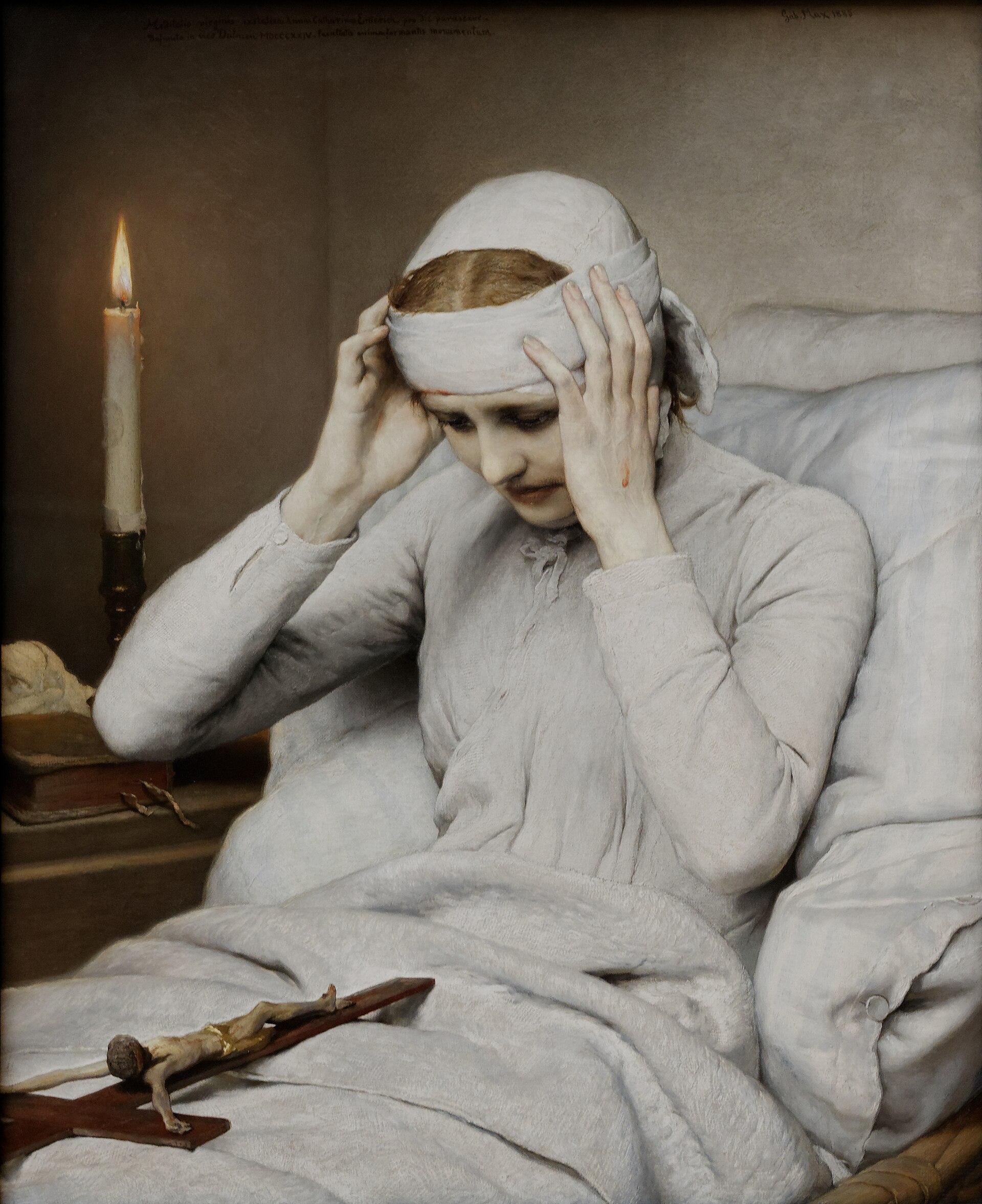
Anne Catherine Emmerich was a poor German nun who bore the stigmata and spent her last years in bed, speaking of what she said she saw: the life of Jesus, the Passion, and the life of Mary. The Church beatified her in 2004 for her holiness. It did not endorse the vision books. This is her story and a guide to everything recorded under her name, with the cautions stated plainly.
Who she was
Anna Katharina Emmerick was born on 8 September 1774 in Flamsche, a farming hamlet near Coesfeld in Westphalia, into a family that worked the land and had little else. She had almost no schooling. From childhood she said she saw things others did not: souls in Purgatory, the Child Jesus, scenes from the Gospels.
She entered the Augustinian convent at Agnetenberg in Dülmen in 1802 and made her vows the next year. The convent was suppressed in 1812, and she spent her remaining years in rented rooms, increasingly ill and bedridden. In 1813 marks resembling the wounds of Christ were reported on her hands, feet, and side. Church and civil authorities investigated more than once and found no fraud, though opinions stayed divided.
She died in Dülmen on 9 February 1824, at forty-nine. John Paul II declared her Venerable in 2001 and beatified her on 3 October 2004. Her feast is 9 February. She has not been canonized.
What the Church says about the visions
Start here, because everything else depends on it.
Private revelation is not public revelation. The faith was handed down once, in Christ, and no later vision adds to it. The Catechism is explicit: private revelations do not belong to the deposit of faith, and their role is to help people live the Gospel more fully. No one is obliged to believe them CCC 67 (tier 1 citation). The 2024 norms of the Dicastery for the Doctrine of the Faith say the same thing from the other side: even an approved devotion asks no assent of faith.
Her beatification was a judgment about her virtue, not about the visions. The Vatican's own officials said the books could not be used as evidence, because it was impossible to separate what came from her and what was added. One prefect of the causes of saints called the books the artistic work of the poet who wrote them down. The decree rested on her patience, her faith, and her charity.
Pious tradition, not doctrineSo the honest label is this: private revelation, recorded and edited by someone else, with real questions about how much of it is hers. Read them as devotional writing. Do not read them as a chronicle.
“They do not, however, belong to the deposit of faith.
”
The books, one by one
Almost everything published under her name comes through Clemens Brentano, a Romantic poet who interviewed her from 1818 until her death. He could not take notes in her presence and did not speak her Westphalian dialect, so he wrote from memory afterward, then edited for years. Later editors, above all Carl E. Schmöger, arranged the material into the volumes we have. The complete notebooks, thirty-eight volumes, were not published until 2009.
What follows is a guide to that whole body of material, grouped as it is usually printed.
The Dolorous Passion of Our Lord Jesus Christ (1833)
The best known book, and the one that shaped Mel Gibson's film. It follows the Last Supper, the agony, the arrest, the trials, the scourging, the way of the cross, and the death of Jesus, with a detail and a slowness meant for meditation. It is the most influential and the most contested of the books.
The Life of the Blessed Virgin Mary (1852)
Mary's ancestry, her Immaculate Conception, her birth, her childhood in the Temple, the annunciation, the Nativity, the flight into Egypt, and her later life. It ends with her death and with the house near Ephesus that her visions describe, a place later associated with a shrine.
The Life of Jesus Christ and Biblical Revelations (four volumes)
A day by day account of the public life, compiled by Schmöger from Brentano's papers.
- Volume I. Creation and the fall of the angels, Adam and Eve, the patriarchs and the Old Testament, and the line of Mary down to her birth.
- Volume II. The desert and the temptations, the marriage feast at Cana, the first Passover in Jerusalem, the Samaritan woman, the first years of preaching in Galilee, and the conversion of Mary Magdalene.
- Volume III. Preaching and miracles around Capernaum, the second conversion of Magdalene, the promise of the keys to Peter, the second Passover, and the raising of Lazarus.
- Volume IV. The Passion in full, then the Resurrection, the Ascension, Pentecost, and the life of Mary after the Ascension.
The Nativity of Our Lord Jesus Christ
A shorter book on the birth of Jesus, printed in English as early as 1899.
Mary Magdalen
A gathering of the visions that concern Mary Magdalene, drawn from the larger Life of Jesus Christ.
The Life and Revelations of Anne Catherine Emmerich (two volumes)
Schmöger's biography of her, with many visions of the lives of the saints, of Purgatory, and of things to come. This is the widest in subject matter and the least like the Gospel narratives.
The complete notebooks and the New Light series
The 2009 publication of Brentano's original notebooks made the whole record available for the first time, and recent English editions draw on them. The New Light series gathers the same material by theme: the Virgin Mary, the lives of the saints, Creation, the Old Testament, the inner life, and her own biography. These are the most textually careful editions, which is why serious readers prefer them.
What runs through all of it
Four threads appear again and again.
- The Passion. She returns to the suffering of Christ as the center of everything, which is why the Dolorous Passion has lasted.
- Mary. Her visions of Mary's life are intimate and domestic, and they fed a century of Marian devotion.
- The Eucharist and the priesthood. She speaks of the Mass as the center of the Church's life, a theme the Church has always taught.
- Purgatory and the hidden world. She describes souls being purified and the unseen struggle around us, always as a call to pray, never as a map.
How to read them without harm
Read them the way the Church reads any private revelation: as help for prayer, never as a fifth Gospel.
- Keep Scripture and the Catechism first. If a passage conflicts with the faith, the faith wins.
- Take the visions as pictures, not as records. They are meant to move the heart toward Christ.
- Do not build doctrine, dates, or predictions on them. The Church does not, and neither should you.
- If a passage troubles you, set it down. You owe it nothing.
The hard parts
Two problems are real and should be named.
The first is authenticity. Brentano was a poet, not a stenographer. He worked from memory, years later, and edited freely. Scholars comparing his notebooks to the printed books found maps, travel guides, and apocryphal sources among his papers. The Vatican did not rely on the books in her cause. That does not make them worthless. It does mean you cannot read them as a transcript.
The second is antisemitism. Some passages in the Brentano books carry hostile material about Jews, including the old and false charge of ritual murder. The Church has rejected this teaching plainly, and the Second Vatican Council taught that the Jews remain beloved of God and that what happened in the Passion cannot be charged to all Jews then or now (Nostra Aetate 4). Such passages are not revelation. They are the sediment of their time, and they should be refused, not repeated.
None of this takes away from her holiness, which the Church has recognized. It does mean that devotion to Blessed Anne Catherine should be devotion to the Christ she loved, not to every page that carries her name.
A short way to pray with her
If you want to use her writings well, keep it simple. Take one scene from the Passion, read it slowly, and stop. Ask for contrition and love. Then close the book and pray. The visions were never meant to replace prayer. They were meant to lead you into it.