Read a page of their writing.
E · Doctors of the Church
Saint Ambrose of Milan
The governor made bishop, who defended the faith, taught Augustine, and wrote hymns the Church still sings.
Memorial · 12-07
 book
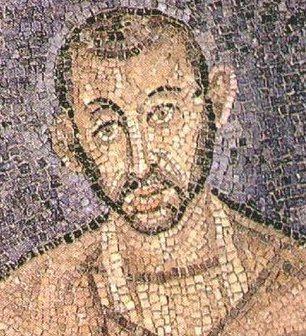
AmbroseOfMilan (cropped) Unknown - Public domain, via Wikimedia Commons
- Feast
- 12-07 · Memorial
- Patronage
- Milan, bishops, beekeepers, learning
- Era
- 4th century
- Region
- Milan
The life
The governor made bishop, who defended the faith, taught Augustine, and wrote hymns the Church still sings.
Ambrose of Milan (Latin: Aurelius Ambrosius; c. 339 – 4 April 397), canonized as Saint Ambrose, was a Roman theologian, statesman, preacher, and Bishop of Milan from 374 until his death. Trained in rhetoric and law, he served as Roman civil governor of Aemilia-Liguria at Milan before being unexpectedly chosen as bishop by popular acclamation in 374.
His preaching, ecclesiastical activity, and writings made him one of the most influential Christian figures of the 4th century. As bishop, Ambrose became a prominent defender of Christian orthodoxy, particularly against Arianism, while also attempting to mediate the conflict between the emperors Theodosius I and Magnus Maximus. " He was also a strong advocate of monasticism and asceticism, and his theological activity helped interpret and transmit Eastern Christian theology to the Latin West.
Ambrose left a substantial body of writings. Among his important works were De Virginibus (377), on the literal and metaphorical significance of virginity and purity; De Sacramentis, which contains the earliest witness to the present Roman Canon of the Mass; and the ethical treatise De officiis ministrorum (377–391), concerned especially with the conduct of the clergy. His exegetical writings include the Exameron (386–390).
Ambrose was also the author of at least four hymns, including "Veni redemptor gentium", which form the core of the corpus known as the Ambrosian hymns, alongside other hymns traditionally attributed to him. He exercised a notable influence on Augustine of Hippo, whom he helped convert to Christianity. In Western Christianity, Ambrose came to be recognized alongside Augustine, Jerome, and Pope Gregory the Great as one of the four Great Latin Church Fathers.
Why the Church remembers
Holiness is not a personality type. The Doctors are not a rank of importance but a recognition of service: their writing and holiness helped the Church understand and teach the faith. Their books are still worth opening.
Pray with them
Ask for light in your study or work.
Teach one truth gently to someone who needs it.
More in this family
Sources
| Tier | Reference |
|---|---|
| Tier 1 | Catechism of the Catholic Church, 946-962 (the communion of saints) (opens in new tab) |
| Tier 2 | Wikipedia, "Saint Ambrose of Milan" (biographical outline) (opens in new tab) |
Last reviewed: 2026-11-14