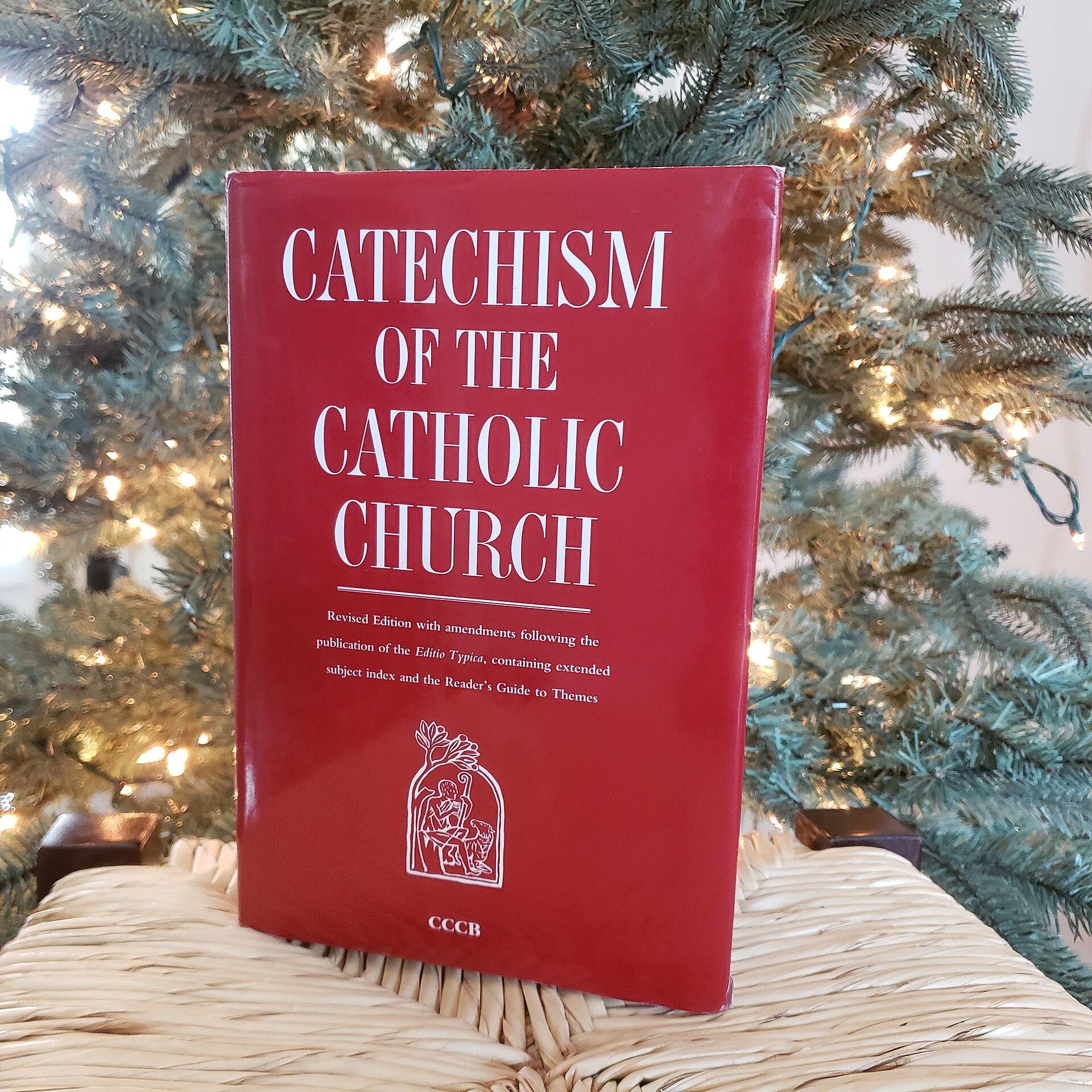
The Catechism of the Catholic Church is one book that gathers what the Catholic Church teaches, the whole of it, and numbers every paragraph so a person can point at a single sentence. It runs to 2,865 paragraphs in four parts: what the Church believes, what she celebrates in her liturgy, how her people are to live, and how they are to pray. Pope John Paul II published it on 11 October 1992 in the apostolic constitution Fidei Depositum, and he wrote of it: "I declare it to be a valid and legitimate instrument for ecclesial communion and a sure norm for teaching the faith" (FD IV).
The book came out of a request. In 1985 the bishops of the world, met in an extraordinary synod in Rome, asked "that a catechism or compendium of all Catholic doctrine regarding both faith and morals be composed" (CCC 10). A commission of cardinals and bishops spent six years writing the answer. The finished text was offered first to the bishops, then to the people who write catechisms, to priests and to catechists, and, in the Prologue's last words on the matter, to "all other Christian faithful" (CCC 12). The Catechism describes itself in one line: it "aims at presenting an organic synthesis of the essential and fundamental contents of Catholic doctrine, as regards both faith and morals" (CCC 11).
Its job is the same job the word catechism names
The Catechism is a tool for a task the Church calls catechesis, which means teaching the faith so that a person becomes a disciple. The Prologue gives the definition first: "Quite early on, the name catechesis was given to the totality of the Church's efforts to make disciples, to help men believe that Jesus is the Son of God so that believing they might have life in his name, and to educate and instruct them in this life, thus building up the body of Christ" (CCC 4).
Then it borrows a sharper sentence from John Paul II's 1979 exhortation on catechesis: "Catechesis is an education in the faith of children, young people and adults which includes especially the teaching of Christian doctrine imparted, generally speaking, in an organic and systematic way, with a view to initiating the hearers into the fullness of Christian life" (CCC 5, quoting Catechesi Tradendae 18). Notice the two words that matter most for a reference book: organic and systematic. A catechism is the part of this work that has to be in order, one thing after another, so nothing gets left out.
The Prologue also says this teaching is tied to the Church's whole life. "Catechesis is intimately bound up with the whole of the Church's life. Not only her geographical extension and numerical increase, but even more her inner growth and correspondence with God's plan depend essentially on catechesis" (CCC 7). A Catholic who cannot say what the Church believes has a problem the Church counts as hers.
“The whole concern of doctrine and its teaching must be directed to the love that never ends.
”
Why the bishops asked for one in 1985
The Catechism tells the story of its own need, and the story is a history of catechisms.
Great renewals in the Church have produced great teaching books. In the era of the Fathers, bishops who were also writers did this work themselves: Cyril of Jerusalem, John Chrysostom, Ambrose, and Augustine left catechetical writings that the Prologue calls "models for us" (CCC 8). Then the Council of Trent, meeting in the 1500s, put catechesis first in its constitutions and decrees, and the Prologue says of that council: "It lies at the origin of the Roman Catechism, which is also known by the name of that council and which is a work of the first rank as a summary of Christian teaching" (CCC 9). Trent also set off a wave of catechisms through bishops and theologians named in the same paragraph: Peter Canisius, Charles Borromeo, Turibius of Mongrovejo, Robert Bellarmine (CCC 9).
The modern run of events starts at the Second Vatican Council, which ended in 1965. The Prologue puts it this way: catechesis "has again attracted attention in the wake of the Second Vatican Council, which Pope Paul VI considered the great catechism of modern times" (CCC 10). The General Catechetical Directory followed in 1971, synod sessions on evangelization in 1974 and on catechesis in 1977, and the exhortations Evangelii Nuntiandi in 1975 and Catechesi Tradendae in 1979 (CCC 10). Bishops in 1985 asked for the compendium. John Paul II made their wish his own, saying "this desire wholly corresponds to a real need of the universal Church and of the particular Churches" (CCC 10).
The work the book had to do is stated in the letter that published it. Local catechisms "must take into account various situations and cultures, while carefully preserving the unity of faith and fidelity to Catholic doctrine" (FD IV). A text at the level of the whole Church gives bishops something to measure their own books against, which is what a Catholic abroad often cannot find otherwise.
How the text was drafted, and how it was approved
Fidei Depositum gives the process in a few sentences worth reading exactly.
The book "is the result of very extensive collaboration: it was prepared over six years of intense work done in a spirit of complete openness and fervent zeal" (FD II). Then the machinery: "In 1986 I entrusted a commission of 12 Cardinals and Bishops, chaired by Cardinal Joseph Ratzinger, with the task of preparing a draft of the catechism requested by the Synod Fathers. An editorial committee of seven diocesan Bishops, experts in theology and catechesis, assisted the commission in its work" (FD II). The commission "followed all the stages in editing the nine subsequent drafts," while the bishops who wrote the text weighed notes from "the Bishops of the whole world" (FD II).
The consultation was real, and the pope drew a conclusion from it. "It can be said that this catechism is the result of the collaboration of the whole Episcopate of the Catholic Church," he wrote, and "the harmony of so many voices truly expresses what could be called the symphony of the faith" (FD II).
Approval came in two steps. John Paul II approved the text on 25 June 1992 and ordered its publication "by virtue of my Apostolic Authority" on 11 October 1992 (FD IV). He calls it "a statement of the Church's faith and of Catholic doctrine, attested to or illumined by Sacred Scripture, Apostolic Tradition and the Church's Magisterium," and then declares it "a valid and legitimate instrument for ecclesial communion and a sure norm for teaching the faith" (FD IV). The date was chosen: 11 October 1992 was "the thirtieth anniversary of the opening of the Second Vatican Ecumenical Council," in the fourteenth year of his pontificate (FD V).
The next step took five more years. The 1992 text appeared first in French, and translations in other languages were made from it. On 15 August 1997 the same pope issued the apostolic letter Laetamur Magnopere to approve and promulgate the Latin edition, an edition "thus becom[ing] the definitive text of the aforementioned Catechism" (LM). A commission of cardinals and bishops, appointed in 1993 and again chaired by Ratzinger, worked through suggested changes that had "come from around the world and from various parts of the ecclesial community," and the Latin text "faithfully repeats the doctrinal content" of 1992 (LM). Existing translations then had to be corrected against the Latin, and English second editions followed (Wikipedia; LM).
If you buy or borrow a copy, this matters. Check that the title page says second edition or revised, which means the translators went through the 1997 Latin text.
The four parts, and what each one holds
The Prologue states the plan in one sentence: "The plan of this catechism is inspired by the great tradition of catechisms which build catechesis on four pillars: the baptismal profession of faith (the Creed), the sacraments of faith, the life of faith (the Commandments), and the prayer of the believer (the Lord's Prayer)" (CCC 13).
Fidei Depositum adds that the order is an old one: the Catechism "repeats the old, traditional order already followed by the Catechism of St Pius V, arranging the material in four parts: the Creed, the Sacred Liturgy, with pride of place given to the sacraments, the Christian way of life, explained beginning with the Ten Commandments, and finally, Christian prayer" (FD III). John Paul II put the whole thing in four verbs when he promulgated the Latin edition: it lets "everyone know what the Church professes, celebrates, lives, and prays in her daily life" (LM).
Those four verbs are the four parts, in that order, and the order carries a claim about how faith begins. The Catechism's first pages say that God "calls together all men, scattered and divided by sin, into the unity of his family, the Church," and that the treasure received from the apostles is handed on "by professing the faith, by living it in fraternal sharing, and by celebrating it in liturgy and prayer" (CCC 1, 3). A person hears the faith before he lives it, so belief comes first in the book.
Part One: The Profession of Faith (paragraphs 26-1065)
Part One begins with the word the Creed begins with. "We begin our profession of faith by saying: 'I believe' or 'We believe'" (CCC 26). Then the Catechism makes its first claim about every human being: "The desire for God is written in the human heart, because man is created by God and for God; and God never ceases to draw man to himself" (CCC 27).
From there it explains how God makes himself known (revelation), how the apostles passed that on (Tradition, and the Scriptures that flow from it), and what the word faith means for a person. The bulk of the part walks through the Apostles' Creed and then the Nicene Creed clause by clause: God the Father and creation, Jesus Christ, the Holy Spirit, the Church, the communion of saints, forgiveness, resurrection, life everlasting. It closes on the word that ends every creed: "Jesus Christ himself is the 'Amen'" (CCC 1065).
This is the part to read if your question is what Catholics actually say they believe, and how the Creed's sentences got their shape. The site's own account of the Church, with her claim to succession from the apostles, is at The Church.
Part Two: The Celebration of the Christian Mystery (paragraphs 1066-1690)
Part Two opens by naming what the Creed confessed: "the mystery of the Holy Trinity and of the plan of God's 'good pleasure' for all creation" (CCC 1066). Its subject is now the same mystery arriving through bodily signs. It covers what liturgy is and who acts in it, the seven sacraments, the Church's calendar and the Liturgy of the Hours, the blessings and sacred signs called sacramentals, and Christian funerals.
Two paragraphs are worth starting with. "The sacraments of Christian initiation - Baptism, Confirmation, and the Eucharist - lay the foundations of every Christian life" (CCC 1212). And on the Mass: "The Eucharist is 'the source and summit of the Christian life'" (CCC 1324). The part also defines the blessings and sacred objects Catholics use around a house as "sacred signs which bear a resemblance to the sacraments" (CCC 1667).
Read the site's pages on the sacraments and the sacramentals beside this part. Sacramentals are where the Catechism's teaching turns into the blessings and sacred objects a Catholic keeps in a house.
Part Three: Life in Christ (paragraphs 1691-2557)
Part Three opens with an address to the reader, borrowed from an ancient sermon: "Christian, recognize your dignity and, now that you share in God's own nature, do not return to your former base condition by sinning. Remember who is your head and of whose body you are a member" (CCC 1691). The paragraph after it explains the hinge between the parts: "What faith confesses, the sacraments communicate" (CCC 1692).
The first section of this part sets out the aim a Christian is living toward, which the Catechism calls beatitude (CCC 1716), then human freedom, the conscience a person must form, the passions, the virtues, and sin. "The dignity of the human person is rooted in his creation in the image and likeness of God," it says, and that dignity is "fulfilled in his vocation to divine beatitude" (CCC 1700). Quoting an older catechism, it defines the disposition morality is built on: "A virtue is an habitual and firm disposition to do the good," and the virtuous person "tends toward the good with all his sensory and spiritual powers" (CCC 1803). The four cardinal virtues, prudence, justice, fortitude, temperance, organize what follows. The part also states the reach of the demand: "All Christians in any state or walk of life are called to the fullness of Christian life and to the perfection of charity" (CCC 2013).
The second section walks the Ten Commandments, which is where catechesis becomes concrete about money, speech, parents, anger, marriage, and property. The site's account of what Catholics do about all of it is at What do Catholics do?, and the seven capital sins with their counter-virtues are treated at Sins and spiritual warfare.
Part Four: Christian Prayer (paragraphs 2558-2865)
The last part opens by gathering the other three into a single sentence. "Great is the mystery of the faith!" the Catechism writes, and then: "This mystery, then, requires that the faithful believe in it, that they celebrate it, and that they live from it in a vital and personal relationship with the living and true God. This relationship is prayer" (CCC 2558).
Part Four explains where prayer comes from (God's initiative, before any human effort), the ways the Old and New Testaments hand it on, the forms of prayer the Catechism sorts under blessing, adoration, petition, intercession, thanksgiving, and praise, then meditation and contemplation, and then a verse-by-verse commentary on the Our Father. The book's final paragraph sits on that prayer's closing word: "By the final 'Amen,' we express our 'fiat' concerning the seven petitions: 'So be it'" (CCC 2865).
For the whole of that part in one place, read How do Catholics pray? and Ways to pray.
What the book says about its own aim, and who it was written for
The Prologue answers both questions flatly, and the second answer is a ladder.
The aim: an "organic synthesis of the essential and fundamental contents of Catholic doctrine, as regards both faith and morals, in the light of the Second Vatican Council and the whole of the Church's Tradition," drawn from "the Sacred Scriptures, the Fathers of the Church, the liturgy, and the Church's Magisterium," meant to serve "as a point of reference for the catechisms or compendia that are composed in the various countries" (CCC 11).
The readers: "This work is intended primarily for those responsible for catechesis: first of all the bishops, as teachers of the faith and pastors of the Church" (CCC 12). From the bishops it goes to "redactors of catechisms, to priests, and to catechists," and the Prologue finally says it "will also be useful reading for all other Christian faithful" (CCC 12). Fidei Depositum widens that last step: the book "is offered to every individual who asks us to give an account of the hope that is in us (cf. 1 Pt 3:15) and who wants to know what the Catholic Church believes" (FD IV). A non-Catholic is included in the address.
It is also aimed at other Christians. The text is "meant to support ecumenical efforts that are moved by the holy desire for the unity of all Christians, showing carefully the content and wondrous harmony of the Catholic faith" (FD IV). You cannot have that conversation from a paraphrase. This book is what a Catholic will hand you instead of a description of himself.
How the paragraphs are built for use
Twenty-five paragraphs of Prologue come before any doctrine, and most of them tell a reader how to use the other 2,840. Six of those instructions are worth following.
Read it as one piece. "This catechism is conceived as an organic presentation of the Catholic faith in its entirety. It should be seen therefore as a unified whole," the Prologue says, and it points to its own apparatus: cross-references in the margin, "numbers found at the end of a sentence referring to other paragraphs that deal with the same theme," and an analytical index at the back (CCC 18). When one paragraph seems harsh, the margin numbers are the way to see what the same Catechism says elsewhere about it.
Follow the bare Bible references. Scripture is "often not quoted word for word but [is] merely indicated by a reference (cf.)," and the Prologue tells readers to go to the biblical passage itself and calls those references "a valuable working-tool in catechesis" (CCC 19). A paragraph with a cf. mark is half an argument until you read the verse.
Notice the small print. Smaller type flags two things: "observations of an historical or apologetic nature, or supplementary doctrinal explanations," and quotations "from patristic, liturgical, magisterial or hagiographical sources" chosen for direct catechetical use (CCC 20-21). A footnote-sized quote from a Father or a pope is not decoration. It is the evidence line.
Use the In Brief blocks. "At the end of each thematic unit, a series of brief texts in small italics sums up the essentials of that unit's teaching in condensed formulae," and the Prologue hopes these will "suggest to local catechists brief summary formulae that could be memorized" (CCC 22). If you want a first pass through the whole book, read the In Brief sections and nothing else. You will have the skeleton.
Know what it will not do for you. "By design, this Catechism does not set out to provide the adaptation of doctrinal presentations and catechetical methods required by the differences of culture, age, spiritual maturity, and social and ecclesial condition among all those to whom it is addressed," the Prologue warns. That work belongs "to particular catechisms and, even more, to those who instruct the faithful" (CCC 24). The book also says what it is for: "The Catechism emphasizes the exposition of doctrine. It seeks to help deepen understanding of faith," so that faith grows roots and shows up in conduct (CCC 23).
Remember where it wants to end. The Prologue's last paragraph quotes the Roman Catechism on the point of the whole exercise: "The whole concern of doctrine and its teaching must be directed to the love that never ends," so that anyone can see that every Christian virtue "spring[s] from love and ha[s] no other objective than to arrive at love" (CCC 25). This is why a teaching on sex or on money in Part Three should be read with the sentence about love at the end of the Prologue in mind.
What a Catholic owes these paragraphs
Whether these paragraphs count as dogma depends on the paragraph. The book gathers teachings that each carry their own weight, and Church law describes the weights.
Things contained in the word of God and proposed as divinely revealed "must [be] believe[d] with divine and Catholic faith," and the same is required of what the magisterium proposes definitively about faith and morals (can. 750 §1-§2). Below that sits a wide zone of authentic teaching. It asks something less than the assent of faith and still binds: "a religious submission of the intellect and will must be given to a doctrine which the Supreme Pontiff or the college of bishops declares concerning faith or morals when they exercise the authentic magisterium, even if they do not intend to proclaim it by definitive act" (can. 752). Bishops teaching in communion with Rome are "authentic teachers" to whom the faithful owe "religious submission of mind" (can. 753).
Two cautions come with this. Infallibility, in the strict sense, requires a definitive act, and "no doctrine is understood as defined infallibly unless this is manifestly evident" (can. 749 §3). Most of the Catechism's 2,865 paragraphs are not that kind of text, which is exactly why the book is useful to a non-Catholic: it lets you see which claims a Catholic is being asked to accept, and at which level.
What Fidei Depositum claims for the book is narrower than a definition. It is "a sure norm for teaching the faith" and "a valid and legitimate instrument for ecclesial communion" (FD IV), which is the job of a reference point. The Catechism states the rule about revelation close to its opening: "no new public revelation is to be expected before the glorious manifestation of our Lord Jesus Christ," and because Revelation "has not been made completely explicit, it remains for Christian faith gradually to grasp its full significance over the course of the centuries" (CCC 66). Private revelations, the next paragraph says, "do not belong, however, to the deposit of faith" (CCC 67). A book that recites those rules plainly intends to explain the deposit of faith rather than enlarge it. Read as a norm for teaching, the Catechism is doing what the pope who published it meant it to do.
Who owes the teaching, in the Church's law
Canon law belongs in this account for a practical reason. It names the people obliged to hand on the faith, and it explains why the book described here sits alongside the one your own diocese uses.
"It is a proper and grave duty especially of pastors of souls to take care of the catechesis of the Christian people," canon 773 says, and canon 774 §1 extends the duty to "all members of the Church according to each one's role." Parents are named first among the non-ordained: they "are obliged to form their children by word and example in faith and in the practice of Christian life" (can. 774 §2).
The bishop's part is where a catechism enters. It is his job to issue norms for catechesis and "to make provision that suitable instruments of catechetics are available, even by preparing a catechism if it seems opportune" (can. 775 §1). Bishops' conferences may publish catechisms for their territory, but only "with the previous confirmation of the Apostolic See" (can. 775 §2). That is the legal shape of the relationship between this Catechism and the one your children sat through.
A parish priest owes catechesis "for the celebration of the sacraments" and preparation of children for first confession, first communion and confirmation, and he is told to enrich those children "more fully and deeply" after communion, and to reach those with disabilities "insofar as their condition permits" (can. 777). Catechists themselves are owed training: local ordinaries must see that they "understand the doctrine of the Church appropriately" and learn method as well as content (can. 780).
One paragraph in the Catechism belongs here too, because it settles an argument people have about rosaries and medals. "Besides sacramental liturgy and sacramentals, catechesis must take into account the forms of piety and popular devotions among the faithful," it says, and the religious sense of the Christian people "finds expression in various forms of piety" surrounding the one liturgy (CCC 1674). The book that teaches the Creed also tells teachers to reckon with the devotions people actually practice. That is why this site has a whole section on sacramentals.
Shorter versions, and the one aimed at the young
The Catechism is not the only official version of itself.
John Paul II "in 2003, established a Commission under the presidency of Cardinal Joseph Ratzinger" to produce a compressed form, the Compendium of the Catechism of the Catholic Church. Two years of work went into a draft, the cardinals and the presidents of bishops' conferences were consulted, and the finished text was published in 2005. It has the same four parts and ends at question 598.
The Compendium's Introduction lists three characteristics: close reliance on the Catechism, a "dialogical format, reflecting the ancient catechetical literary genre of questions and answers," and the use of images, "drawn from the rich patrimony of Christian iconography," on the old conciliar principle that "images are also a preaching of the Gospel." Its status is explicit: it "is not a work that stands alone, nor is it intended in any way to replace the Catechism," and it is "meant to reawaken interest in and enthusiasm for the Catechism, which... always remains the basic text for catechesis in the Church today."
Many readers should start there, because the question-and-answer form is easier to hold in the head, and each answer carries the paragraph number of the longer text in the margin.
For young people there is YouCat, a catechism in question form published in 2011 for World Youth Day in Madrid, with a preface written by Pope Benedict XVI on 2 February 2011. The Church's own teaching books now cover an adult's full read, a portable summary, and a first version for a teenager.
Common ways people misread it
Treating a paragraph number as a page number. "CCC 1234" names the same paragraph in every edition and language; page numbers move. This is the single most useful habit to pick up.
Expecting one sentence to be the Catholic position. Paragraphs cross-reference each other on purpose (CCC 18). A claim about God's justice and a claim about his mercy sit in different parts of the book and are meant to be read together.
Reading Part Three as a rule list. It opens on happiness and dignity, and the commandments come last, as the specification of a life already given (CCC 1691-1692, 1700). The order of the part is the argument of the part.
Assuming the 1992 book replaced Vatican II. It was written "in the light of the Second Vatican Council" (CCC 11), and John Paul II placed it in a series of renewals after the liturgy and the codes of canon law, calling it "a very important contribution to that work of renewing the whole life of the Church" (FD V).
Assuming the Council's documents and the Catechism compete. The Catechism quotes them constantly and cites popes, councils, and Fathers in its small print precisely "to enrich the doctrinal presentations" (CCC 21). The footnote apparatus is the map back to the sources.
Using it as a gotcha book. Its own Prologue names love as the point of all doctrine (CCC 25), and its readership ladder ends with ordinary believers, not with opponents (CCC 12).
A first order of reading
If you want to know what the book is like rather than read it entire, this order gives you the shape of each part in about an hour.
- The Prologue, paragraphs 11-25. It is 25 paragraphs, and it teaches you how to use the other 2,840.
- Part One, 27-28: the desire for God, the Catechism's first claim about you.
- Part One, 150: "Faith is first of all a personal adherence of man to God," and, inseparably, "a free assent to the whole truth that God has revealed."
- Part Two, 1212 and 1324: the three sacraments of initiation, and the Eucharist as source and summit.
- Part Two, 1667 and 1674: sacramentals, and the devotions the Church tells teachers to reckon with.
- Part Three, 1691 and 1700: the address to the reader, and dignity rooted in the image of God.
- Part Three, 1803-1804 and 2013: what virtue is, and how far the demand reaches.
- Part Four, 2558-2561: what prayer is, and the claim that God seeks it first.
- The final paragraphs, 2858-2865, on the Our Father.
Then decide which part matches your actual question and go back through it with the margin numbers. Cite what you find as "CCC" plus the paragraph number, and anybody who knows the book can check you in a few seconds.
Where the full text is online
The Holy See's archive carries the whole Catechism in English, part by part, with the paragraph numbers intact. Part One covers the Creed, Part Two the sacraments, Part Three the commandments, and Part Four prayer, with the Prologue that explains the numbering and the small print.
For a printed copy, look for a second edition or later, since the 1997 Latin typical edition is the definitive text and the revisions after it corrected the translations made from the French (LM). Print editions carry the same paragraph numbers as the online text, so a note made in a book works in the web version and the other way around. The publication history has one practical upshot: the text is easy to reach, and John Paul II wanted it reached, which is why he called it a reference text for the Church's catechisms (FD IV).