The origin
The Father is the source of the whole Godhead: not made, not begotten, not one person among three rivals. The Son is eternally from him, and the Spirit proceeds from him.
The First Person · God the Father
Before the world, beyond the sky, and closer than your own breath.
Not a distant force. Not an old man in the sky. The Father of the Son, the creator who holds you, the Abba who waits.
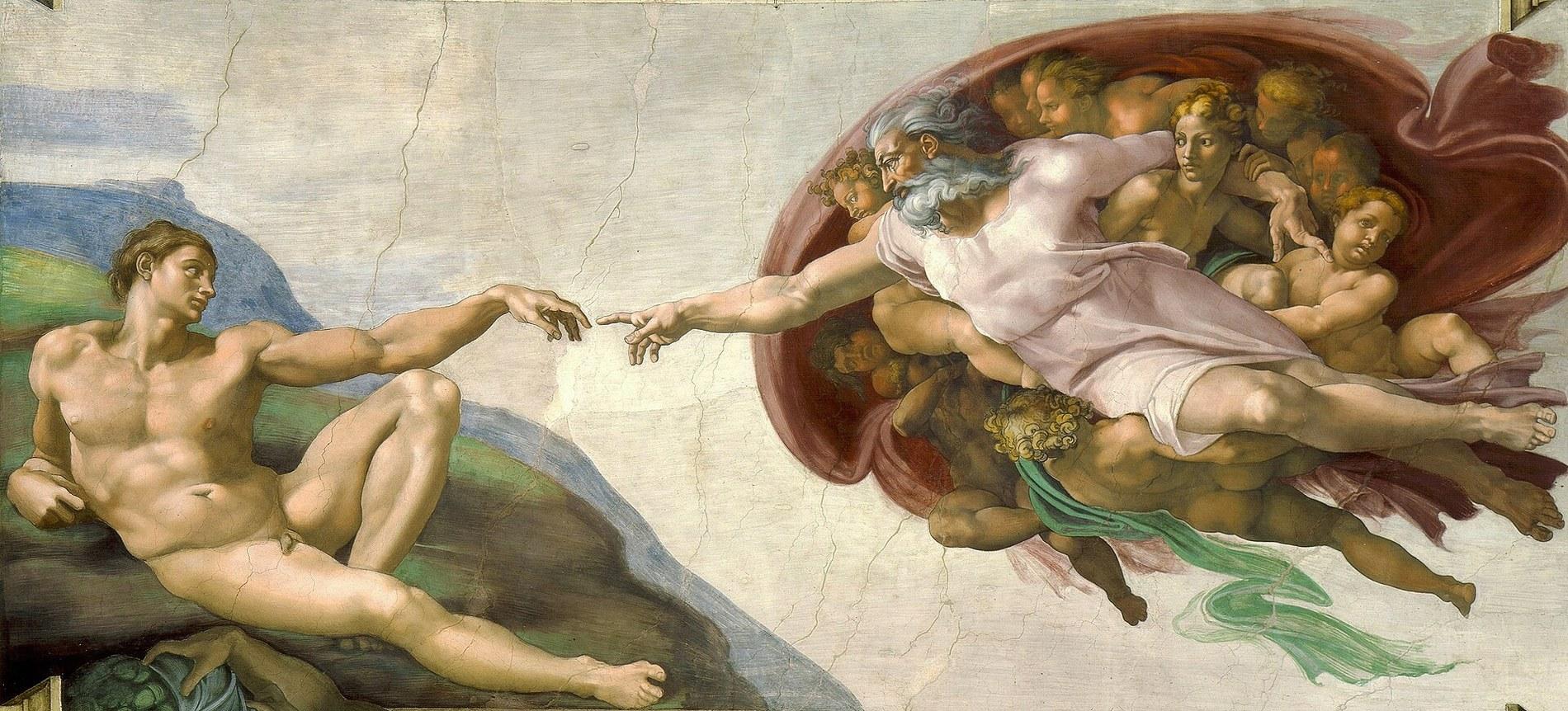
Cover: Michelangelo, The Creation of Adam, c. 1512. Public domain, via Wikimedia Commons.
The God who speaks
The Old Testament rarely calls God “Father,” and never in the familiar way Jesus does. Then the Son arrives and says: “Whoever has seen me has seen the Father” (Jn 14:9). The Father is not a hidden extra God behind Jesus. He is the one Jesus makes known.
The Father is the source of the whole Godhead: not made, not begotten, not one person among three rivals. The Son is eternally from him, and the Spirit proceeds from him.
Almighty does not mean raw force. It means no creature can stop his purpose, and no power can take you out of his hand. He is free, faithful, and near.
Everything that exists is his gift. Creation is not a machine left running; he holds it in being at every moment. Your next breath is not self-owned.
“The Father and I are one.”John 10:30
The long rescue
The Father does not reveal himself in a single idea. He reveals himself by making promises and keeping them, across centuries, with a stubborn people. Every covenant is a step toward the Son.
A promise of descendants and a land; a blessing for every family on earth.
A rescued people, a covenant at Sinai, and the Name spoken in fire.
A king after God's own heart, and a throne promised forever.
A faithful remnant, a new heart, and a covenant written inside.
The Son who fulfils every promise and makes the Father known.
The name Jesus gives
It is the word a child uses for a father, and Jesus lets his disciples use it too. The Spirit cries it in you: you are not a servant hoping for a hearing. You are a son or daughter who has been given access (Rom 8:15).
May his name be holy in us, not used as a slogan.
May his rule arrive where we actually live.
May his purpose be done on earth as in heaven.
Give us what we need today, not what we hoard.
As we forgive: the sentence we ask him to use.
Keep us from the test we cannot bear.
Break evil's claim and bring us home.
“Our Father, who art in heaven, hallowed be thy name.”Matthew 6:9
The parable of the prodigal son is really the parable of the father who runs. The son rehearses a speech; the father does not wait for it. He sees him “while he was still a long way off,” runs, embraces him, and calls for the robe and the ring (Lk 15:20-22). That is the Father Jesus came to show.
The Father’s house is not a reward for the impressive. It is the place where the hungry are fed and the lost are found. You do not clean yourself up first. You come home, and the Father does the rest.
References
Catechism paragraph numbers are stable across editions; Scripture is cited from the New American Bible, Revised Edition.