Sin has a definition, a shape, and a cure, and the Church states all three before she states any rule. She calls sin "an utterance, a deed, or a desire contrary to the eternal law", something that "wounds the nature of man and injures human solidarity" (CCC 1849). She says what it does over time: "Sin creates a proclivity to sin; it engenders vice by repetition of the same acts" (CCC 1865). And she names seven founts of that drift. They "are called 'capital' because they engender other sins, other vices. They are pride, avarice, envy, wrath, lust, gluttony, and sloth or acedia" (CCC 1866).
Against each of the seven the tradition sets a virtue, and the Catechism supplies the reason for the pairing: sins are sorted "according to the virtues they oppose" (CCC 1853), and so are vices (CCC 1866). That is why this page keeps the vice and the counter-virtue in the same paragraph. The seven are not arranged from worst to least worst. The list works as a map of how a person slides, and of the seven handles by which he is pulled back.
The fighting is not something you have to invent. "We pray as we live, because we live as we pray", and the Catechism says straight out that "prayer is a battle. Against whom? Against ourselves and against the wiles of the tempter who does all he can to turn man away from prayer, away from union with God" (CCC 2725). What follows is the diagnosis, the seven, the virtues that answer them, the actual limits of the devil, and the equipment the Church already puts in your hands.
Sin in the Church's own words
Start with the sentence most people expect last. "The Gospel is the revelation in Jesus Christ of God's mercy to sinners" (CCC 1846). The Catechism puts that before its definition of sin, and the order is the point. Grace "must uncover sin so as to convert our hearts", and the Catechism compares the work to a doctor's: "Like a physician who probes the wound before treating it, God, by his Word and by his Spirit, casts a living light on sin" (CCC 1848). It calls the result "a double gift: the gift of the truth of conscience and the gift of the certainty of redemption", and names the Spirit who does it "the Consoler" (CCC 1848).
The definition itself is short enough to carry: "Sin is an offense against reason, truth, and right conscience; it is failure in genuine love for God and neighbor caused by a perverse attachment to certain goods" (CCC 1849). Three things are in it. Sin is against reason, so it is not the same as enjoying something. It is a failure in love, so it is measured by what it does to a relationship. And it is caused by an attachment to a real good, twisted out of proportion, so it rarely looks like choosing evil for its own sake.
Then the vertical side. "Sin is an offense against God: 'Against you, you alone, have I sinned'" (CCC 1850, quoting Psalm 51). It "sets itself against God's love for us and turns our hearts away from it", and the Catechism links it to the first sin as a bid to be "like gods," determining good and evil for oneself. It quotes Augustine for the formula: sin is "love of oneself even to contempt of God" (CCC 1850). And it finishes the paragraph by setting that proud self-exaltation against "the obedience of Jesus, which achieves our salvation" (CCC 1850).
Two claims follow that a reader tends to find surprising.
The first is that the Passion, more than any list, is where the Church says sin shows itself. "It is precisely in the Passion, when the mercy of Christ is about to vanquish it, that sin most clearly manifests its violence and its many forms: unbelief, murderous hatred, shunning and mockery by the leaders and the people, Pilate's cowardice and the cruelty of the soldiers, Judas' betrayal... Peter's denial and the disciples' flight" (CCC 1851). Then, in the same paragraph, the turn: at that hour "the sacrifice of Christ secretly becomes the source from which the forgiveness of our sins will pour forth inexhaustibly" (CCC 1851). A Catholic who wants to see sin clearly is told to look at a cross rather than at a ledger.
The second is that honesty about sin is treated as a condition of mercy rather than an insult to it. The Catechism borrows Augustine's line on why God does not save you by force: "God created us without us: but he did not will to save us without us" (CCC 1847). Then it draws the consequence in its own words: "To receive his mercy, we must admit our faults" (CCC 1847). And it quotes John's letter: "If we say we have no sin, we deceive ourselves, and the truth is not in us. If we confess our sins, he is faithful and just, and will forgive our sins and cleanse us from all unrighteousness" (CCC 1847).
How many kinds of sin are there
"Many" is the answer, and the Catechism says so plainly: "There are a great many kinds of sins. Scripture provides several lists of them" (CCC 1852). It quotes the longest one, Galatians 5:19-21, which runs "fornication, impurity, licentiousness, idolatry, sorcery, enmity, strife, jealousy, anger, selfishness, dissension, factions, envy, drunkenness, carousing, and the like", and ends with St. Paul's warning that "those who do such things shall not inherit the Kingdom of God" (CCC 1852).
But the interesting part of CCC 1853 is that it gives you five different ways to sort sins before it names the root. You can classify a sin by its object, since "Sins can be distinguished according to their objects, as can every human act". Or by the virtue it opposes, "by excess or defect". Or by the commandment it breaks. Or by whether it concerns God, your neighbor, or yourself. Or as a sin "in thought, word, deed, or omission" (CCC 1853). Five grids over the same set of acts, which is why two good confessors can describe the same failure differently without contradicting each other.
Then the root: "The root of sin is in the heart of man, in his free will", quoted from Matthew 15:19, "For out of the heart come evil thoughts, murder, adultery, fornication, theft, false witness, slander" (CCC 1853). The Catechism adds the other half of the sentence, and it is easy to miss: "But in the heart also resides charity, the source of the good and pure works, which sin wounds" (CCC 1853). The heart is not depicted as a sewer with a lid on it. It is a place where two things live at once.
Why the Church grades sins
A Church that forgives everything also says some things are very serious, and she explains how she holds the two together. "Sins are rightly evaluated according to their gravity. The distinction between mortal and venial sin, already evident in Scripture, became part of the tradition of the Church", and the Catechism adds that this division "is corroborated by human experience" (CCC 1854).
The difference is stated by what each one does to charity, which the Catechism calls "the form of all the virtues" (CCC 1844). "Mortal sin destroys charity in the heart of man by a grave violation of God's law; it turns man away from God, who is his ultimate end and his beatitude, by preferring an inferior good to him. Venial sin allows charity to subsist, even though it offends and wounds it" (CCC 1855). One is death of the relationship; the other is injury inside a relationship that survives.
Then the three conditions, which are the sentences people most often quote and least often remember: "For a sin to be mortal, three conditions must together be met: 'Mortal sin is sin whose object is grave matter and which is also committed with full knowledge and deliberate consent'" (CCC 1857, quoting John Paul II, Reconciliatio et Paenitentia 17).
Grave matter is not left vague. It "is specified by the Ten Commandments, corresponding to the answer of Jesus to the rich young man: 'Do not kill, Do not commit adultery, Do not steal, Do not bear false witness, Do not defraud, Honor your father and your mother'" (CCC 1858). And it admits of degrees: "The gravity of sins is more or less great: murder is graver than theft. One must also take into account who is wronged: violence against parents is in itself graver than violence against a stranger" (CCC 1858).
Full knowledge "presupposes knowledge of the sinful character of the act, of its opposition to God's law", and complete consent "implies a consent sufficiently deliberate to be a personal choice" (CCC 1859). The Catechism then closes a loophole people invent for themselves: "Feigned ignorance and hardness of heart do not diminish, but rather increase, the voluntary character of a sin" (CCC 1859).
And the mitigations are real. This is where Catholic teaching is more humane than its reputation. "Unintentional ignorance can diminish or even remove the imputability of a grave offense", though "no one is deemed to be ignorant of the principles of the moral law, which are written in the conscience of every man", and "the promptings of feelings and passions can also diminish the voluntary and free character of the offense, as can external pressures or pathological disorders" (CCC 1860). The earlier section on freedom lists the same factors from the other side: "Imputability and responsibility for an action can be diminished or even nullified by ignorance, inadvertence, duress, fear, habit, inordinate attachments, and other psychological or social factors" (CCC 1735). Habit is on the list. So is fear.
The Catechism still says what the worst case is: "Sin committed through malice, by deliberate choice of evil, is the gravest" (CCC 1860). Then it draws the line of what mortal sin costs. It "results in the loss of charity and the privation of sanctifying grace, that is, of the state of grace. If it is not redeemed by repentance and God's forgiveness, it causes exclusion from Christ's kingdom and the eternal death of hell, for our freedom has the power to make choices for ever, with no turning back" (CCC 1861). And it appends a sentence that keeps this from becoming a private inquisition: "However, although we can judge that an act is in itself a grave offense, we must entrust judgment of persons to the justice and mercy of God" (CCC 1861).
Where venial sin is doing quiet work
Venial sin is defined twice, and the second definition is the one that matters in practice. You commit it "when, in a less serious matter, he does not observe the standard prescribed by the moral law, or when he disobeys the moral law in a grave matter, but without full knowledge or without complete consent" (CCC 1862). So a grave act without knowledge or consent is not mortal for that person.
What venial sin does is wear you down. It "weakens charity; it manifests a disordered affection for created goods; it impedes the soul's progress in the exercise of the virtues and the practice of the moral good; it merits temporal punishment", and, the key line, "Deliberate and unrepented venial sin disposes us little by little to commit mortal sin" (CCC 1863). It does "not break the covenant with God" and "With God's grace it is humanly reparable" (CCC 1863).
Augustine's pastoral logic on this is quoted at length in the same paragraph, and it is worth reading slowly: "While he is in the flesh, man cannot help but have at least some light sins. But do not despise these sins which we call 'light': if you take them for light when you weigh them, tremble when you count them. A number of light objects makes a great mass; a number of drops fills a river; a number of grains makes a heap. What then is our hope? Above all, confession" (CCC 1863).
The one sin that is not forgivable
Mark 3:29 is in the Catechism, and so is its explanation: "Whoever blasphemes against the Holy Spirit never has forgiveness, but is guilty of an eternal sin. There are no limits to the mercy of God, but anyone who deliberately refuses to accept his mercy by repenting, rejects the forgiveness of his sins and the salvation offered by the Holy Spirit" (CCC 1864). The unforgivable thing, on this reading, is not a rude thought about the Spirit. It is a refusal that will not let itself be healed: "Such hardness of heart can lead to final impenitence and eternal loss" (CCC 1864).
Two failures of hope sit near it, and the Catechism names them under the first commandment. "By despair, man ceases to hope for his personal salvation from God, for help in attaining it or for the forgiveness of his sins. Despair is contrary to God's goodness, to his justice - for the Lord is faithful to his promises - and to his mercy" (CCC 2091). And presumption comes in two kinds: "Either man presumes upon his own capacities, (hoping to be able to save himself without help from on high), or he presumes upon God's almighty power or his mercy (hoping to obtain his forgiveness without conversion and glory without merit)" (CCC 2092).
How a slide becomes a habit
This is the most useful paragraph in the whole section, and it is a mechanism rather than a moral. "Sin creates a proclivity to sin; it engenders vice by repetition of the same acts. This results in perverse inclinations which cloud conscience and corrupt the concrete judgment of good and evil. Thus sin tends to reproduce itself and reinforce itself, but it cannot destroy the moral sense at its root" (CCC 1865).
Three things are being claimed. Repeated acts build an inclination. The inclination then damages your perception, so the next act looks smaller than the last one was. And the damage is never total: "it cannot destroy the moral sense at its root" (CCC 1865). The summary puts the whole chain in one line: "The repetition of sins - even venial ones - engenders vices, among which are the capital sins" (CCC 1876).
The good news sits inside the same mechanism, in the mirror image. A virtue is "an habitual and firm disposition to do the good", and it "allows the person not only to perform good acts, but to give the best of himself" (CCC 1803). Human virtues "are acquired by human effort" and "are the fruit and seed of morally good acts" (CCC 1804). They "grow through education, deliberate acts, and perseverance in struggle", and then, so nobody despairs of the effort: "Divine grace purifies and elevates them" (CCC 1839). "Progress in virtue, knowledge of the good, and ascesis enhance the mastery of the will over its acts" (CCC 1734). And the Catechism is candid that the difficulty is structural after the fall: "It is not easy for man, wounded by sin, to maintain moral balance. Christ's gift of salvation offers us the grace necessary to persevere in the pursuit of the virtues" (CCC 1811).
Why "capital" means head, not heaviest
The Catechism gives the list and its authors together: the seven are identified "which Christian experience has distinguished, following St. John Cassian and St. Gregory the Great. They are called 'capital' because they engender other sins, other vices" (CCC 1866). The word's logic is Aquinas's: "The word capital is derived from 'caput' [a head]", used "metaphorically for a principle or director of others", so "a capital vice is one from which other vices arise, chiefly by being their final cause" (Summa Theologiae I-II q.84 a.3). Gregory himself, whom Aquinas is quoting there, "compares these capital vices to the 'leaders of an army'" (Moralia xxxi, 17).
Which is why the common name "deadly sin" is a little misleading, and the 1911 encyclopedia states the correction flatly: "It is not then the gravity of the vice in itself that makes it capital" (Catholic Encyclopedia, "Sin"). A capital vice is a headquarters. Some of them are not the heaviest sins a person can commit, and some of the heaviest are not capital at all.
Where the seven came from
The list has a history, and the Church does not hide it. A monk in the Egyptian desert, Evagrius Ponticus, "developed a comprehensive list in AD 375 of eight evil thoughts, or eight terrible temptations, from which all sinful behavior springs" (Wikipedia, "Evagrius Ponticus"). His eight were "gluttony, lust, greed, sadness, acedia [despondency], anger, vainglory, and pride", and he taught that they all sit on top of one more basic impulse: "The first thought of all is that of love of self; after this, the eight."
John Cassian carried the eight into Latin and into the monasteries of the West, "although Cassian never mentions Evagrius by name, since his reputation was already tainted" (Wikipedia, "Evagrius Ponticus"). Then in AD 590 "Pope Gregory I revised this list into the form that has become common" (Wikipedia, "Seven deadly sins"): he "combined acedia (despondency) with tristitia (sorrow), calling the combination the sin of sloth; vainglory with pride; and added envy" (Wikipedia, "Evagrius Ponticus"), and "removed superbia as it is the 'queen of all vices' leading other seven captains" (Wikipedia, "Seven deadly sins"). Thomas Aquinas "uses and defends Gregory's list in his Summa Theologica, although he calls them the 'capital sins'" (Wikipedia, "Seven deadly sins").
The Catechism's own order follows that settled list: "They are pride, avarice, envy, wrath, lust, gluttony, and sloth or acedia" (CCC 1866). Notice that the seven are not from a single verse. "They are not explicitly listed in the Bible but developed within early Christian theological tradition, drawing on various biblical passages" (Wikipedia, "Seven deadly sins"), and the Church is at peace about that: she calls them aids to self-knowledge, and the Catechism quotes Scripture's own longer lists right before naming them (CCC 1852-1853).
The virtues that answer them
The pairing is old, older than Gregory's revision, and it arrives through a poem. Prudentius' Psychomachia put virtues and vices in single combat, and "The success of this work popularised the concept of capital virtues among medieval authors" (Wikipedia, "Seven virtues"). The usual modern list runs: "The seven capital virtues, also known as seven lively virtues, contrary or remedial virtues, are those opposite to the seven deadly sins", enumerated "as chastity, temperance, charity, diligence, kindness, patience, and humility" (Wikipedia, "Seven virtues").
Two cautions before the table. First, the pairing is a devotional convention rather than dogma: scholars of the medieval period note that "the capital vices are more often contrasted with the remedial or contrary virtues in medieval moral literature than with the principal virtues" (Wikipedia, "Seven virtues", quoting Istvan P. Bejczy). Second, the Catechism supplies the deeper logic: vices and virtues are two answers to the same question, because the vices are listed "according to the virtues they oppose" (CCC 1866), and the four cardinal virtues are the frame the moral life hangs on: prudence, justice, fortitude, temperance (CCC 1805).
So each vice below carries two things: the remedy the tradition names, and the paragraphs where the Catechism actually gives it. Where the name of the virtue comes from the devotional list, it is labeled. Where the fix is the Catechism's own, the number is beside it.
“God created us without us: but he did not will to save us without us.
”
The seven, vice by vice
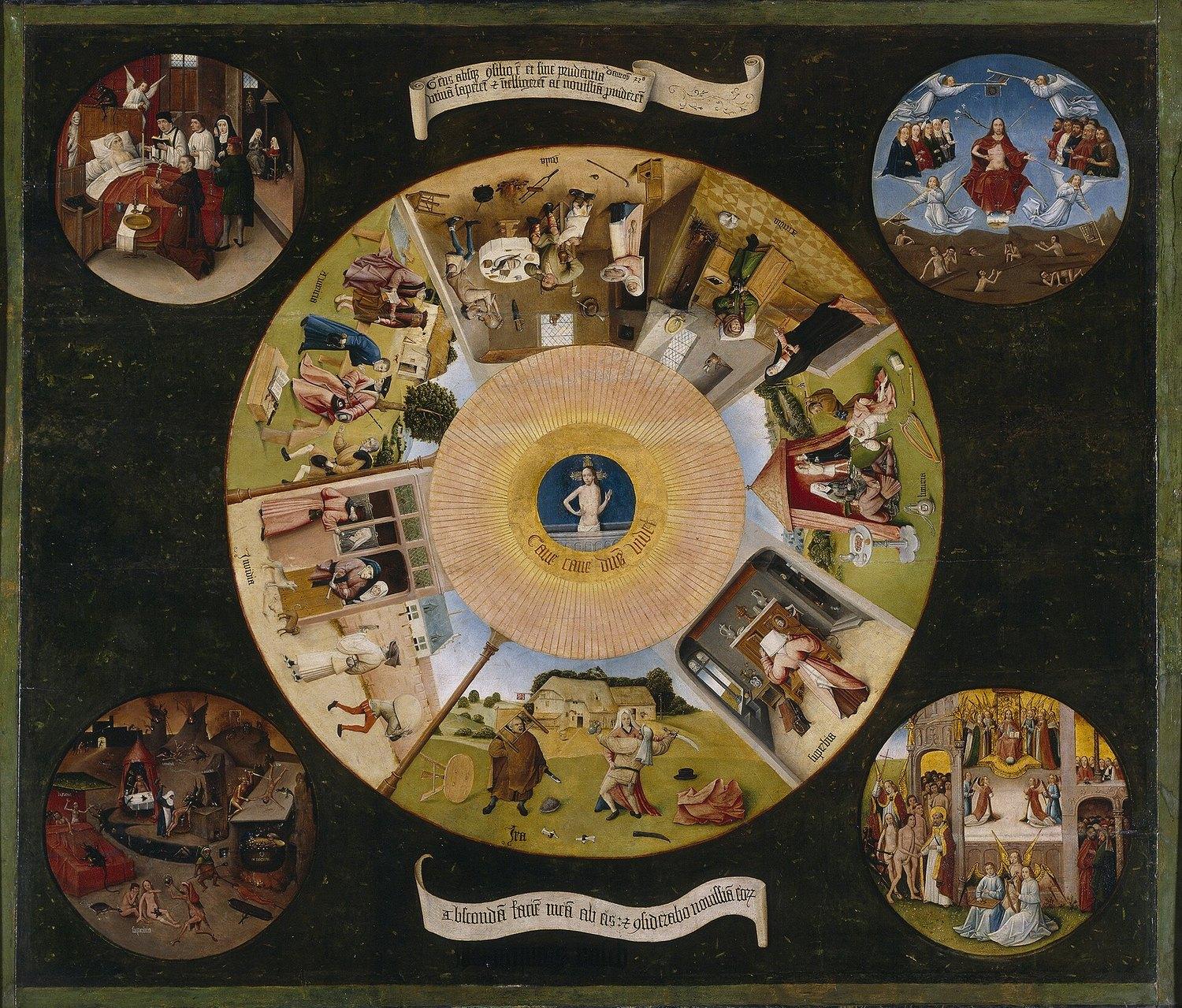
Pride, answered by humility
The oldest definition is the clearest. "Pride is the excessive love of one's own excellence" (Catholic Encyclopedia, "Pride"). The tradition puts it first because it reaches furthest: Thomas Aquinas, "endorsing the appreciation of St. Gregory, considers it the queen of all vices, and puts vainglory in its place as one of the deadly sins" (Catholic Encyclopedia, "Pride"). It breeds on contact: "Vainglory, ambition, and presumption are commonly enumerated as the offspring vices of pride" (Catholic Encyclopedia, "Pride").
In the Catechism the structure of pride is a wrong ranking. Sin is "an offense against reason, truth, and right conscience; it is failure in genuine love for God and neighbor caused by a perverse attachment to certain goods" (CCC 1849), and pride is that attachment running at full speed: my judgment about what is good installed above the one who made the good. The Catechism shows where that road ends, in one line under the first commandment: "hatred of God comes from pride. It is contrary to love of God, whose goodness it denies, and whom it presumes to curse as the one who forbids sins and inflicts punishments" (CCC 2094). Read that slowly. Pride can make a person experience God's goodness as a restriction and his commands as an injury.
The counter-virtue the list names is humility (Wikipedia, "Seven virtues"). The Catechism's own word for it is more concrete: "The Word speaks of voluntary humility as 'poverty in spirit'" (CCC 2546). It then gives the reasoning behind the practice. Jesus "enjoins his disciples to prefer him to everything and everyone, and bids them 'renounce all that [they have]' for his sake and that of the Gospel" (CCC 2544), and the faithful are to "direct their affections rightly, lest they be hindered in their pursuit of perfect charity by the use of worldly things and by an adherence to riches which is contrary to the spirit of evangelical poverty" (CCC 2545). Humility shows up as where you put yourself when somebody else is preferred.
Try this line for the daily practice. "Let the proud seek and love earthly kingdoms, but blessed are the poor in spirit for theirs is the Kingdom of heaven" (CCC 2547, quoting Augustine). The Catechism attaches a psychological observation to it: "Abandonment to the providence of the Father in heaven frees us from anxiety about tomorrow. Trust in God is a preparation for the blessedness of the poor" (CCC 2547). Humility shows up as less anxiety, because you have stopped running the world.
Avarice, answered by liberality and charity
What it actually is. The tenth commandment "forbids greed and the desire to amass earthly goods without limit. It forbids avarice arising from a passion for riches and their attendant power", and the Catechism quotes the Roman Catechism on the appetite: "Our thirst for another's goods is immense, infinite, never quenched. Thus it is written: 'He who loves money never has money enough'" (CCC 2536). The 1911 definition is shorter: "the inordinate love for riches" (Catholic Encyclopedia, "Avarice").
Its respectability is the danger. Avarice "often cloaks itself as a virtue, or insinuates itself under the pretext of making a decent provision for the future" (Catholic Encyclopedia, "Avarice"). The Catechism is on the same track from the other side: the desires the commandment is watching are "good in themselves; but often they exceed the limits of reason and drive us to covet unjustly what is not ours" (CCC 2535). So planning, saving and providing are fine. The problem is the point where provision tips into greed and gets called prudence.
The old catechesis named the jobs. "Traditional catechesis realistically mentions 'those who have a harder struggle against their criminal desires'", listing "merchants who desire scarcity and rising prices, who cannot bear not to be the only ones buying and selling", "those who hope that their peers will be impoverished, in order to realize a profit", "physicians who wish disease to spread; lawyers who are eager for many important cases and trials" (CCC 2537). The wishing is the fault here. Nobody in the list is charged with setting a price.
The counter-virtue the list names is charity (Wikipedia, "Seven virtues"); the tradition more often says liberality or detachment, and the Catechism gives it as a command with a reason: "The precept of detachment from riches is obligatory for entrance into the Kingdom of heaven" (CCC 2544), repeated in its summary as "Detachment from riches is necessary for entering the Kingdom of heaven. 'Blessed are the poor in spirit.'" (CCC 2556).
The practice the Catechism pushes hardest is almsgiving. "Among all these, giving alms to the poor is one of the chief witnesses to fraternal charity: it is also a work of justice pleasing to God" (CCC 2447), and the list it sits in is concrete: "feeding the hungry, sheltering the homeless, clothing the naked, visiting the sick and imprisoned, and burying the dead" (CCC 2447). Love for the poor "is a part of her constant tradition", and it "extends not only to material poverty but also to the many forms of cultural and religious poverty" (CCC 2444). John Paul II gave the vice a social shape: "the all-consuming desire for profit" and "the thirst for power, with the intention of imposing one's will upon others", with the added expression "at any price" (Sollicitudo Rei Socialis 37). If you want one test for avarice, ask what you are willing to do "at any price".
Envy, answered by kindness
The definition and the diagnosis. "Envy is sadness at the sight of another's goods and the immoderate desire to have them for oneself. It is a capital sin" (CCC 2553), stated at greater length as "the sadness at the sight of another's goods and the immoderate desire to acquire them for oneself, even unjustly. When it wishes grave harm to a neighbor it is a mortal sin" (CCC 2539). The 1911 article puts its malice precisely: "Its distinctive malice comes from the opposition it implies to the supreme virtue of charity" (Catholic Encyclopedia, "Jealousy"). Augustine called it "the diabolical sin" (CCC 2539), and Gregory the Great listed what grows out of it: "From envy are born hatred, detraction, calumny, joy caused by the misfortune of a neighbor, and displeasure caused by his prosperity" (CCC 2539).
Scripture's own case study. The tenth commandment "requires that envy be banished from the human heart", and the Catechism recalls Nathan's parable: the rich man with great flocks who "envied the poor man and ended by stealing his lamb" (CCC 2538). Then the warning: "Envy can lead to the worst crimes", and "Through the devil's envy death entered the world" (CCC 2538). Chrysostom's line, quoted in the same paragraph, is the most useful thing in it for a parish, a family or a religious community: "If everyone strives to unsettle the Body of Christ, where shall we end up? ... We declare ourselves members of one and the same organism, yet we devour one another like beasts" (CCC 2538).
The sharpest end. "Jealousy is most evil when one repines at another's spiritual good. It is then said to be a sin against the Holy Ghost" (Catholic Encyclopedia, "Jealousy"). Envy about someone's promotion is common. Envy about someone's holiness, their peace, their answer in prayer, or the love they receive from God, is the version the tradition calls diabolical, because it grieves at charity itself. The encyclopedia also clears a space that scrupulous people lose: legitimate emulation is exempt, "I shall be not jealous but rather laudably emulous" (Catholic Encyclopedia, "Jealousy"). Wanting their good for yourself is not envy. Being sorry they have it is.
The counter-virtue the list names is kindness (Wikipedia, "Seven virtues"). The Catechism's prescription is three words: "The baptized person combats envy through good-will, humility, and abandonment to the providence of God" (CCC 2554). Note the second one. "Envy often comes from pride; the baptized person should train himself to live in humility" (CCC 2540). The cure is therefore aimed upstream. Chrysostom supplies the exercise: "Would you like to see God glorified by you? Then rejoice in your brother's progress and you will immediately give glory to God" (CCC 2540). Deliberate delight at good news about a rival is the training. Patience and kindness are also in the Catechism's list of what the Spirit grows in you: "charity, joy, peace, patience, kindness, goodness, generosity, gentleness, faithfulness, modesty, self-control, chastity" (CCC 1832).
Wrath, answered by patience
The Catechism separates anger from sinful anger, and it is more careful than most people expect. "Anger is a desire for revenge. 'To desire vengeance in order to do evil to someone who should be punished is illicit,' but it is praiseworthy to impose restitution 'to correct vices and maintain justice'" (CCC 2302). The 1911 article says the same from the other direction: "When these are in conformity with the prescriptions of balanced reason, anger is not a sin. It is rather a praiseworthy thing and justifiable with a proper zeal" (Catholic Encyclopedia, "Anger"). So indignation at an injustice is not the fault. Getting even is.
Where it becomes mortal. "If anger reaches the point of a deliberate desire to kill or seriously wound a neighbor, it is gravely against charity; it is a mortal sin" (CCC 2302), and the sentence it cites from Jesus is the one people quote at other people: "Everyone who is angry with his brother shall be liable to judgment" (CCC 2302). Deliberate hatred is a distinct act: "Hatred of the neighbor is a sin when one deliberately wishes him evil. Hatred of the neighbor is a grave sin when one deliberately desires him grave harm" (CCC 2303). The counter-word Christ gives in the same paragraph is a practice, not a feeling: "But I say to you, Love your enemies and pray for those who persecute you, so that you may be sons of your Father who is in heaven" (CCC 2303).
The counter-virtue the list names is patience (Wikipedia, "Seven virtues"), and the Catechism files it under the works of mercy: "Instructing, advising, consoling, comforting are spiritual works of mercy, as are forgiving and bearing wrongs patiently" (CCC 2447). Bearing wrongs patiently is the test case. It is easy to be patient with a stranger's mistake and almost impossible to be patient with a debt you believe you are owed.
Wrath has a public form, and the Catechism names it. "Scandal is an attitude or behavior which leads another to do evil. the person who gives scandal becomes his neighbor's tempter. He damages virtue and integrity; he may even draw his brother into spiritual death" (CCC 2284). Unhoused anger tends to go public as contempt, mockery, or a rule written to hurt somebody. Christ's own warning about that is the millstone: "Whoever causes one of these little ones who believe in me to sin, it would be better for him to have a great millstone fastened round his neck and to be drowned in the depth of the sea" (CCC 2285).
And the goal it misses is peace, which the Catechism defines with real content: "Peace is not merely the absence of war... Peace cannot be attained on earth without safeguarding the goods of persons, free communication among men, respect for the dignity of persons and peoples, and the assiduous practice of fraternity. Peace is 'the tranquillity of order.' Peace is the work of justice and the effect of charity" (CCC 2304). Then the Christological anchor: "Earthly peace is the image and fruit of the peace of Christ, the messianic 'Prince of Peace'... 'He is our peace.' He has declared: 'Blessed are the peacemakers'" (CCC 2305).
Lust, answered by chastity
Start with what chastity is, because the reputation of both words is wrong. "Chastity means the successful integration of sexuality within the person and thus the inner unity of man in his bodily and spiritual being", and sexuality "becomes personal and truly human when it is integrated into the relationship of one person to another, in the complete and lifelong mutual gift of a man and a woman. The virtue of chastity therefore involves the integrity of the person and the integrality of the gift" (CCC 2337). This is a teaching about unity, and it is why the Catechism can put chastity inside the tenth commandment at all: it is about how you want, and about whom you want.
Why the vice is listed as capital. "The pleasure which this vice has as its object is at once so attractive and connatural to human nature as to whet keenly a man's desire, and so lead him into the commission of many other disorders in the pursuit of it" (Catholic Encyclopedia, "Lust"). Lust earns its rank because of its draft: it drags attention, honesty, and money and time along with it.
The honest description of what it does to a life. "The chaste person maintains the integrity of the powers of life and love placed in him... It tolerates neither a double life nor duplicity in speech" (CCC 2338). The alternative is stated as a fork, and the Catechism does not soften it: "either man governs his passions and finds peace, or he lets himself be dominated by them and becomes unhappy" (CCC 2339). Chastity "comes under the cardinal virtue of temperance, which seeks to permeate the passions and appetites of the senses with reason" (CCC 2341).
The means, given as a list you can actually use. "Whoever wants to remain faithful to his baptismal promises and resist temptations will want to adopt the means for doing so: self-knowledge, practice of an ascesis adapted to the situations that confront him, obedience to God's commandments, exercise of the moral virtues, and fidelity to prayer" (CCC 2340). Two cautions come with it. Self-mastery "is a long and exacting work. One can never consider it acquired once and for all. It presupposes renewed effort at all stages of life" (CCC 2342), and growth is honestly uneven: "Chastity has laws of growth which progress through stages marked by imperfection and too often by sin" (CCC 2343). Then the sentence that keeps the whole thing from becoming willpower: chastity "is also a gift from God, a grace, a fruit of spiritual effort. The Holy Spirit enables one whom the water of Baptism has regenerated to imitate the purity of Christ" (CCC 2345).
Purity of heart is the deeper layer. "The heart is the seat of moral personality: 'Out of the heart come evil thoughts, murder, adultery, fornication....'" (CCC 2517). The sixth beatitude is then read as a requirement and a promise at once: "Blessed are the pure in heart, for they shall see God" (CCC 2518), and "Pure in heart" is explained in three registers: "chiefly in three areas: charity; chastity or sexual rectitude; love of truth and orthodoxy of faith" (CCC 2518). "Purity of heart is the precondition of the vision of God. Even now it enables us to see according to God, to accept others as 'neighbors'; it lets us perceive the human body - ours and our neighbor's - as a temple of the Holy Spirit, a manifestation of divine beauty" (CCC 2519).
The practice for someone already baptized and already struggling. Baptism "confers on its recipient the grace of purification from all sins. But the baptized must continue to struggle against concupiscence of the flesh and disordered desires", and the Catechism again lists means: purity of intention, "purity of vision, external and internal", "discipline of feelings and imagination", refusal of "complicity in impure thoughts", and prayer (CCC 2520). The prayer it quotes is Augustine's, and it is the most disarming sentence in the whole chapter: "I thought that continence arose from one's own powers, which I did not recognize in myself... no one can be continent unless you grant it" (CCC 2520). Modesty belongs here, and it is defined as protection rather than policing: "Modesty protects the intimate center of the person. It means refusing to unveil what should remain hidden... It guides how one looks at others and behaves toward them in conformity with the dignity of persons and their solidarity" (CCC 2521).
Gluttony, answered by temperance
The vice is about excess, and the appetite is not the fault. "The sensitive appetite leads us to desire pleasant things we do not have, e.g., the desire to eat when we are hungry or to warm ourselves when we are cold. These desires are good in themselves; but often they exceed the limits of reason" (CCC 2535). The 1911 definition: gluttony is "the excessive indulgence in food and drink" (Catholic Encyclopedia, "Gluttony").
The tradition's test is a set of five adverbs. It distinguishes the ways of offending: eating "too soon, too expensively, too much, too eagerly, too daintily" (Catholic Encyclopedia, "Gluttony"). The last two are the interesting ones. "Too eagerly" is about the inner posture, and "too daintily" about the demand for refinement. Then the encyclopedia's own bottom line: "one who uses food or drink in such a way as to injure his health or impair the mental equipment needed for the discharge of his duties, is guilty of the sin of gluttony" (Catholic Encyclopedia, "Gluttony").
Gravity, stated fairly. "Gluttony is in general a venial sin in so far forth as it is an undue indulgence in a thing which is in itself neither good nor bad" (Catholic Encyclopedia, "Gluttony"). That is the mercy side. The severity side is in the Catechism: temperance "disposes us to avoid every kind of excess: the abuse of food, alcohol, tobacco, or medicine. Those incur grave guilt who, by drunkenness or a love of speed, endanger their own and others' safety on the road, at sea, or in the air" (CCC 2290). Note that this paragraph widens the vice past food, and includes medicine and driving. The Catechism also calls the drug trade "scandalous practices" and its use "except on strictly therapeutic grounds... a grave offense" (CCC 2291). Paul's line, quoted in the 1911 article, is the verse people remember: "whose god is their belly" (Catholic Encyclopedia, "Gluttony", quoting Phil 3:19).
The counter-virtue is temperance, one of the four cardinal virtues the moral life hangs on (CCC 1805), and "self-control" is on the list of what the Spirit produces (CCC 1832). Two disciplines lie close by, and this site has pages for both: saying grace before meals, which puts the appetite inside a relationship of thanks (Grace at meals), and the Friday fast, which the Catechism names as a season and day of penance together with almsgiving (CCC 1438).
There is a spiritual gluttony, and the tradition takes it seriously. The 1911 article, drawing on John of the Cross, describes people who expect consolations on demand and "will feel and taste God, as if he were palpable and accessible to them" (Catholic Encyclopedia, "Gluttony"). Read that next to the dryness section of prayer, where the Catechism lists "discouragement during periods of dryness" as one of the ordinary failures of prayer (CCC 2728). Wanting to feel God is not the same as wanting God.
Sloth and acedia, answered by diligence and hope
The hardest one to name, and the easiest to have. The Catechism defines it under the first commandment as part of what refuses God's love: "acedia or spiritual sloth goes so far as to refuse the joy that comes from God and to be repelled by divine goodness" (CCC 2094). The 1911 article gives the technical definition: sloth is "sadness in the face of some spiritual good which one has to achieve (Tristitia de bono spirituali)", and the article explains the Greek word plainly: acedia "means the don't-care feeling. A man apprehends the practice of virtue to be beset with difficulties and chafes under the restraints imposed by the service of God" (Catholic Encyclopedia, "Sloth"). The sentence worth keeping is the diagnosis: "The idea of right living inspires not joy but disgust, because of its laboriousness" (Catholic Encyclopedia, "Sloth"). And its offense is against the main thing: "In this sense sloth is directly opposed to charity" (Catholic Encyclopedia, "Sloth").
Why it is not laziness. Rest, tiredness, and pace limits are not this vice. Acedia is a sorrow about the good itself, so it survives a full night's sleep. Gregory's revision is exactly this merge: he "combined acedia (despondency) with tristitia (sorrow), calling the combination the sin of sloth" (Wikipedia, "Evagrius Ponticus"). That is why the seventh slot carries so many faces: procrastination, resentment at prayer, carelessness about the sacraments, dropping a resolution the week it is made, and a flat reading of Scripture.
A line you should read twice if you are tired. The Catechism treats psychological illness as a different category from possession and from moral fault, and it says the consequences are medical: "Illness, especially psychological illness, is a very different matter; treating this is the concern of medical science" (CCC 1673). It also softens the charge where a disorder is involved: "the promptings of feelings and passions can also diminish the voluntary and free character of the offense, as can external pressures or pathological disorders" (CCC 1860), and "Imputability and responsibility for an action can be diminished or even nullified by ignorance, inadvertence, duress, fear, habit, inordinate attachments, and other psychological or social factors" (CCC 1735). A symptom is not a capital sin. Get the help; the diagnosis belongs to a doctor.
The counter-virtue the list names is diligence (Wikipedia, "Seven virtues"), and the Catechism adds the theological one, hope, with a functional description: hope "keeps man from discouragement; it sustains him during times of abandonment; it opens up his heart in expectation of eternal beatitude" (CCC 1818). Then its military line, which is the reason sloth is a battle-word and not a personality trait: "Hope is also a weapon that protects us in the struggle of salvation" (CCC 1820). Hope "is expressed and nourished in prayer, especially in the Our Father" (CCC 1820). For the small hours, Teresa of Ãvila's line is quoted in the Catechism itself: "Hope, O my soul, hope. You know neither the day nor the hour. Watch carefully, for everything passes quickly, even though your impatience makes doubtful what is certain, and turns a very short time into a long one" (CCC 1821).
The practical answer is smallness. Sloth is beaten by a dose too small to resent. The Catechism's own schedule for penance is deliberately modest in each instance: Lent and "each Friday in memory of the death of the Lord", "voluntary self-denial such as fasting and almsgiving", and "fraternal sharing" (CCC 1438). A daily examen of ten minutes belongs to the same strategy (The daily examen).
Using the seven as an instrument
Do not try to be guilty about all seven. The list is a diagnostic, and it works by reaction. Read the seven names in the Catechism's order, "pride, avarice, envy, wrath, lust, gluttony, and sloth or acedia" (CCC 1866), and notice which one you flinch at, which one you immediately explain, and which one you find interesting rather than uncomfortable. The vice you defend is usually the one you have. The vice you find boring is usually the one hiding behind it.
Two cautions on the instrument itself. The seven names are no ranking of weight. "It is not then the gravity of the vice in itself that makes it capital" (Catholic Encyclopedia, "Sin"): a capital vice is a headquarters. And nobody carries all seven at equal strength, which is why the site's quiz exists as a starting point rather than a verdict (Which deadly sin am I most likely to fall into?). Take whatever it points at into the examen, and then into confession, where the Catechism's advice on repetition applies: the confession of venial faults "without being necessary in itself, is nevertheless strongly recommended by the Church" (CCC 1493).
Sins against faith, hope, and love
The seven capital vices are sins against neighbor, self, and the body. The Catechism keeps a separate shelf for sins aimed straight at God, and it lists them under the first commandment, which is where the whole moral life starts. A person "must turn away from" these, in the order the Catechism gives them.
Against faith. "There are various ways of sinning against faith: Voluntary doubt about the faith disregards or refuses to hold as true what God has revealed and the Church proposes for belief" (CCC 2088). The Catechism is careful with the involuntary kind, and this sentence has helped a great many people who thought they had lost the faith: "Involuntary doubt refers to hesitation in believing, difficulty in overcoming objections connected with the faith, or also anxiety aroused by its obscurity. If deliberately cultivated doubt can lead to spiritual blindness" (CCC 2088). The doubt that worries you is usually the one that has not been cultivated. Then the harder lines: "Incredulity is the neglect of revealed truth or the willful refusal to assent to it", and, quoting the Code of Canon Law, "Heresy is the obstinate post-baptismal denial of some truth which must be believed with divine and catholic faith, or it is likewise an obstinate doubt concerning the same; apostasy is the total repudiation of the Christian faith; schism is the refusal of submission to the Roman Pontiff or of communion with the members of the Church subject to him" (CCC 2089, quoting canon 751). Note the qualifier "obstinate". The law is about a fixed refusal, and it names the repentance that unfixes it.
Against hope. "The first commandment is also concerned with sins against hope, namely, despair and presumption" (CCC 2091). "By despair, man ceases to hope for his personal salvation from God, for help in attaining it or for the forgiveness of his sins. Despair is contrary to God's goodness, to his justice - for the Lord is faithful to his promises - and to his mercy" (CCC 2091). Presumption has two faces, and the second one is the more common in practice: "Either man presumes upon his own capacities, (hoping to be able to save himself without help from on high), or he presumes upon God's almighty power or his mercy (hoping to obtain his forgiveness without conversion and glory without merit)" (CCC 2092).
Against charity. "One can sin against God's love in various ways", and the Catechism gives five, in a sequence that reads like a slide: "indifference neglects or refuses to reflect on divine charity; it fails to consider its prevenient goodness and denies its power. ingratitude fails or refuses to acknowledge divine charity and to return him love for love. lukewarmness is hesitation or negligence in responding to divine love; it can imply refusal to give oneself over to the prompting of charity. acedia or spiritual sloth goes so far as to refuse the joy that comes from God and to be repelled by divine goodness. hatred of God comes from pride" (CCC 2094). Read the first three again. Indifference, ingratitude, lukewarmness. Almost nobody recognizes themselves in "hatred of God," and a great many recognize themselves in lukewarmness, which is where the Catechism says the road to it begins.
Sins that cry to heaven, and the sin of putting others down
The list the catechetical tradition kept. "The catechetical tradition also recalls that there are 'sins that cry to heaven': the blood of Abel, The sin of the Sodomites, The cry of the people oppressed in Egypt, The cry of the foreigner, the widow, and the orphan, injustice to the wage earner" (CCC 1867). Read that row slowly. It is short, and four of the five are sins against other people, including one about wages. These are ordinary offenses: violence, exploitation, and the cry of people Scripture says God actually hears.
Scandal is the Catechism's word for leading someone else into sin, and it is aimed first at people with influence. "Scandal is an attitude or behavior which leads another to do evil. the person who gives scandal becomes his neighbor's tempter. He damages virtue and integrity; he may even draw his brother into spiritual death. Scandal is a grave offense if by deed or omission another is deliberately led into a grave offense" (CCC 2284). It "takes on a particular gravity by reason of the authority of those who cause it or the weakness of those who are scandalized", which is why the Catechism says it "is grave when given by those who by nature or office are obliged to teach and educate others" (CCC 2285). Then the application list, and it is not abstract: scandal "can be provoked by laws or institutions, by fashion or opinion", and "they are guilty of scandal who establish laws or social structures leading to the decline of morals and the corruption of religious practice", including "business leaders who make rules encouraging fraud, teachers who provoke their children to anger, or manipulators of public opinion who turn it away from moral values" (CCC 2286). The closing sentence puts power and responsibility together: "Anyone who uses the power at his disposal in such a way that it leads others to do wrong becomes guilty of scandal and responsible for the evil that he has directly or indirectly encouraged" (CCC 2287).
Social sin and the structures people leave behind
The Church insists the unit is a person. "Sin, in the proper sense, is always a personal act, since it is an act of freedom on the part of an individual person and not properly of a group or community" (Reconciliatio et Paenitentia 16). The Catechism opens the same way: "Sin is a personal act", and then it adds the obligation most spiritual writing skips: "we have a responsibility for the sins committed by others when we cooperate in them" (CCC 1868). The four modes of cooperation are worth reading as a test: "by participating directly and voluntarily in them; by ordering, advising, praising, or approving them; by not disclosing or not hindering them when we have an obligation to do so; by protecting evil-doers" (CCC 1868). Silence and approval are on the list. So is looking away.
Then the Catechism explains how personal sins harden into a situation. "Thus sin makes men accomplices of one another and causes concupiscence, violence, and injustice to reign among them. Sins give rise to social situations and institutions that are contrary to the divine goodness. 'Structures of sin' are the expression and effect of personal sins. They lead their victims to do evil in their turn. In an analogous sense, they constitute a 'social sin'" (CCC 1869). John Paul II draws the same line and keeps the person in the center of it: "From one point of view, every sin is personal; from another point of view, every sin is social insofar as and because it also has social repercussions", and "At the heart of every situation of sin are always to be found sinful people" (Reconciliatio et Paenitentia 16). That is also the hope in the account: structures are made by people, so they can be unmade by people.
John Paul II named the two master structures. He insisted that "'structures of sin'... are rooted in personal sin, and thus always linked to the concrete acts of individuals who introduce these structures, consolidate them and make them difficult to remove" (Sollicitudo Rei Socialis 36). The two he isolated are "the all-consuming desire for profit" and "the thirst for power, with the intention of imposing one's will upon others", and to characterize each of these attitudes "one can add the expression: 'at any price'" (Sollicitudo Rei Socialis 37). Then he names the only thing that beats them, and it is a habit of the will rather than a policy: "a commitment to the good of one's neighbor with the readiness, in the gospel sense, to 'lose oneself' for the sake of the other" (Sollicitudo Rei Socialis 38).
The Catechism refuses both cowardice. Institutional change and conversion of heart go together, in that order: "It is necessary, then, to appeal to the spiritual and moral capacities of the human person and to the permanent need for his inner conversion, so as to obtain social changes that will really serve him", and the priority of the heart "in no way eliminates but on the contrary imposes the obligation of bringing the appropriate remedies to institutions and living conditions when they are an inducement to sin" (CCC 1888). Wrong structures do real damage to real holiness: the inversion of means and ends "engenders unjust structures which 'make Christian conduct in keeping with the commandments of the divine Law-giver difficult and almost impossible'" (CCC 1887). And the middle path is narrow: "Without the help of grace, men would not know how 'to discern the often narrow path between the cowardice which gives in to evil, and the violence which under the illusion of fighting evil only makes it worse.' This is the path of charity... Charity is the greatest social commandment" (CCC 1889).
The diagnosis John Paul II gave his own time is the sentence people still quote: "the sin of the century is the loss of the sense of sin" (Reconciliatio et Paenitentia 18), and "When the conscience is weakened the sense of God is also obscured" (Reconciliatio et Paenitentia 18). If you find it hard to name wrong as wrong, the Catechism has already told you what is happening and what to do about it.
The conscience that has to be formed
Everything above assumes you can tell right from wrong in a concrete case. That faculty has a name, a job, and a history of going wrong, and the Catechism treats it at length. If you read one part of this page twice, read this part.
What conscience is. "Deep within his conscience man discovers a law which he has not laid upon himself but which he must obey... For man has in his heart a law inscribed by God... His conscience is man's most secret core and his sanctuary. There he is alone with God whose voice echoes in his depths" (CCC 1776, quoting Gaudium et Spes 16). Then the working definition: "Moral conscience, present at the heart of the person, enjoins him at the appropriate moment to do good and to avoid evil. It also judges particular choices, approving those that are good and denouncing those that are evil" (CCC 1777). And a cooler, third description: "Conscience is a judgment of reason whereby the human person recognizes the moral quality of a concrete act that he is going to perform, is in the process of performing, or has already completed" (CCC 1778). The same paragraph quotes Newman: "Conscience is the aboriginal Vicar of Christ" (CCC 1778).
It is a hearing capacity, and hearing takes quiet. "It is important for every person to be sufficiently present to himself in order to hear and follow the voice of his conscience. This requirement of interiority is all the more necessary as life often distracts us from any reflection, self-examination or introspection: Return to your conscience, question it.... Turn inward, brethren, and in everything you do, see God as your witness" (CCC 1779, quoting Augustine). This is the doctrinal reason the Church keeps recommending a short daily review of the day. Without interiority there is nothing to hear (The daily examen).
Conscience is no permission slip, and the Catechism says so twice. It "includes the perception of the principles of morality... their application in the given circumstances by practical discernment of reasons and goods; and finally judgment about concrete acts yet to be performed or already performed" (CCC 1780). The truth about the moral good "is recognized practically and concretely by the prudent judgment of conscience. We call that man prudent who chooses in conformity with this judgment" (CCC 1780). Then the obligation, stated flatly: "A human being must always obey the certain judgment of his conscience. If he were deliberately to act against it, he would condemn himself" (CCC 1790). And the clause that keeps the two from collapsing into each other: "Conscience can remain in ignorance or make erroneous judgments. Such ignorance and errors are not always free of guilt" (CCC 1801).
How conscience goes blind. "This ignorance can often be imputed to personal responsibility. This is the case when a man 'takes little trouble to find out what is true and good, or when conscience is by degrees almost blinded through the habit of committing sin'" (CCC 1791, quoting Gaudium et Spes 16). The list of sources is a warning label: "Ignorance of Christ and his Gospel, bad example given by others, enslavement to one's passions, assertion of a mistaken notion of autonomy of conscience, rejection of the Church's authority and her teaching, lack of conversion and of charity: these can be at the source of errors of judgment in moral conduct" (CCC 1792). Two of those are structural rather than emotional. A conscience that insists it answers to nobody, and a conscience that has stopped listening to the Church, appear here among the causes of error.
And where the person is not at fault. "If - on the contrary - the ignorance is invincible, or the moral subject is not responsible for his erroneous judgment, the evil committed by the person cannot be imputed to him", with a clause nobody enjoys: "It remains no less an evil, a privation, a disorder. One must therefore work to correct the errors of moral conscience" (CCC 1793). The Catechism holds both things at once. Real invincible ignorance excuses the person of guilt, and it does not make the act good.
Formation is a lifelong task with named means. "Conscience must be informed and moral judgment enlightened. A well-formed conscience is upright and truthful", and "the education of conscience is indispensable for human beings who are subjected to negative influences and tempted by sin to prefer their own judgment and to reject authoritative teachings" (CCC 1783). "The education of the conscience is a lifelong task", and this part is pastorally sharp: prudent education "prevents or cures fear, selfishness and pride, resentment arising from guilt, and feelings of complacency, born of human weakness and faults", and it "guarantees freedom and engenders peace of heart" (CCC 1784). The means arrive in one sentence: "In the formation of conscience the Word of God is the light for our path, we must assimilate it in faith and prayer and put it into practice. We must also examine our conscience before the Lord's Cross. We are assisted by the gifts of the Holy Spirit, aided by the witness or advice of others and guided by the authoritative teaching of the Church" (CCC 1785). The advice of other people and the teaching of the Church appear there as aids, and "A good and pure conscience is enlightened by true faith" (CCC 1794).
The sentence for anybody who has done real damage. "For the man who has committed evil, the verdict of his conscience remains a pledge of conversion and of hope" (CCC 1797). The same idea appears earlier at greater length: "the just judgment of conscience can remain within him as the witness to the universal truth of the good, at the same time as the evil of his particular choice. the verdict of the judgment of conscience remains a pledge of hope and mercy. In attesting to the fault committed, it calls to mind the forgiveness that must be asked, the good that must still be practiced, and the virtue that must be constantly cultivated with the grace of God" (CCC 1781). A conscience that still accuses you has not gone blind. The duty, in one line: "Everyone must avail himself of the means to form his conscience" (CCC 1798).
Freedom, and how much a person is actually on the hook
The Church grades guilt instead of stamping everyone with it, and the reason is her account of freedom. Freedom is "the power, rooted in reason and will, to act or not to act, to do this or that, and so to perform deliberate actions on one's own responsibility. By free will one shapes one's own life" (CCC 1731). It is real and it is still developing in us: "As long as freedom has not bound itself definitively to its ultimate good which is God, there is the possibility of choosing between good and evil, and thus of growing in perfection or of failing and sinning" (CCC 1732). Then the paradox worth memorizing: "The more one does what is good, the freer one becomes. There is no true freedom except in the service of what is good and just. the choice to disobey and do evil is an abuse of freedom and leads to 'the slavery of sin'" (CCC 1733).
Responsibility tracks voluntariness: "Freedom makes man responsible for his acts to the extent that they are voluntary. Progress in virtue, knowledge of the good, and ascesis enhance the mastery of the will over its acts" (CCC 1734). Then the list that keeps moral teaching from becoming a hammer: "Imputability and responsibility for an action can be diminished or even nullified by ignorance, inadvertence, duress, fear, habit, inordinate attachments, and other psychological or social factors" (CCC 1735). Habit is there. Fear is there. So are other people.
There is also a distinction between what you willed and what merely happened. "An effect can be tolerated without being willed by its agent; for instance, a mother's exhaustion from tending her sick child. A bad effect is not imputable if it was not willed either as an end or as a means of an action, e.g., a death a person incurs in aiding someone in danger" (CCC 1737). And a person can be guilty through carelessness: "An action can be indirectly voluntary when it results from negligence regarding something one should have known or done" (CCC 1736).
When the conscience accuses falsely
Scrupulosity is a common pastoral problem with a precise name. The 1911 encyclopedia defines it as "An unfounded apprehension and consequently unwarranted fear that something is a sin which, as a matter of fact, is not" (Catholic Encyclopedia, "Scruple"). It is a fault of the judgment rather than a delicate conscience, and the article calls it "a bad habit doing harm, sometimes grievously, to body and soul" which "makes shipwreck of salvation either on the Scylla of despair or the Charybdis of unheeding indulgence in vice" (Catholic Encyclopedia, "Scruple").
The remedy is the one directors still give: "having reposed confidence in some confessor, to obey his decisions and commands entirely and absolutely", together with "avoid idleness", and guard against "the reading of ascetical books of a rigorist trend" and "intercourse with those afflicted in the same way" (Catholic Encyclopedia, "Scruple"). If your moral life has become a schedule of anxieties, that is the treatment: one stable confessor, real obedience to his judgment, less reading about sin, and less time alone with the question. Pair it with the Catechism on despair and presumption (CCC 2091-2092). The call to interiority in CCC 1779 is a call to examine, and never to examine without end.
Temptation, and how to tell one from the other
Most of what people fear about temptation is a misunderstanding, and the Catechism corrects it inside the Our Father. "This petition goes to the root of the preceding one, for our sins result from our consenting to temptation; we therefore ask our Father not to 'lead' us into temptation", and the Catechism notes the awkward verb: "the Greek means both 'do not allow us to enter into temptation' and 'do not let us yield to temptation.' 'God cannot be tempted by evil and he himself tempts no one'; on the contrary, he wants to set us free from evil" (CCC 2846). "We are engaged in the battle 'between flesh and spirit'; this petition implores the Spirit of discernment and strength" (CCC 2846).
Three distinctions, and they solve most cases. "The Holy Spirit makes us discern between trials, which are necessary for the growth of the inner man, and temptation, which leads to sin and death. We must also discern between being tempted and consenting to temptation. Finally, discernment unmasks the lie of temptation, whose object appears to be good, a 'delight to the eyes' and desirable, when in reality its fruit is death" (CCC 2847). Hardship is not the same as temptation. Being baited is not the same as consenting, which is why being disturbed by a bad thought is a different moral fact from doing the thought.
Then the sentence that reframes the whole experience. The Catechism quotes a long passage on the usefulness of being tested: "God does not want to impose the good, but wants free beings.... There is a certain usefulness to temptation. No one but God knows what our soul has received from him, not even we ourselves. But temptation reveals it in order to teach us to know ourselves, and in this way we discover our evil inclinations and are obliged to give thanks for the goods that temptation has revealed to us" (CCC 2847). Temptation is information about you. That is also why the examen works.
The promise attached to the petition. "'Lead us not into temptation' implies a decision of the heart: 'For where your treasure is, there will your heart be also.... No one can serve two masters.' ... In this assent to the Holy Spirit the Father gives us strength. 'No testing has overtaken you that is not common to man. God is faithful, and he will not let you be tempted beyond your strength, but with the temptation will also provide the way of escape, so that you may be able to endure it'" (CCC 2848). No test arrives that is unique to you, and none arrives without an exit.
And the exit is prayer, because this is a fight. "Such a battle and such a victory become possible only through prayer. It is by his prayer that Jesus vanquishes the tempter, both at the outset of his public mission and in the ultimate struggle of his agony... In this petition to our heavenly Father, Christ unites us to his battle and his agony. He urges us to vigilance of the heart in communion with his own. Vigilance is 'custody of the heart,' and Jesus prayed for us to the Father: 'Keep them in your name.' The Holy Spirit constantly seeks to awaken us to keep watch. Finally, this petition takes on all its dramatic meaning in relation to the last temptation of our earthly battle; it asks for final perseverance. 'Lo, I am coming like a thief! Blessed is he who is awake'" (CCC 2849). Read this next to the Catechism's earlier line on prayer as a career: "prayer is a battle. Against whom? Against ourselves and against the wiles of the tempter who does all he can to turn man away from prayer, away from union with God. We pray as we live, because we live as we pray" (CCC 2725). For the actual methods, see Ways to pray.
Why the struggle never finishes in this life. Baptism "confers on its recipient the grace of purification from all sins", and yet "the baptized must continue to struggle against concupiscence of the flesh and disordered desires" (CCC 2520). The Catechism's anthropological note explains the remainder: original sin leaves human nature "wounded in the natural powers proper to it, subject to ignorance, suffering and the dominion of death, and inclined to sin - an inclination to evil that is called concupiscence. Baptism, by imparting the life of Christ's grace, erases original sin and turns a man back towards God, but the consequences for nature, weakened and inclined to evil, persist in man and summon him to spiritual battle" (CCC 405). Unwarmed-up assumption about yourself is the first thing this paragraph removes.
And the ignorance of it has consequences beyond the personal. "By our first parents' sin, the devil has acquired a certain domination over man, even though man remains free. Original sin entails 'captivity under the power of him who thenceforth had the power of death, that is, the devil'. Ignorance of the fact that man has a wounded nature inclined to evil gives rise to serious errors in the areas of education, politics, social action and morals" (CCC 407). Every naive program for perfecting human beings runs into this sentence.
What the Church teaches about the devil, and what she refuses
The teaching is narrow, and it has edges. "Scripture and the Church's Tradition see in this being a fallen angel, called 'Satan' or the 'devil'. The Church teaches that Satan was at first a good angel, made by God: 'The devil and the other demons were indeed created naturally good by God, but they became evil by their own doing'" (CCC 391). The fall is described as a choice of a particular kind: "This 'fall' consists in the free choice of these created spirits, who radically and irrevocably rejected God and his reign. We find a reflection of that rebellion in the tempter's words to our first parents: 'You will be like God.' The devil 'has sinned from the beginning'; he is 'a liar and the father of lies'" (CCC 392). The reason there is no forgiveness for it is stated carefully: "It is the irrevocable character of their choice, and not a defect in the infinite divine mercy, that makes the angels' sin unforgivable" (CCC 393).
The two sentences that should govern any interest in this topic. First, on his strength: "The power of Satan is, nonetheless, not infinite. He is only a creature, powerful from the fact that he is pure spirit, but still a creature. He cannot prevent the building up of God's reign. Although Satan may act in the world out of hatred for God and his kingdom in Christ Jesus, and although his action may cause grave injuries - of a spiritual nature and, indirectly, even of a physical nature - to each man and to society, the action is permitted by divine providence which with strength and gentleness guides human and cosmic history. It is a great mystery that providence should permit diabolical activity, but 'we know that in everything God works for good with those who love him'" (CCC 395). Second, on the petition: "In this petition, evil is not an abstraction, but refers to a person, Satan, the Evil One, the angel who opposes God. the devil (dia-bolos) is the one who 'throws himself across' God's plan and his work of salvation accomplished in Christ" (CCC 2851).
Where the victory is already located. "Victory over the 'prince of this world' was won once for all at the Hour when Jesus freely gave himself up to death to give us his life. This is the judgment of this world, and the prince of this world is 'cast out'" (CCC 2853). The practical conclusion the Catechism draws, quoting Ambrose, is the one to keep on the wall: "The Lord who has taken away your sin and pardoned your faults also protects you and keeps you from the wiles of your adversary the devil, so that the enemy, who is accustomed to leading into sin, may not surprise you. One who entrusts himself to God does not dread the devil. 'If God is for us, who is against us?'" (CCC 2852). And the Mass itself prays the deliverance petition as the Church's own complaint about the whole human situation: "Deliver us, Lord, we beseech you, from every evil and grant us peace in our day, so that aided by your mercy we might be ever free from sin and protected from all anxiety" (CCC 2854, quoting the Roman embolism).
Two mistakes, and the Catechism blocks both. The first is to treat the devil as a myth, since the prayer the Church prays every week names him: "In this petition, evil is not an abstraction, but refers to a person, Satan, the Evil One, the angel who opposes God. the devil (dia-bolos) is the one who 'throws himself across' God's plan and his work of salvation accomplished in Christ" (CCC 2851). The second is to hand him a size he does not have. If reading about him has made him feel larger than God, that second mistake has already been made for you, and the answer is CCC 395. The comparisons on this site show where the second error turns up in real devotion: Conspiracy decoding versus discernment, Spirit guides versus angels, Ghost hunting versus prayer for the dead, Smudging versus holy water.
Possession, exorcism, and the discipline around both
The definition, with its limits inside it. "When the Church asks publicly and authoritatively in the name of Jesus Christ that a person or object be protected against the power of the Evil One and withdrawn from his dominion, it is called exorcism. Jesus performed exorcisms and from him the Church has received the power and office of exorcizing. In a simple form, exorcism is performed at the celebration of Baptism. the solemn exorcism, called 'a major exorcism,' can be performed only by a priest and with the permission of the bishop. the priest must proceed with prudence, strictly observing the rules established by the Church" (CCC 1673). Then the sentence most people skip: "Illness, especially psychological illness, is a very different matter; treating this is the concern of medical science. Therefore, before an exorcism is performed, it is important to ascertain that one is dealing with the presence of the Evil One, and not an illness" (CCC 1673).
Canon law, and the reason for the rule. In 1985 the Congregation for the Doctrine of the Faith wrote to every bishop restating the canon: "no one can legitimately perform exorcisms over the possessed unless he has obtained special and express permission from the local Ordinary", and "this permission should be granted by the local Ordinary only to priests who are endowed with piety, knowledge, prudence and integrity of life" (CDF, Letter to Ordinaries regarding norms on Exorcism, 1985, quoting canon 1172). The rule exists to stop private enterprise, and the letter says so in the negative: "it is not even licit that the faithful use the formula of exorcism against Satan and the fallen angels", the formula extracted from the one published by order of Leo XIII, "and even less that they use the integral text of this exorcism" (CDF 1985). Bishops were asked to watch a third thing, "even in cases that do not concern true demonic possession": meetings run by people without the faculty where "invocations, to obtain release, are uttered in which demons are questioned directly and their identity sought to be known" (CDF 1985). Asking demons names is the practice the letter names as dangerous. And the same letter guards the other direction, since the warning "should in no way distance the faithful from praying that, as Jesus taught us, they may be delivered from evil" (CDF 1985).
How the rite is regulated today. The current discipline is set out in the rite "De Exorcismis et Supplicationibus Quibusdam", and "The Catholic Church revised the Rite of Exorcism in January 1999", while "The traditional Rite of Exorcism in Ecclesiastical Latin remains as an option" (Wikipedia, "Exorcism in the Catholic Church"). A solemn exorcism requires "the express permission of the local bishop" and can be authorized "only after a careful medical examination to exclude the possibility of mental illness" (Wikipedia, "Exorcism in the Catholic Church"). The same source records the ordinary judgment of experienced exorcists: "some people need only spiritual or medical help, especially if drugs or other addictions are present, and not exorcism" (Wikipedia, "Exorcism in the Catholic Church"). This is the most reassuring fact in the topic: the Church's professionals expect the vast majority of apparent cases to need something else.
What an ordinary Catholic is permitted to do. Nothing on the major-exorcism side, and a great deal on the prayer side. The Church's ordinary protections belong to everyone: holy water, the blessing of a home or an object, the scapulars and medals, and the Prayer to St. Michael said as a private devotion rather than as a rite. Three pages answer the questions people actually ask: Minor and solemn exorcism: who may do what, Deliverance prayer: what lay people may pray, and Discerning oppression: priest, doctor, and calm. The reason none of these works like a machine is stated in the Catechism: "Sacramentals do not confer the grace of the Holy Spirit in the way that the sacraments do, but by the Church's prayer, they prepare us to receive grace and dispose us to cooperate with it" (CCC 1670). They "dispose" a person; they do not switch God on.
How the fight is fought, and with what
Everything above is diagnosis. The Catechism spends far more space on cure, and the cure has an order: a decision, a habit of noticing, a sacrament, and a set of practices that keep the first three alive.
The premise is that this is a fight, and that prayer is where it is decided. "Prayer is both a gift of grace and a determined response on our part. It always presupposes effort. the great figures of prayer of the Old Covenant before Christ, as well as the Mother of God, the saints, and he himself, all teach us this: prayer is a battle. Against whom? Against ourselves and against the wiles of the tempter who does all he can to turn man away from prayer, away from union with God. We pray as we live, because we live as we pray... the 'spiritual battle' of the Christian's new life is inseparable from the battle of prayer" (CCC 2725). The reasons people give up on prayer are listed too, and they are embarrassingly ordinary: prayer reduced to "a simple psychological activity" or to "ritual words and postures", the claim of having no time, and the discouragement of "periods of dryness" (CCC 2726-2728). "the conclusion is always the same: what good does it do to pray? To overcome these obstacles, we must battle to gain humility, trust, and perseverance" (CCC 2728). For the actual methods, postures, times and places, see Ways to pray.
Step one is a decision, and the Catechism calls it conversion. "Jesus calls to conversion. This call is an essential part of the proclamation of the kingdom: 'The time is fulfilled, and the kingdom of God is at hand; repent, and believe in the gospel.'... Baptism is the principal place for the first and fundamental conversion" (CCC 1427). Then the sentence that takes the pressure off perfectionists: the call "continues to resound in the lives of Christians. This second conversion is an uninterrupted task for the whole Church who, 'clasping sinners to her bosom, (is) at once holy and always in need of purification, (and) follows constantly the path of penance and renewal'" (CCC 1428). Ambrose's image is the one to remember: "in the Church, 'there are water and tears: the water of Baptism and the tears of repentance'" (CCC 1429). Peter is the example the Catechism uses, and it is chosen on purpose: Peter's denial, Christ's look, "tears of repentance", and then a threefold affirmation of love (CCC 1429).
And the decision is aimed at the heart first. "Jesus' call to conversion and penance, like that of the prophets before him, does not aim first at outward works, 'sackcloth and ashes,' fasting and mortification, but at the conversion of the heart, interior conversion. Without this, such penances remain sterile and false; however, interior conversion urges expression in visible signs, gestures and works of penance" (CCC 1430). The definition of that interior act is worth reading as a description of what repentance feels like from the inside: "Interior repentance is a radical reorientation of our whole life, a return, a conversion to God with all our heart, an end of sin, a turning away from evil, with repugnance toward the evil actions we have committed. At the same time it entails the desire and resolution to change one's life, with hope in God's mercy and trust in the help of his grace. This conversion of heart is accompanied by a salutary pain and sadness which the Fathers called animi cruciatus (affliction of spirit) and compunctio cordis (repentance of heart)" (CCC 1431). Then the line that keeps it from being self-improvement: "The human heart is heavy and hardened. God must give man a new heart... Conversion is first of all a work of the grace of God who makes our hearts return to him: 'Restore us to thyself, O LORD, that we may be restored!' God gives us the strength to begin anew" (CCC 1432).
Daily conversion has a concrete list attached, and it is not austere. "Conversion is accomplished in daily life by gestures of reconciliation, concern for the poor, the exercise and defense of justice and right, by the admission of faults to one's brethren, fraternal correction, revision of life, examination of conscience, spiritual direction, acceptance of suffering, endurance of persecution for the sake of righteousness. Taking up one's cross each day and following Jesus is the surest way of penance" (CCC 1435). The classic three are given as one unit: Scripture and the Fathers "insist above all on three forms, fasting, prayer, and almsgiving, which express conversion in relation to oneself, to God, and to others", alongside "effort at reconciliation with one's neighbor, tears of repentance, concern for the salvation of one's neighbor, the intercession of the saints, and the practice of charity 'which covers a multitude of sins'" (CCC 1434). And two lines that should change how you treat the Eucharist and the Our Father: "Daily conversion and penance find their source and nourishment in the Eucharist... 'It is a remedy to free us from our daily faults and to preserve us from mortal sins'" (CCC 1436), and "Reading Sacred Scripture, praying the Liturgy of the Hours and the Our Father - every sincere act of worship or devotion revives the spirit of conversion and repentance within us and contributes to the forgiveness of our sins" (CCC 1437).
Noticing: the examination of conscience
The Church's instruction is about the light source, not the technique. "The reception of this sacrament ought to be prepared for by an examination of conscience made in the light of the Word of God. the passages best suited to this can be found in the moral catechesis of the Gospels and the apostolic Letters, such as the Sermon on the Mount and the apostolic teachings" (CCC 1454). This is why the exam is done with a Gospel open rather than with a list of rules, and it is why the site keeps the day's Gospel one tap away (Daily gospel).
The five-step form most people now use is Ignatius of Loyola's, and the pattern is short enough to memorize: followers "thank God for the benefits received; in the second, they ask grace to know and correct their faults; in the third, they pass in review the successive hours of the day, noting what faults they have committed in deed, word, thought, or omission; in the fourth, they ask God's pardon; in the fifth, they consider amendment" (Wikipedia, "Examination of conscience"). Notice that step one is thanks and step four is pardon. The review is the middle of the exercise, and it is the part people get wrong by expanding it. Bernard of Clairvaux's line in the same article is the instruction that matters: "Strive to know yourself. Place all your faults before your eyes" (Wikipedia, "Examination of conscience"), and the scriptural warrant given for the whole practice is 1 Corinthians 11:28, "Let a man examine himself" (Wikipedia, "Examination of conscience"). Do it, ten minutes, before bed: The daily examen.
What the examination is for. Not for a better memory of your sins. The Catechism says regular confession of venial sins "helps us form our conscience, fight against evil tendencies, let ourselves be healed by Christ and progress in the life of the Spirit" (CCC 1458). That is four jobs, and the first is the one the whole page has been about.
Confession: the ordinary machinery of recovery
The acts are three, and the priest's absolution is not one of yours. "The sacrament of Penance is a whole consisting in three actions of the penitent and the priest's absolution. the penitent's acts are repentance, confession or disclosure of sins to the priest, and the intention to make reparation and do works of reparation" (CCC 1491). Contrition comes first: "Contrition is 'sorrow of the soul and detestation for the sin committed, together with the resolution not to sin again'" (CCC 1451). It comes in two grades, and the Catechism is encouraging about the lower one: "The contrition called 'imperfect' (or 'attrition') is also a gift of God, a prompting of the Holy Spirit. It is born of the consideration of sin's ugliness or the fear of eternal damnation and the other penalties threatening the sinner... it disposes one to obtain forgiveness in the sacrament of Penance" (CCC 1453). You do not have to love God enough before you go. You have to go.
The telling is described as freedom, and the honesty requirement is specific. "The confession (or disclosure) of sins, even from a simply human point of view, frees us and facilitates our reconciliation with others. Through such an admission man looks squarely at the sins he is guilty of, takes responsibility for them, and thereby opens himself again to God and to the communion of the Church in order to make a new future possible" (CCC 1455). The rule for what has to be said: "All mortal sins of which penitents after a diligent self-examination are conscious must be recounted by them in confession, even if they are most secret and have been committed against the last two precepts of the Decalogue" (CCC 1456). And the reason withholding defeats the visit is a medical image: "if the sick person is too ashamed to show his wound to the doctor, the medicine cannot heal what it does not know" (CCC 1456).
Then the effects, listed. "The spiritual effects of the sacrament of Penance are: reconciliation with God by which the penitent recovers grace; reconciliation with the Church; remission of the eternal punishment incurred by mortal sins; remission, at least in part, of temporal punishments resulting from sin; peace and serenity of conscience, and spiritual consolation; an increase of spiritual strength for the Christian battle" (CCC 1496). The last clause is the answer to anyone who has ever wondered whether confession does anything for a person who sins "about the same things" his whole life. It is also the sentence that puts the sacrament inside the warfare.
Penance and reparation are about the damage, which absolution does not erase. "Many sins wrong our neighbor. One must do what is possible in order to repair the harm (e.g., return stolen goods, restore the reputation of someone slandered, pay compensation for injuries). Simple justice requires as much", because "Absolution takes away sin, but it does not remedy all the disorders sin has caused" (CCC 1459). The penance the priest gives is described in the same practical register: "prayer, an offering, works of mercy, service of neighbor, voluntary self-denial, sacrifices, and above all the patient acceptance of the cross we must bear" (CCC 1460). The hour in the confessional has a shape: examine the conscience, name the sins out loud, take the penance, come back next month. The preparation is the daily examen, and where the sacrament sits among the seven is on The Sacraments.
The rest of the equipment
Grace, and the disposition it creates. "The moral life of Christians is sustained by the gifts of the Holy Spirit. These are permanent dispositions which make man docile in following the promptings of the Holy Spirit", and the seven are "wisdom, understanding, counsel, fortitude, knowledge, piety, and fear of the Lord", gifts which "complete and perfect the virtues of those who receive them" (CCC 1830-1831). The harvest is listed separately, as twelve things the Spirit grows in a person: "charity, joy, peace, patience, kindness, goodness, generosity, gentleness, faithfulness, modesty, self-control, chastity" (CCC 1832). Read that list as a description of what a person looks like five years after he starts taking the examen seriously. Note the counter-virtue pairs from the earlier section appear here too: patience, kindness, modesty, self-control, chastity.
Works of mercy, which are the offensive side. "The works of mercy are charitable actions by which we come to the aid of our neighbor in his spiritual and bodily necessities. Instructing, advising, consoling, comforting are spiritual works of mercy, as are forgiving and bearing wrongs patiently. the corporal works of mercy consist especially in feeding the hungry, sheltering the homeless, clothing the naked, visiting the sick and imprisoned, and burying the dead. Among all these, giving alms to the poor is one of the chief witnesses to fraternal charity" (CCC 2447). Almsgiving is also the Catechism's listed remedy for avarice and one of the three pillars of penance (CCC 1434), which is a hint about how the whole moral system interlocks.
A last, practical line about the interior life. "Indeed it is through chastity that we are gathered together and led back to the unity from which we were fragmented into multiplicity" (CCC 2340, quoting Augustine). This is the Catechism's deepest claim about why any of the seven remedies work: they reassemble a person. The alternative is the divided self, the double life, the duplicity of speech, "the slavery of sin" (CCC 1733, 2338).
Death, judgment, and hell, stated the way the Church states it
The teaching exists, and it is about choice. "We cannot be united with God unless we freely choose to love him. But we cannot love God if we sin gravely against him, against our neighbor or against ourselves... To die in mortal sin without repenting and accepting God's merciful love means remaining separated from him for ever by our own free choice. This state of definitive self-exclusion from communion with God and the blessed is called 'hell.'" (CCC 1033). The language of the texts is real: Jesus "often speaks of 'Gehenna' of 'the unquenchable fire' reserved for those who to the end of their lives refuse to believe and be converted" (CCC 1034), and "The teaching of the Church affirms the existence of hell and its eternity", with a definition of the penalty that is not about fire: "The chief punishment of hell is eternal separation from God, in whom alone man can possess the life and happiness for which he was created and for which he longs" (CCC 1035).
And the two things the doctrine is for. Responsibility, and conversion: "The affirmations of Sacred Scripture and the teachings of the Church on the subject of hell are a call to the responsibility incumbent upon man to make use of his freedom in view of his eternal destiny. They are at the same time an urgent call to conversion: 'Enter by the narrow gate...'" (CCC 1036). Then the sentence the Catechism places right beside it, which is the one to preach: "God predestines no one to go to hell; for this, a willful turning away from God (a mortal sin) is necessary, and persistence in it until the end. In the Eucharistic liturgy and in the daily prayers of her faithful, the Church implores the mercy of God, who does not want 'any to perish, but all to come to repentance'" (CCC 1037). The Roman Canon's own petition is quoted in the same paragraph: "Father, accept this offering from your whole family. Grant us your peace in this life, save us from final damnation, and count us among those you have chosen" (CCC 1037).
Persistence is the operative word, and it answers the question everybody is afraid to ask. The condition is not one bad afternoon; it is "a willful turning away from God... and persistence in it until the end" (CCC 1037), and the Catechism's mirror sentence about what happens now is the practical one: mortal sin "results in the loss of charity and the privation of sanctifying grace... If it is not redeemed by repentance and God's forgiveness, it causes exclusion from Christ's kingdom" (CCC 1861). Redeemed, it does not. That is why Reconciliatio et Paenitentia puts "the four last things of man: death, judgment (universal and particular), hell and heaven" back into catechesis rather than leaving them to preachers, and why the same document calls hope a "weapon" (CCC 1820) and Teresa's line belongs here: "Hope, O my soul, hope. You know neither the day nor the hour. Watch carefully, for everything passes quickly" (CCC 1821).
Confession is where the two meet. "In this sacrament, the sinner, placing himself before the merciful judgment of God, anticipates in a certain way the judgment to which he will be subjected at the end of his earthly life. For it is now, in this life, that we are offered the choice between life and death, and it is only by the road of conversion that we can enter the Kingdom, from which one is excluded by grave sin" (CCC 1470). The two questions people ask next have their own pages here: purgatory, on Leftover Rice versus Purgatory, and the return of Christ, on Date-Setting versus Vigilance.
What people get wrong about sin, all the time
These are the errors the sources keep producing, in the order the Catechism handles them.
Counting temptation as sin. "We must also discern between being tempted and consenting to temptation" (CCC 2847). A thought that arrives, disgusts you, and leaves is not a sin. The sin is the "yes", and the "no" is actually the material the saints' victories are made of (CCC 2847, 405).
Ranking the seven like a leaderboard. "It is not then the gravity of the vice in itself that makes it capital" (Catholic Encyclopedia, "Sin"). The seven are headquarters, and the worst sin a person can commit is usually a mortal sin of a kind that never appears on the list at all.
Treating the list as the moral life. "There are a great many kinds of sins" (CCC 1852), and the Catechism's five grids of sin are wider than the seven vices (CCC 1853). If your spiritual life is only about your one vice, you are reading the index and calling it the whole argument.
Ending in panic over one act instead of looking at the pattern. The three conditions matter, and so does the list of what reduces them: "ignorance, inadvertence, duress, fear, habit, inordinate attachments, and other psychological or social factors" (CCC 1735). "although we can judge that an act is in itself a grave offense, we must entrust judgment of persons to the justice and mercy of God" (CCC 1861). If you are deciding whether you are damned from the outside, you have left the subject.
Turning the examen into an interrogation. The exercise has five steps and a fourth one, "they ask God's pardon" (Wikipedia, "Examination of conscience"). Scrupulosity is "An unfounded apprehension and consequently unwarranted fear that something is a sin which, as a matter of fact, is not" (Catholic Encyclopedia, "Scruple"), and its treatment is obedience to one confessor, not more searching.
Blaming structures and skipping the people. "At the heart of every situation of sin are always to be found sinful people" (Reconciliatio et Paenitentia 16). And on the other side: the priority of conversion of heart "in no way eliminates but on the contrary imposes the obligation of bringing the appropriate remedies to institutions and living conditions when they are an inducement to sin" (CCC 1888). Both halves, or you have a political opinion.
Treating sacramentals as machines. They "prepare us to receive grace and dispose us to cooperate with it" (CCC 1670), and every one of them "always include a prayer" (CCC 1668). A medal carried without prayer is jewelry. The Church's own devotions "extend the liturgical life of the Church, but do not replace it" (CCC 1675).
Reading psychological illness as possession, or possession as illness. "Illness, especially psychological illness, is a very different matter; treating this is the concern of medical science" (CCC 1673), and the permission to exorcise comes "only after a careful medical examination to exclude the possibility of mental illness" (Wikipedia, "Exorcism in the Catholic Church"). The medical help you need is not a lack of faith, and the deliverance you need is not a lack of diagnosis.
Presuming the forgiveness and skipping the conversion. "he presumes upon God's almighty power or his mercy (hoping to obtain his forgiveness without conversion and glory without merit)" (CCC 2092). The other side is despair, which "is contrary to God's goodness, to his justice... and to his mercy" (CCC 2091). Both errors are errors about the same God.
Waiting to feel sorry enough. "The contrition called 'imperfect' (or 'attrition') is also a gift of God... it disposes one to obtain forgiveness in the sacrament of Penance" (CCC 1453). Perfect contrition is a gift given to people who are already going. Go, and the feeling follows more often than the other way around.
A kit that fits in one week
- One examination, ten minutes, tonight. Thanks, then light, then the hours of the day, then pardon, then amendment (Wikipedia, "Examination of conscience"). Do it with the day's Gospel open (Daily gospel), and read the steps at The daily examen.
- Pick the vice that made you defensive and read its counter-virtue once a day. Use the seven above, and the quiz if you need a starting point (Which deadly sin am I most likely to fall into?).
- Book a confession, and go on a schedule. Confessing venial faults, "without being necessary in itself, is nevertheless strongly recommended by the Church" (CCC 1493), and regular confession "helps us form our conscience, fight against evil tendencies" (CCC 1458). Where the sacrament sits in the Church's life is on The Sacraments.
- Put one corporal and one spiritual work of mercy on the calendar for this week, in the Catechism's own terms: feeding the hungry, visiting the sick, forgiving, bearing wrongs patiently (CCC 2447).
- Keep one Friday. Lent and "each Friday in memory of the death of the Lord" are the Church's own penitential days, with "fasting and almsgiving" and "fraternal sharing" attached (CCC 1438).
- Say the Our Father slowly, once, meaning the last petition. "deliver us from evil" names a person and asks for deliverance, and it is prayed "in communion with the whole Church, for the deliverance of the whole human family" (CCC 2850-2851).
- If you are worried about your house or a person, use what is permitted and get the right help. Holy water, a blessing of the home, the St. Michael prayer as private devotion (Minor and solemn exorcism), and a doctor for anything that might be illness (CCC 1673).
- Get one stable confessor or director and obey his judgment rather than your own reading of rigorist books (Catholic Encyclopedia, "Scruple"; CCC 1785, which lists "the witness or advice of others" among the means).
- Track what is actually happening. For the calendar of the year, see Today in the Church, and for the temporal punishment the Catechism mentions in CCC 1472-1473, see Indulgence tracker.
The single sentence to keep, from the whole section: "Sin creates a proclivity to sin", and equally, "Progress in virtue, knowledge of the good, and ascesis enhance the mastery of the will over its acts" (CCC 1865, 1734). The slide and the climb use the same machinery. Start feeding the one you want to grow.