Read a page of their writing.
E · Doctors of the Church
Saint Athanasius of Alexandria
The defender of Nicaea who endured exile rather than deny the divinity of the Son.
Memorial · 05-02
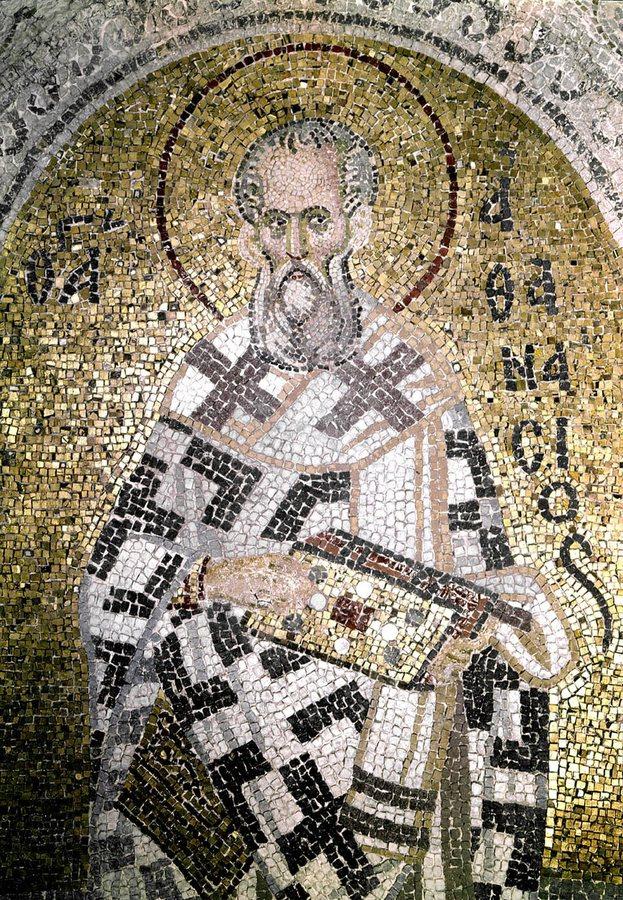 book
Fethiye Camii, parekklesion, diakonikon, mosaics, Istanbul, Turkey - South wall, St. Athanasius, detail of upper half Byzantine Institute staff - CC0, via Wikimedia Commons
- Feast
- 05-02 · Memorial
- Patronage
- The Trinity, exiles, those who stand alone
- Era
- 4th century
- Region
- Alexandria
The life
The defender of Nicaea who endured exile rather than deny the divinity of the Son.
Athanasius I of Alexandria (c. 296–298 – 2 May 373), also called Athanasius the Great, Athanasius the Confessor, or, among Coptic Christians, Athanasius the Apostolic, was an Egyptian Christian theologian and the 20th Patriarch of Alexandria. His intermittent episcopacy spanned 45 years (328 – 373).
Conflict with Arius and Arianism, as well as with successive Roman emperors, shaped Athanasius' career. In 325, at age 27, Athanasius began his leading role against the Arians as a deacon and assistant to Bishop Alexander of Alexandria during the First Council of Nicaea. Three years after that council, Athanasius succeeded his mentor as Patriarch of Alexandria.
During his reign as Patriarch, he faced repeated conflict with the Arians (including powerful and influential Arian churchmen led by Eusebius of Nicomedia), in addition to the Emperors Constantine, Constantius II, Julian the Apostate, and Valens, resulting in five exiles over a total period of 17 years. In addition to his anti-Arian polemical works, his other notable writings include On the Incarnation and his biography of St. Anthony the Great.
Athanasius is venerated as a saint in the Catholic Church, Eastern Orthodox Church, Oriental Orthodox Churches, Church of the East, the Anglican Communion, and Lutheranism and is traditionally honored as one of the four Great Greek Church Fathers along with Basil of Caesarea, Gregory of Nazianzus, and John Chrysostom. His heroic efforts against Arianism have won him wide acclaim in both the East and West under the title "Father of Orthodoxy," and his writings continue to be widely read.
Why the Church remembers
Holiness is not a personality type. The Doctors are not a rank of importance but a recognition of service: their writing and holiness helped the Church understand and teach the faith. Their books are still worth opening.
Pray with them
Ask for light in your study or work.
Teach one truth gently to someone who needs it.
More in this family
Sources
| Tier | Reference |
|---|---|
| Tier 1 | Catechism of the Catholic Church, 946-962 (the communion of saints) (opens in new tab) |
| Tier 2 | Wikipedia, "Saint Athanasius of Alexandria" (biographical outline) (opens in new tab) |
Last reviewed: 2026-11-14