Read a page of their writing.
E · Doctors of the Church
Saint Gregory the Great
The monk-pope who sent the mission to England, organised the Church's life, and gave the liturgy a lasting shape.
Memorial · 09-03
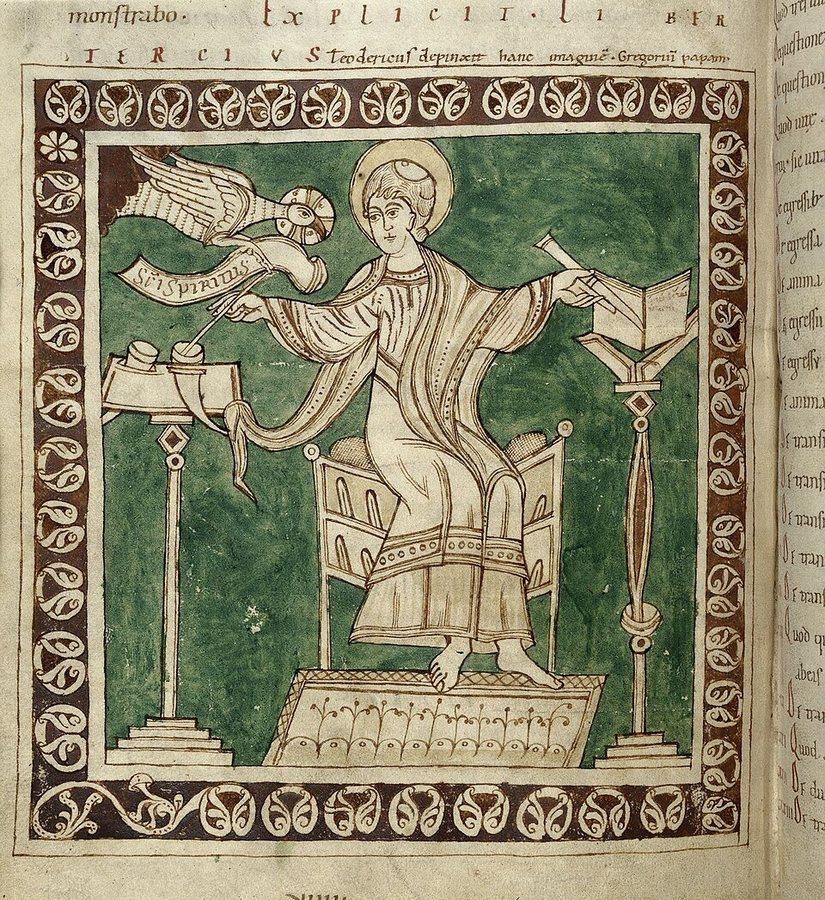 book
Gregory the Great with the Holy Spirit British Library - CC0, via Wikimedia Commons
- Feast
- 09-03 · Memorial
- Patronage
- Popes, musicians, teachers, England
- Era
- 6th century
- Region
- Rome
The life
The monk-pope who sent the mission to England, organised the Church's life, and gave the liturgy a lasting shape.
Pope Gregory I (Latin: Gregorius I; Gregorio I; c. 540 – 12 March 604), commonly known as Saint Gregory the Great (Latin: Sanctus Gregorius Magnus; Italian: San Gregorio Magno), was the 64th Bishop of Rome from 3 September 590 until his death on 12 March 604. Gregory was originally from Rome, a Roman senator's son, and himself the prefect of Rome at 30.
He lived in a monastery that he established on his family estate before becoming a papal ambassador and then pope. During his papacy, his administration greatly surpassed that of the emperors Maurice and Theodosius in improving the welfare of the people of Rome. Gregory regained papal authority in Spain and France and sent missionaries to England, including Augustine of Canterbury and Paulinus of York.
Gregory saw Franks, Lombards, and Visigoths align with Rome in religion from their Arian Christian alliances. The realignment of barbarian allegiance to Rome shaped medieval Europe. He also combated the Donatist heresy, popular particularly in North Africa at the time.
Gregory is also well known for his writings, which were more prolific than those of any of the previous popes. The epithet Saint Gregory the Dialogist has been attached to him in Eastern Christianity because of his Dialogues. Throughout the Middle Ages, he was known as "the Father of Christian Worship" because of his exceptional efforts in revising the Roman worship of his day.
Why the Church remembers
Holiness is not a personality type. The Doctors are not a rank of importance but a recognition of service: their writing and holiness helped the Church understand and teach the faith. Their books are still worth opening.
Pray with them
Ask for light in your study or work.
Teach one truth gently to someone who needs it.
More in this family
Sources
| Tier | Reference |
|---|---|
| Tier 1 | Catechism of the Catholic Church, 946-962 (the communion of saints) (opens in new tab) |
| Tier 2 | Wikipedia, "Saint Gregory the Great" (biographical outline) (opens in new tab) |
Last reviewed: 2026-11-14