Read a page of their writing.
E · Doctors of the Church
Saint Bede the Venerable
The monk of Jarrow whose Ecclesiastical History and Scripture commentaries shaped English Christianity.
Memorial · 05-25
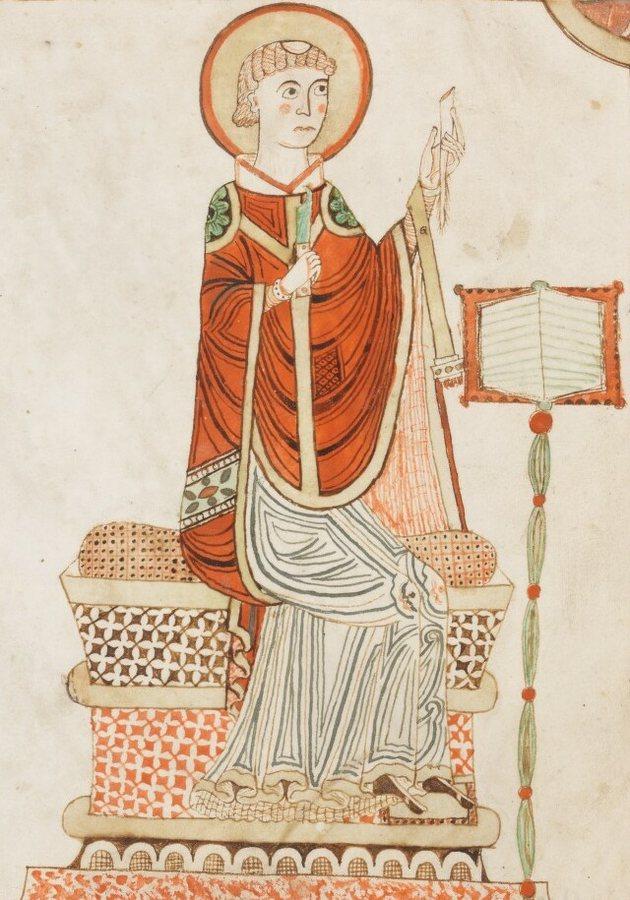 book
E-codices bke-0047 001v medium (cropped) http://www.e-codices.unifr.ch/de/bke/0047/1v - Public domain, via Wikimedia Commons
- Feast
- 05-25 · Memorial
- Patronage
- Historians, scholars, students
- Era
- 7th-8th century
- Region
- England
The life
The monk of Jarrow whose Ecclesiastical History and Scripture commentaries shaped English Christianity.
Bede, OSB (; Old English: Bēda [ˈbeːdɑ]; 672/3 – 26 May 735), also known as the Venerable Bede or Bede the Venerable, was an English Benedictine monk, author and scholar. He was one of the best known writers during the Early Middle Ages, and his most famous work, Ecclesiastical History of the English People, gained him the title "The Father of English History". He served at the monastery of St Peter and its companion monastery of St Paul in the Kingdom of Northumbria of the Angles.
Born on lands belonging to the twin monastery of Monkwearmouth–Jarrow in present-day Tyne and Wear, England, Bede was sent to Monkwearmouth at the age of seven and later joined Abbot Ceolfrith at Jarrow. Both of them survived a plague that struck in 686 and killed the majority of the population there. While Bede spent most of his life in the monastery, he travelled to several abbeys and monasteries across the British Isles, even visiting the Archbishop of York and King Ceolwulf of Northumbria.
His theological writings were extensive and included a number of Biblical commentaries and other works of exegesis. Another important area of study for Bede was the academic discipline of computus, otherwise known to his contemporaries as the science of calculating calendar dates. One of the more important dates Bede tried to compute was Easter, an effort that was mired in controversy.
He also helped to popularise the practice of dating forward from the birth of Christ (Anno Domini—in the year of our Lord), a practice which eventually became commonplace in medieval Europe. He is considered by many historians to be the most important scholar of antiquity for the period between the death of Pope Gregory I in 604 and the coronation of Charlemagne in 800. Bede was moreover a skilled linguist and translator, and his work made the Greek and Latin writings of the early Church Fathers much more accessible to his fellow Anglo-Saxons, which contributed significantly to English Christianity.
Why the Church remembers
Holiness is not a personality type. The Doctors are not a rank of importance but a recognition of service: their writing and holiness helped the Church understand and teach the faith. Their books are still worth opening.
Pray with them
Ask for light in your study or work.
Teach one truth gently to someone who needs it.
More in this family
Sources
| Tier | Reference |
|---|---|
| Tier 1 | Catechism of the Catholic Church, 946-962 (the communion of saints) (opens in new tab) |
| Tier 2 | Wikipedia, "Saint Bede the Venerable" (biographical outline) (opens in new tab) |
Last reviewed: 2026-11-14