Read a page of their writing.
E · Doctors of the Church
Saint Anselm of Canterbury
The monk-archbishop who sought understanding through faith and wrote the classic Cur Deus Homo.
Memorial · 04-21
 book
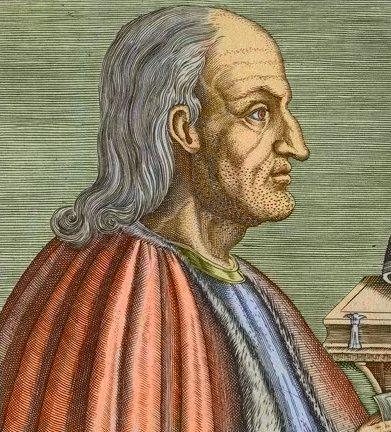
Anselm of Canterbury. Unknown author Unknown author - Public domain, via Wikimedia Commons
- Feast
- 04-21 · Memorial
- Patronage
- Theologians, philosophers, Canterbury
- Era
- 11th-12th century
- Region
- Italy and England
The life
The monk-archbishop who sought understanding through faith and wrote the classic Cur Deus Homo.
Anselm of Canterbury (; 1033/4–1109), also known as Anselm of Aosta (French: Anselme d'Aoste, Italian: Anselmo d'Aosta) after his birthplace and Anselm of Bec (French: Anselme du Bec) after his monastery, was a Benedictine abbot, philosopher and theologian who served as Archbishop of Canterbury from 1093 to 1109. As Archbishop of Canterbury, he defended the Church's interests in England amid the Investiture Controversy. For his resistance to the English kings William II and Henry I, he was exiled twice: once from 1097 to 1100 and then from 1105 to 1107.
While in exile, he participated in the Council of Bari, where he helped convince the Greek Catholic bishops of southern Italy to adopt the Roman Rite. In England, he asserted the primacy of Canterbury over the Archbishop of York and over the bishops of Wales, and at the time of his death he appeared to have been successful in this. However, Pope Paschal II later reversed the papal decisions on the matter and restored York's earlier status.
Beginning during his time at Bec, Anselm composed dialogues and treatises with both a mystical and a rational or philosophical approach, this latter aspect causing him sometimes to be credited as the founder of Scholasticism. Despite his lack of recognition in this field in his own lifetime, Anselm is famously regarded as the originator of the ontological argument for the existence of God and of the satisfaction theory of atonement. After his death, Anselm was canonized as a saint; his feast day is 21 April.
He was proclaimed a Doctor of the Church by a papal bull of Pope Clement XI in 1720.
Why the Church remembers
Holiness is not a personality type. The Doctors are not a rank of importance but a recognition of service: their writing and holiness helped the Church understand and teach the faith. Their books are still worth opening.
Pray with them
Ask for light in your study or work.
Teach one truth gently to someone who needs it.
More in this family
Sources
| Tier | Reference |
|---|---|
| Tier 1 | Catechism of the Catholic Church, 946-962 (the communion of saints) (opens in new tab) |
| Tier 2 | Wikipedia, "Saint Anselm of Canterbury" (biographical outline) (opens in new tab) |
Last reviewed: 2026-11-14