Sacramentals · last reviewed 2026-10-03
Church-approvedThe St. Benedict Medal: What It Is and What It Is For
Good for
At a glance
The St. Benedict medal is one of the sacramentals of the Church: it bears the saint holding the cross and his Rule, and its inscriptions are a prayer for light and protection rather than a device with power of its own.
- Category
- Medals
- Status
- Church Approved
- Sources
- 4 cited
- Last reviewed
- 2026-10-03
Primary source Catechism of the Catholic Church 1667, 1673
The St. Benedict medal is a blessed medal of the Church carrying an image of St. Benedict with the cross and his Rule. It is used in prayer for protection and against temptation, and its power, like that of every sacramental, is ascribed to Christ and to the blessing of the Church rather than to the metal.
What it is
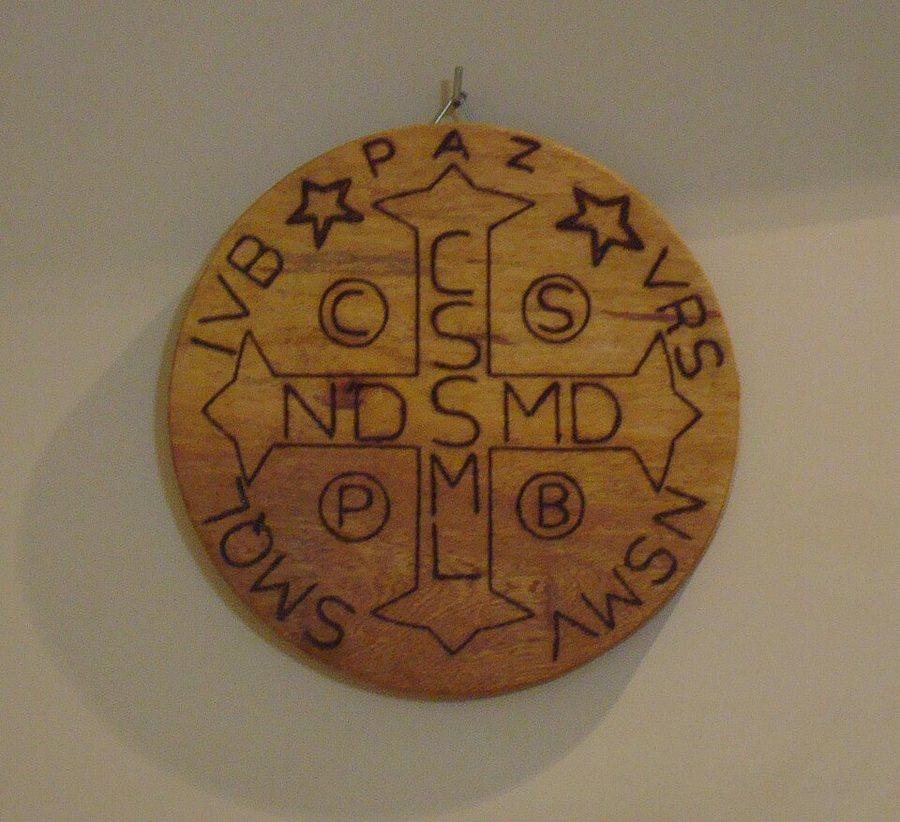
EWTN's account of the Jubilee medal describes what the object actually is. One side represents St. Benedict holding the Cross in one hand and the Holy Rule in the other. The reverse is dominated by a cross: the letters on its arms abbreviate "May the holy Cross be my light; let not the dragon be my guide," and C.S.P.B. at the corners stands for Cross of the holy Father Benedict. No particular prayer is prescribed for its use, because the wearing itself is treated as a continual silent prayer.
In the Church's terms the medal is a sacramental, a sacred sign which bears a resemblance to the sacraments and is used to dispose us to receive grace (CCC 1667). The Directory on Popular Piety lists medals and badges among the bodily and gestural expressions through which popular piety gives external expression to the heart (n. 15), and warns in the same paragraph that without that interior aspect, symbolic gesture runs the risk of degenerating into empty customs or, in the worst cases, mere superstitions.
How to use it
Have it blessed by a priest. Then use it plainly: carry it, hang it where you will see it, and let the inscriptions be the prayer they were written to be.
It is worth being clear about scope. The Catechism reserves solemn exorcism to a priest acting with his bishop's permission (CCC 1673). The medal is not a private exorcism and does not replace one; it is a reminder you carry into prayer.
Where it gets misused
Two habits are worth refusing. The first is treating the medal as an object with a force of its own, which the Catechism calls superstition when efficacy is credited to an external act apart from the interior dispositions it demands (CCC 2111). The second is trusting the medal while ignoring what it depicts. The cross on the front is there to point at Christ, and the Rule in the saint's hand is there to point at obedience.
FAQ
What is on the St. Benedict medal?
One side shows St. Benedict holding the Cross in one hand and his Rule in the other; the reverse is dominated by a cross whose initials spell a prayer, "May the holy Cross be my light, let not the dragon be my guide," with C.S.P.B., the Cross of the holy Father Benedict, at the corners (EWTN).
Is the medal an exorcism?
No. A major exorcism is a public act the Church performs in Christ's name, and it may be done only by a priest with the permission of the bishop (CCC 1673). The medal is a sacramental worn or kept in prayer, and it does not stand in for that rite.
How should I carry it?
There is no prescribed way. It may be worn around the neck, attached to a scapular or rosary, or carried on your person (EWTN). Its value is ascribed to Christ, to the Church's blessing, and to the faith and disposition of the person using it, not to the metal.
Sources
Last reviewed: 2026-10-03