Sacramentals · last reviewed 2026-10-05
Church-approvedCorpus Christi Procession: Walking the Streets With the Host
Good for
At a glance
After Mass on Corpus Christi the Church carries the Host through town in witness to the Real Presence; popes attached indulgences to it, and Trent commended it, under the usual conditions.
- Category
- Rites
- Status
- Church Approved
- Sources
- 4 cited
- Last reviewed
- 2026-10-05
Primary source Catechism of the Catholic Church 1471, 1478 (what an indulgence is; Church opens the treasury)
You leave Mass and walk into the streets behind the monstrance. The Corpus Christi procession carries Christ through your town so neighbors, shops, and homes meet him in the open. It began in the fourteenth century and the Church still walks it.
What it is
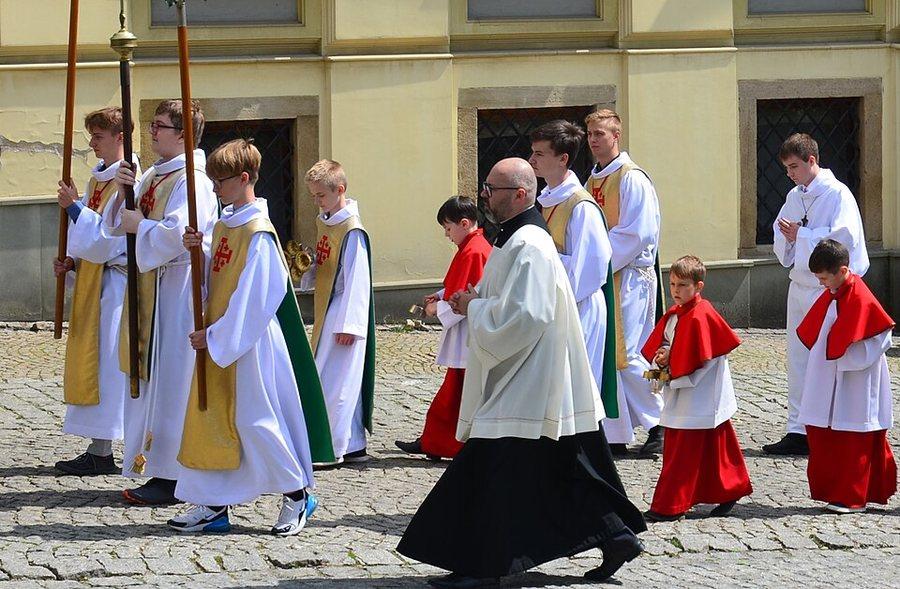
You follow the priest who carries the Host in the monstrance beneath a canopy. Children scatter flowers. Bells ring. Hymns sound, above all Aquinas' Pange Lingua written for this Office. The faithful kneel at their doors as the Lord passes. Benediction often closes the walk.
Juliana of Mont Cornillon longed for a feast of the Sacrament alone, apart from Holy Thursday's sorrow and press of rites. She told Bishop Robert of Liege, who ordered it by synod in 1246. Jacques Pantaléon, once archdeacon of Liege, became Urban IV and extended it to the whole Church in 1264 with Transiturus, granting indulgences for Mass and Office attendance. Clement V and John XXII pressed it forward. Martin V and Eugene IV endowed the procession itself with indulgences. Trent solemnly approved and recommended it as public profession of faith in the Real Presence.
Indulgences here follow the same doctrine as everywhere. An indulgence is a remission before God of temporal punishment for forgiven sins, gained by the duly disposed under prescribed conditions CCC 1471 (tier 1 citation). The Church intervenes for individuals and opens the treasury CCC 1478 (tier 1 citation). The Penitentiary names the usual conditions plainly: confession, Communion, prayer for the Pope, and detachment from all sin.
How to use it
Walk on Thursday where Thursday is kept and on Sunday where the solemnity moves. Bring children and the elderly early for a place near an altar of repose. Sing the hymns rather than watching them. Kneel as the monstrance approaches. Return for Benediction at the close.
Prepare the conditions beforehand when you seek the indulgence: confession near the day, Communion, prayer for the Pope, freedom from attachment to sin, and the pious attention the grant asks. Ask your priest which concession your walk falls under.
Where it gets misused
Marchers sometimes promise others an indulgence for showing up. No one may promise what the Church grants under conditions. State the grant, meet the conditions, and leave judgment to God. Others treat the pageant as folklore and skip Mass before it. The procession crowns the sacrifice. Attend Mass first, then walk behind the Lord you just received.
FAQ
When did the procession start?
Very early in the fourteenth century the custom grew of carrying the Sacrament through town after Mass on the feast. Popes encouraged it and granted indulgences to participants. Trent later approved and recommended it as a public profession of faith in the Real Presence.
When is the feast kept?
Thursday after Trinity Sunday in the Latin Church, with the Sunday after Trinity used in the United States and some countries. Juliana of Liege prompted it, Liege kept it from 1246, and Urban IV extended it to the whole Church in 1264 with Transiturus. Thomas Aquinas composed its Office.
Does walking earn an indulgence automatically?
No, never automatically. An indulgence remits temporal punishment for forgiven sins for the duly disposed under prescribed conditions through the Church's action (CCC 1471), and the Church opens the treasury for individuals (CCC 1478). The Enchiridion lists adoration and procession among its concessions. Meet confession, Communion, prayer for the Pope, and detachment as the grant states, and ask your parish which concession applies.
What does the procession look like?
The Host in the monstrance under a canopy, bells pealing, bands playing hymns like Pange Lingua, guilds and guards accompanying, and the faithful kneeling at their doors to adore as the Lord passes. Rome walks from St. John Lateran to St. Mary Major.
Sources
Last reviewed: 2026-10-05