Sacramentals · last reviewed 2026-10-03
Pious tradition, not doctrineThe Advent Wreath: What It Is and How to Pray With It
Good for
At a glance
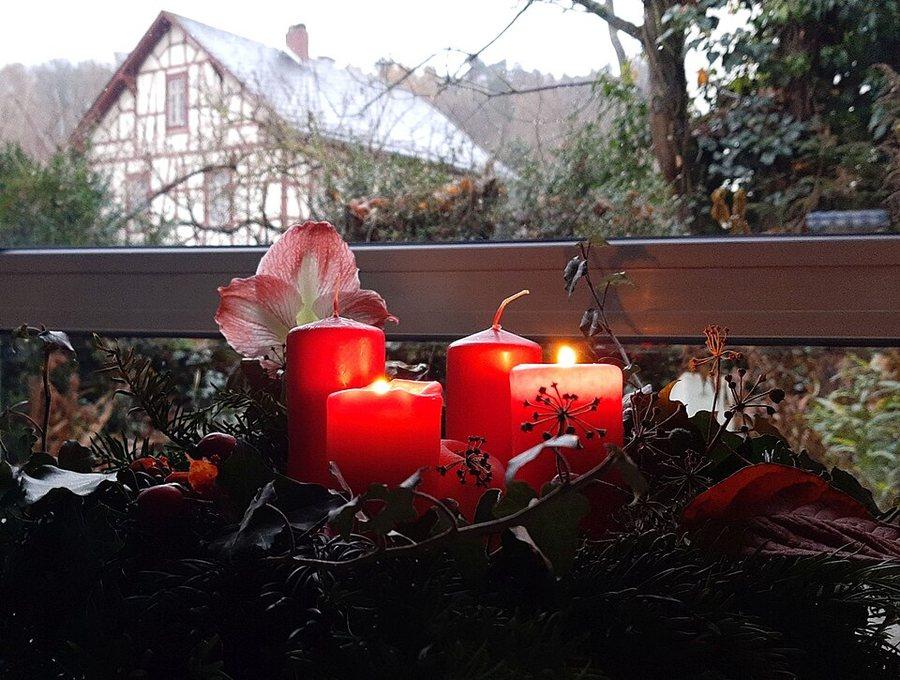
The Advent wreath is four candles on a wreath of greenery, one more lit each Sunday until Christmas, and the Directory calls it a symbol of salvation history unfolding toward the coming of Christ.
- Category
- Devotions
- Status
- Pious Tradition
- Sources
- 4 cited
- Last reviewed
- 2026-10-03
Primary source Directory on Popular Piety and the Liturgy 98
The Advent wreath is a ring of greenery holding four candles, with one more lit on each of the four Sundays before Christmas. The Directory on Popular Piety calls it a symbol of salvation history moving toward the coming of Christ.
What it is
The Directory describes it plainly: placing four candles on green fronds has become a symbol of Advent in many Christian homes, especially in the Germanic countries and in North America (n. 98). The lighting is progressive. Sunday after Sunday, until the Solemnity of Christmas, the wreath marks the stages of salvation history before Christ's coming and becomes a symbol of prophetic light gradually illuminating the long night before the rising of the Sun of justice.
That is a description of popular piety, not of a rite. The Catechism treats such devotions honestly: they extend the liturgical life of the Church, they do not replace it, and they should be drawn up so that they harmonize with the liturgical seasons and lead people to the liturgy rather than compete with it (CCC 1675). The wreath succeeds when Advent keeps its shape: a season of waiting, not a head start on Christmas.
Popular piety also needs discernment. The Catechism says pastoral discernment is needed to sustain it and, where necessary, to purify and correct the religious sense underlying these devotions (CCC 1676). A wreath passes that test easily.
How to use it
Put the wreath where the family already passes through: a table, a low shelf, the entryway. Light the candles at supper or at evening prayer on Advent Sundays, say a short reading or a decade, then extinguish them. Keep the week's unlit candles unlit; the growth across four weeks is the point.
Ask your priest to bless it if you like. Once blessed, it is a sacramental in the sense canon law gives the word (can. 1166), and it should be treated as something set apart for prayer rather than as seasonal decor.
Where it gets misused
Two failures are worth naming. The first is treating the wreath as a decoration that happens to be religious, with no prayer attached, which leaves the gesture empty. The second is crediting the candles themselves with bringing good fortune, which the Catechism classifies as superstition when a lawful practice is given a magical importance it does not have (CCC 2111).
FAQ
Is the Advent wreath a liturgical rite or a family devotion?
It is popular piety. The Directory lists it under expressions of piety connected with Advent and describes its symbolism (n. 98), while the Catechism teaches that such devotions extend the liturgical life of the Church without replacing it (CCC 1675).
What do the four candles mean?
The Directory says the progressive lighting of four candles, Sunday after Sunday until the Solemnity of Christmas, recalls the stages of salvation history before Christ's coming and symbolizes prophetic light growing toward the rising of the Sun of justice.
Should the wreath be blessed?
It may be. Once blessed it functions as a sacramental, a sacred sign by which spiritual effects are signified in imitation of the sacraments and obtained through the intercession of the Church (can. 1166).
Sources
| Tier | Reference |
|---|---|
| Tier 1 | Directory on Popular Piety and the Liturgy 98 (opens in new tab) |
| Tier 1 | Catechism of the Catholic Church 1674-1676 (opens in new tab) |
| Tier 1 | Code of Canon Law can. 1166 (opens in new tab) |
| Tier 1 | Catechism of the Catholic Church 2111 (opens in new tab) |
Last reviewed: 2026-10-03