Name the need you carry before them.
H · Popular Patron and Devotional Saints
Saint Nicholas of Myra
The bishop of Myra whose secret generosity became the root of the Christmas gift-giver tradition.
Memorial · 12-06
 star
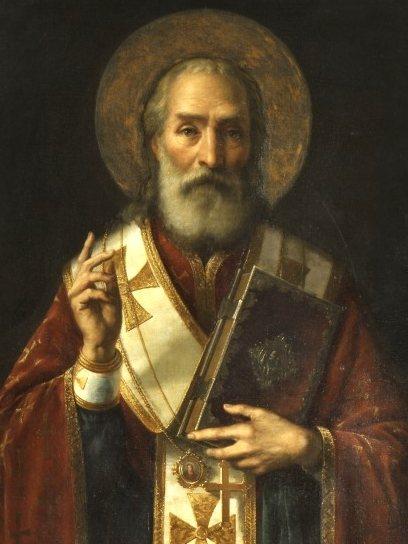
Jaroslav Čermák (1831 - 1878) - Sv. Mikuláš (cropped) Jaroslav Čermák - Public domain, via Wikimedia Commons
- Feast
- 12-06 · Memorial
- Patronage
- Children, sailors, the poor, gifts
- Era
- 3rd-4th century
- Region
- Asia Minor
The life
The bishop of Myra whose secret generosity became the root of the Christmas gift-giver tradition.
Saint Nicholas of Myra (traditionally 15 March 270 – 6 December 343), also known as Nicholas of Bari, was an early Christian bishop of Greek descent from the maritime city of Patara in Anatolia (in modern-day Antalya Province, Turkey) during the time of the Roman Empire. Because of the many miracles attributed to his intercession, he is also known as Nicholas the Wonderworker. Saint Nicholas is the patron saint of sailors, merchants, archers, repentant thieves, children, brewers, pawnbrokers, toymakers, unmarried people, and students in various cities and countries around Europe.
His reputation evolved among the pious, as was common for early Christian saints, and his legendary habit of secret gift-giving gave rise to the folklore of Santa Claus ("Saint Nick") through Sinterklaas. Little is known about the historical Saint Nicholas. The earliest accounts of his life were written centuries after his death and probably contain legendary elaborations.
He is said to have been born in the Anatolian seaport of Patara, Lycia, in Asia Minor to wealthy Christian parents. In one of the earliest attested and most famous incidents from his life, he is said to have rescued three girls from being forced into prostitution by dropping a sack of gold coins through the window of their house each night for three nights so their father could pay a dowry for each of them. Other early stories tell of him calming a storm at sea, saving three innocent soldiers from wrongful execution, and chopping down a tree possessed by a demon.
In his youth, he is said to have made a pilgrimage to Egypt and Syria Palaestina. Shortly after his return, he became Bishop of Myra. He was later cast into prison during the persecution of Diocletian, but was released after the accession of Constantine.
Why the Church remembers
Holiness is not a personality type. These saints became beloved because they stood near the ordinary places of human need: the road, the sickbed, the home, the storm, the poor. Their popularity is a school of prayer when it leads to Christ.
Pray with them
Pray for someone in the same need.
Visit or call someone who is sick or alone.
More in this family
Sources
| Tier | Reference |
|---|---|
| Tier 1 | Catechism of the Catholic Church, 946-962 (the communion of saints) (opens in new tab) |
| Tier 2 | Wikipedia, "Saint Nicholas of Myra" (biographical outline) (opens in new tab) |
Last reviewed: 2026-11-14